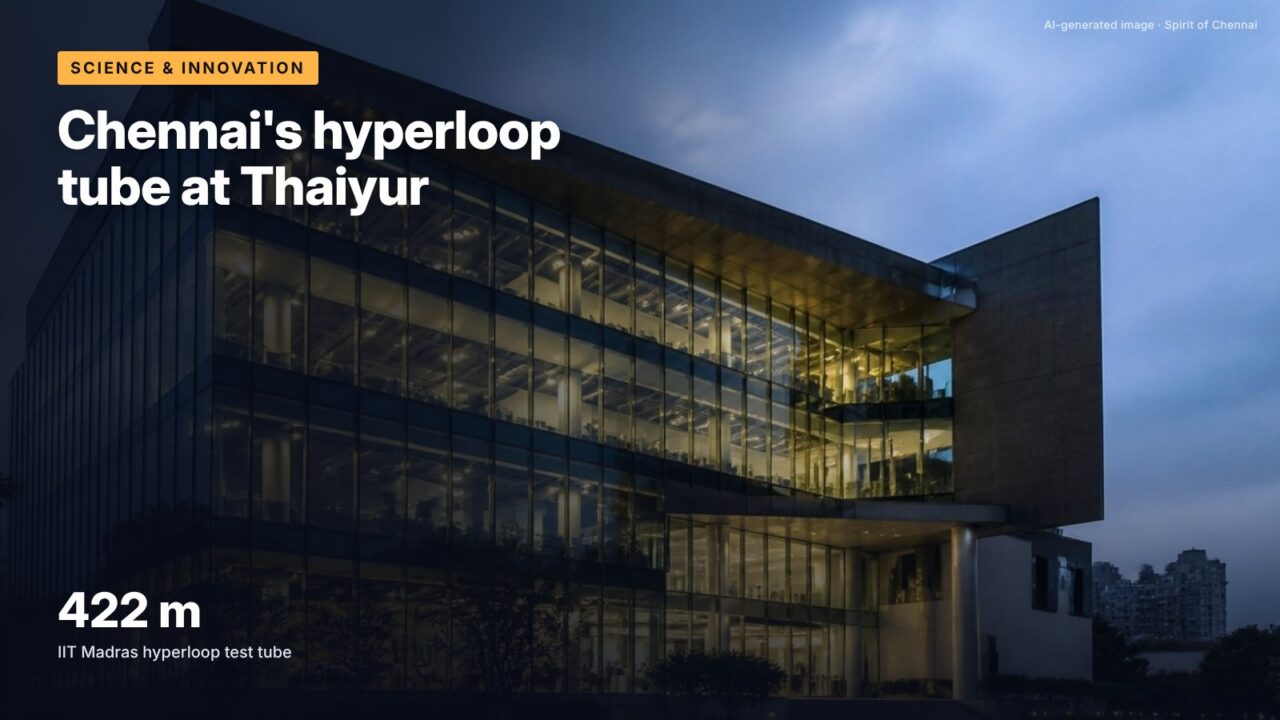
India’s first hyperloop test track runs through IIT Madras’s Discovery satellite campus at Thaiyur, off OMR beyond Kelambakkam. The institute describes it as the longest operational student-run hyperloop test tube and track, at 422 metres, in a press release on Railway Minister Ashwini Vaishnaw’s visit on 15 March 2025. When the minister announced its completion in December 2024, he gave the length as 410 metres, so the two official figures differ slightly.
A hyperloop is a proposed transport system in which pods travel through a tube from which most of the air has been pumped out, so they meet very little air resistance. The idea was popularised by Elon Musk in 2013. The Thaiyur track is a test bed for the pieces such a system needs: the tube, the vacuum, pod levitation and propulsion.
From a student project to a Railways-funded facility
The track grew out of Avishkar Hyperloop, a student team at IIT Madras’s Centre for Innovation. An IIT Madras page from May 2022 described a 70-member team from 11 disciplines that had patented its own tube design and was planning a 500-metre test facility at the Discovery campus, about 35 km from the main Guindy campus. L&T Technology Services backed the team with funding and technical support.
The team had earlier taken part in the SpaceX Hyperloop Pod Competition, and its pod, named Garv, won a most scalable pod design award at European Hyperloop Week. Its first vacuum tube prototype was inaugurated in November 2021.
Key steps since then:
| Date | Milestone |
|---|---|
| May 2022 | Railway Ministry approves Rs 8.34 crore to develop and validate a hyperloop system |
| Jan 2024 | ArcelorMittal Nippon Steel India agrees to supply 400 tonnes of steel for a 400 m vacuum tube |
| Dec 2024 | Railway Minister announces completion of the test track |
| Feb 2025 | Minister announces a third USD 1 million grant |
| 15 Mar 2025 | Minister visits the Thaiyur facility |
The Discovery campus, where the tube was built, covers 163 acres. The third grant, announced in February 2025, followed two earlier grants of USD 1 million each.
Who does what at Thaiyur
Three groups share the project. The student team Avishkar Hyperloop builds pods and subsystems. TuTr Hyperloop, a deep-tech startup incubated at IIT Madras, works on taking the technology towards commercial use. Indian Railways is the funder and the likely eventual user. When the minister announced the track’s completion, he credited all three: the Railways team, the Avishkar team and TuTr.
IIT Madras says it has been doing hyperloop research for seven years and that capsules could in principle exceed 1,000 km/h. That speed is a design aim for a full system, not what pods do on a 422-metre test tube, where the focus is on proving that the vacuum holds, that the pod levitates stably and that the motor and braking work.
Reports on the project describe pods designed to carry 24 to 28 passengers non-stop between two points, with a design speed of up to 1,100 km/h. Those numbers come from the developers and have not been demonstrated on the Thaiyur track, which is too short for high-speed runs.
What comes after the test track
The next step being discussed is far bigger. In February 2025 the minister said Indian Railways would begin a first commercial project once the technology was fully tested, and reports described a planned test stretch of about 40 to 50 km, which would be the longest in the world. No site for that stretch had been publicly announced as of October 2026.
Cost is the big open question. Industry estimates quoted in trade press put a 40 km test line at USD 150 million to 300 million, and figures for full commercial lines vary widely. Hyperloop projects elsewhere have struggled, with some companies shifting to freight or closing. Anyone reading about Chennai to Bengaluru in half an hour should treat it as a long-range ambition rather than a timeline.
Can the public see it?
The Discovery campus at Thaiyur is a research campus and does not run regular public visits to the hyperloop facility. The best chance for most residents is IIT Madras’s Centre for Innovation open house, where student teams including Avishkar show their work. The 2025 edition featured 60 innovations from 26 teams, according to the institute.
Quick answers
Where is the IIT Madras hyperloop track?
At the institute’s Discovery satellite campus in Thaiyur, south of Kelambakkam, about 35 km from the main campus.
How long is the hyperloop test track?
IIT Madras gives 422 metres for the tube and track; the Railway Minister’s December 2024 announcement said 410 metres.
Who paid for it?
Mainly the Ministry of Railways, which approved Rs 8.34 crore in 2022, with industry support for steel and engineering.
Information checked against official sources on 18 October 2026. Fees, dates and rules can change; confirm on the linked official pages before acting.