Muslims, Christians, Sikhs, Buddhists, Parsis and Jains in Chennai can borrow from TAMCO, the Tamil Nadu Minorities Economic Development Corporation, at 3% to 8% interest. That is well below what a bank or finance company charges for a business or study loan. The money reaches borrowers through co-operative banks, not through TAMCO’s own counter.
The corporation was set up in 1999 and lends with support from the national minorities finance corporation. Its current rates sit in two plans, one for low-income families and one for those earning up to ₹6 lakh a year. Here is what each loan offers and how a Chennai family should apply.
Two income plans
The latest published table, on the district minorities welfare page, splits most loans by family income:
- Plan I: annual family income up to ₹1,03,000 in urban areas such as Chennai, or ₹81,000 in rural areas.
- Plan II: annual family income up to ₹6,00,000. Interest is higher, and women get a lower rate than men.
| Loan | Plan I | Plan II |
|---|---|---|
| Personal (business) loan | Up to ₹20 lakh, 5% to 6% | Up to ₹30 lakh, 6% women, 8% men |
| Micro credit through SHGs | ₹1 lakh per member, 7% | ₹1.5 lakh, 8% women, 10% men |
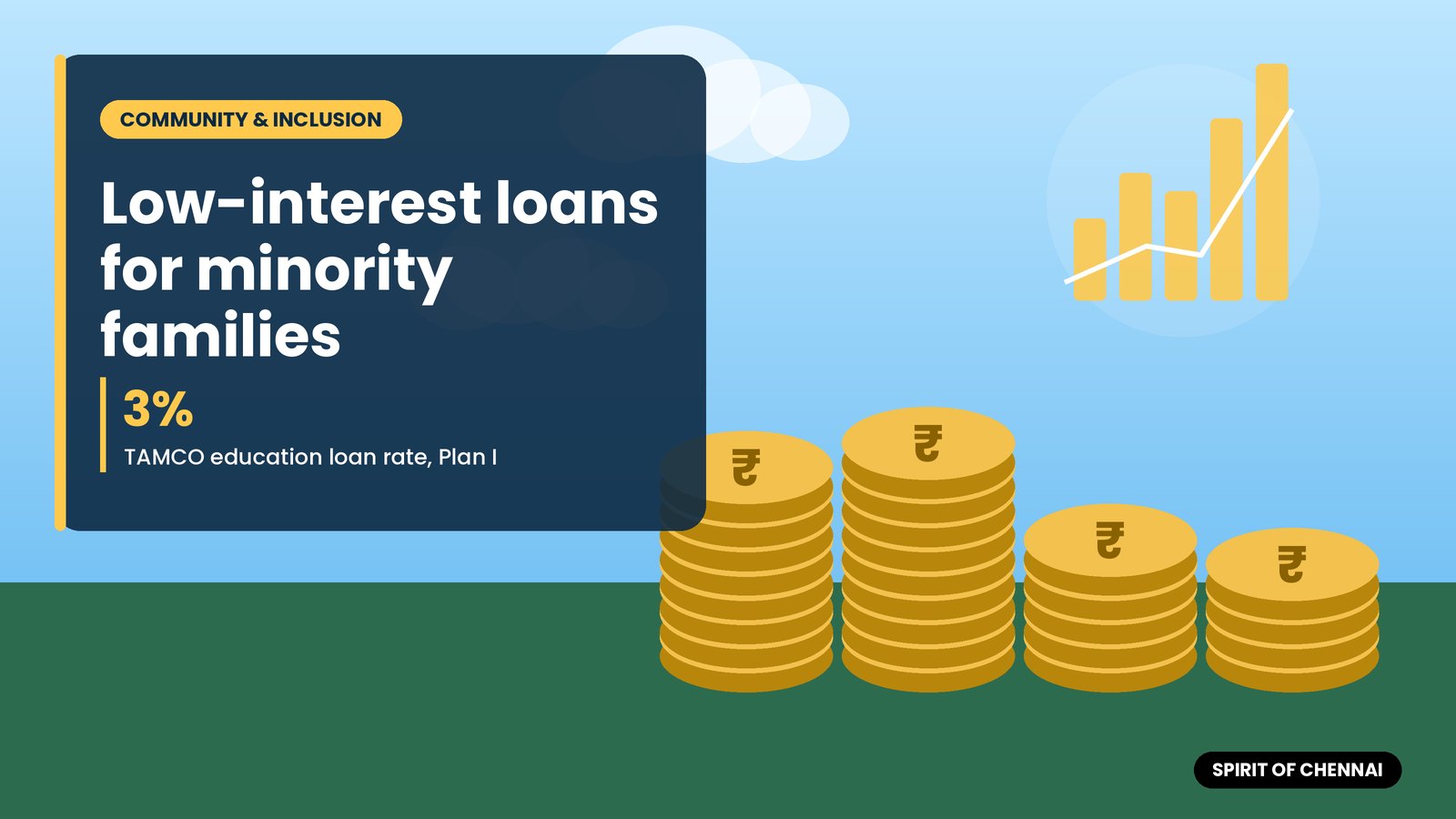
| Education loan | ₹3 lakh to ₹20 lakh, 3% | ₹3 lakh to ₹30 lakh, 5% girls, 8% boys |
| Auto loan | LPG auto ₹1.21 lakh, others ₹1 lakh, 6% | Not listed |
Education loans cover professional and short-term high-skill courses. A milch animal loan also exists, but it is of little use in the city.
The individual bank decides how much of the ceiling you actually get. The Ramanathapuram co-operative bank’s TAMCO page, for instance, caps its loan at ₹1 lakh at 6%, for borrowers aged 18 to 60, with a 5% margin and three to five years to repay. Expect similar fine print from the Chennai bank that handles your file.
Craft workers: the Virasat scheme
A June 2026 district notice lists the Virasat scheme alongside the personal, SHG and education loans. It is a loan scheme for artisans and traditional craftsmen from minority communities, the kind of work found in embroidery, metalwork or leather units. The notice does not give amounts, so ask the district office for the current limits.
Where to apply in Chennai
TAMCO does not lend over the counter. According to the district scheme listing, applications go through:
- District central co-operative banks and urban co-operative banks
- Primary agricultural co-operative credit societies
- The Tamil Nadu Industrial Co-operative Bank (TAICO) and other state co-operatives
In Chennai, start with the District Backward Classes and Minorities Welfare Officer at the Collectorate, who handles TAMCO files for the district, or ask at your nearest co-operative bank branch. The corporation’s RTI handbook gives its office as 807 Anna Salai, 5th floor, Chennai 600002. That handbook dates from 2012-13, so treat its address and old loan limits with care. Back then the urban income limit was only ₹55,000 a year, term loans topped out at ₹5 lakh, and education loans at ₹50,000 a year. The ceilings have risen several times since.
Documents to carry
The Erode page lists what banks ask for:
- A certificate proving your minority religion
- An income certificate and proof of residence
- A project report for the business you plan to start
- A driving licence, for vehicle loans
- An Aadhaar copy, and anything else the co-operative bank needs
Income and residence certificates can be applied for online through e-Sevai. Get them issued before you approach the bank, since an old income certificate is a common reason files are sent back.
Other help for minority communities
The same district page lists related state support. Christians can get ₹20,000 each towards a Jerusalem pilgrimage. Eligible Ulema get a pension of ₹1,000 a month.
Students from minority communities can also apply for central pre-matric scholarships (Classes 1 to 10, family income up to ₹1 lakh), post-matric scholarships (Class 11 to Ph.D., up to ₹2 lakh) and merit-cum-means scholarships for professional courses (up to ₹2.5 lakh). Applicants need at least 50% marks in the previous year’s exam, except in Class 1. Thirty per cent of these scholarships are reserved for girls, and a family can claim for at most two children. Loans are a financial commitment, so read the terms carefully before you sign.
Quick answers
What is the TAMCO income limit in Chennai?
₹1,03,000 a year for Plan I in urban areas, and up to ₹6 lakh a year for Plan II.
What is the TAMCO education loan interest rate?
3% under Plan I. Under Plan II it is 5% for girls and 8% for boys.
Which communities qualify?
Muslims, Christians, Sikhs, Buddhists, Parsis and Jains.
Can I apply at TAMCO’s office directly?
Loans are routed through co-operative banks. Start with the district minorities welfare officer or a co-operative bank branch.
Information checked against official sources on 18 October 2026. Fees, dates and rules can change; confirm on the linked official pages before acting.
Sources
- BC/MBC/DNC and Minorities Welfare Office, Erode District (Erode District Administration)
- TAMCO handbook under RTI Act (Government of Tamil Nadu)
- Tamil Nadu Minorities Economic Development Corporation (Krishnagiri District Administration)
- Loans for minorities, SHGs and the Virasat scheme, June 2026 (Nilgiris District Administration)
- TAMCO Loan (Ramanathapuram District Central Co-operative Bank)