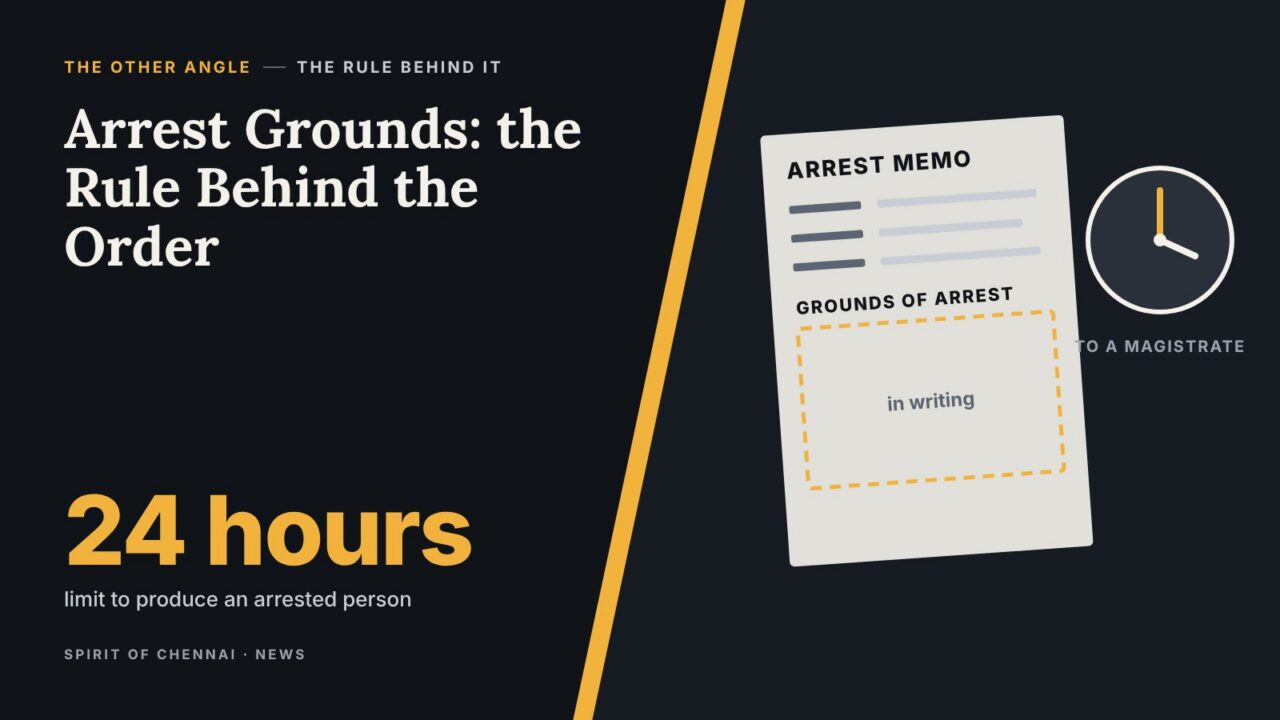
In October 2026 the Madras High Court ordered Tamil Nadu’s police chief to tell every unit that failing to give an arrested person written grounds of arrest is a dereliction of duty that invites departmental action. The reports focused on the bail. This piece looks at where the written rule actually comes from, since the arrest law itself does not say “in writing”, and what the order changes at a police station counter.
The numbers
What was reported
Justice N. Ramesh granted bail to a coaching company executive arrested in a Coimbatore cheating case and impleaded the Director General of Police on his own motion. The court found that the arrest memo contained no grounds, that an oral explanation was not enough, and that the arrest and remand were vitiated. The man was formally arrested inside Puzhal prison on 11 August 2026 and released on a ₹50,000 bond with two sureties.
What the statute says, and what it does not
Article 22(1) of the Constitution says no arrested person shall be detained without being informed, as soon as may be, of the grounds of arrest, and guarantees the right to consult a lawyer. Article 22(2) requires production before the nearest magistrate within 24 hours, excluding travel time.
The Bharatiya Nagarik Suraksha Sanhita (BNSS), which replaced the Code of Criminal Procedure in July 2024, repeats the duty in Section 47: an officer arresting without a warrant must forthwith communicate full particulars of the offence or other grounds, and in a bailable case must say the person can be released on bail. Neither text uses the word “writing”. Section 36 requires an arrest memo attested by at least one witness, a family member or a respectable local resident, and countersigned by the arrested person. Section 48 requires that a relative or friend be told, and that the station keep a register of who was informed.
How “in writing” became the rule
The written requirement was built by the Supreme Court. It was first applied to arrests under special laws such as the money-laundering and anti-terror statutes. On 6 November 2025, in Mihir Rajesh Shah v. State of Maharashtra, a Bench of Chief Justice B.R. Gavai and Justice A.G. Masih extended it to every offence under the general criminal law. The Court held that grounds must be given in writing in a language the arrested person understands, in each case without exception, and that failure makes the arrest and remand illegal. The ruling also sets an outer limit of two hours before production for remand where written grounds cannot be handed over at the moment of arrest.
The time between the Supreme Court’s 6 November 2025 ruling and the High Court’s October 2026 direction that Tamil Nadu units be told non-compliance is a dereliction of duty.
The printed form at the centre of it
The Coimbatore arrest was recorded on a printed arrest memo with no grounds filled in, and the grounds were explained orally. That is the gap the High Court aimed at. It asked the DGP to report at the next hearing on the circulars issued, on whether the printed arrest memo had been withdrawn, on whether a circular had reached the arresting station before 11 August, and on training for officers, according to the court’s order.
In practice the change is paperwork at the moment of arrest: a separate written statement of grounds, in Tamil or another language the person reads, handed over and acknowledged, alongside the witness-attested memo and the Section 48 intimation. A pre-printed form with a blank for “offence” and a section number will not meet the standard on its own.
| Step at arrest | Where it comes from | What a lapse can lead to |
|---|---|---|
| Tell the person the grounds as soon as may be | Article 22(1); BNSS Section 47(1) | Detention open to challenge |
| Give the grounds in writing, in a language understood | Supreme Court, 6 November 2025 | Arrest and remand held illegal |
| Arrest memo with one witness, countersigned | BNSS Section 36 | Defect in the arrest record |
| Inform a relative or friend; record it | BNSS Section 48 | Magistrate must check compliance |
| Produce before a magistrate | Article 22(2): within 24 hours | Detention beyond limit unlawful |
| Failing to give written grounds (Tamil Nadu) | Madras High Court, October 2026 | Departmental proceedings against the officer |
Source: Constitution of India, Article 22; BNSS 2023, Sections 36, 47, 48 (India Code); Supreme Court ruling of 6 November 2025; Madras High Court order of October 2026.
From an illegal arrest to a disciplinary charge
Until now the cost of a missing written ground fell on the case: the accused walked out on bail and the investigation carried on. The High Court moved part of the cost to the officer. It directed the DGP (Law and Order) to instruct all units that the lapse is a dereliction of duty attracting departmental proceedings, relying on paragraph 25.1 of an earlier ruling in Jaskaran Jeet Singh Deol, which, as the court noted, also asks the superior officer to reassign the investigation when an accused is released for such a violation. The court added that this was not a finding against the investigating officer personally, who may be heard in any later proceeding.
It’s often said that if police skip the written grounds, the whole case collapses.
The record shows the arrest and remand are vitiated and the person is released, but the FIR and investigation survive. In the Coimbatore case the accused got bail on conditions; the cheating case continues.
Who notices first
The rule matters most for people arrested for ordinary offences without a lawyer on hand, who may be produced for remand within hours. For them, the written note of grounds can be the first document that tells a family or a legal aid lawyer what the case is about. The remand magistrate, who under Section 48(4) must already check that a relative was informed, is the first official in a position to see whether written grounds were given.
What this means for you
- If you or a family member is arrested, ask for the grounds in writing and in a language you read. It is a constitutional requirement, not a favour.
- Keep a copy of the arrest memo and the written grounds; a lawyer will need both at the first remand hearing.
- Missing written grounds can lead to release, but not to the case being closed. Bail conditions still apply.
- Families should expect a call or message under BNSS Section 48 telling them where the person is held.
What to watch
10 November 2026
The High Court lists the case for compliance, when the DGP is to report on circulars, the printed arrest memo and officer training.
Pending
Publication of any Tamil Nadu Police circular or revised arrest memo format following the order.
Checked against official sources on 4 November 2026. Details may change; confirm on the linked official pages.
Sources
- Constitution of India (2024 edition), Article 22, Legislative Department, Ministry of Law and Justice
- Bharatiya Nagarik Suraksha Sanhita, 2023 (Act 46 of 2023), Sections 35, 36, 47, 48, India Code
- Mihir Rajesh Shah v. State of Maharashtra, Criminal Appeal No. 2195/2025, record of proceedings, 6 November 2025, Supreme Court of India