Chennai’s northern neighbourhoods have produced carrom world champions for more than three decades, and the line is still going. In December 2025, L. Keerthana of Kasimedu won three gold medals, in women’s singles, doubles and team events, at the 7th Carrom World Cup in Male, Maldives, The Logical Indian reported. At the previous World Cup in San Francisco, 18-year-old M. Khazima won the singles, doubles and team titles, and the Tamil Nadu government awarded her ₹1 crore, according to South First.
The game here is organised and fiercely competitive, yet it is still played for a few rupees a board at neighbourhood clubs. Here is who the champions are, which bodies run the sport, and the rules a beginner needs before a first tournament.
The champions from North Chennai
A. Maria Irudayam of Periamet is the best known. He won world titles in 1991, 1995 and 2000, was national champion nine times, and in 1996 became the first carrom player to receive the Arjuna Award, according to a 2020 profile by The Quint. He runs Maria’s International Training Academy, where ranked players train alongside neighbourhood children.
An Outlook report mapped the depth of that talent. Pulianthope, Periamet, Vyasarpadi, New Washermenpet and Tondiarpet had produced more than 40 champions in about four decades. It profiled Ilavazhagi, then 22, who grew up in a slum clearance board tenement in Vyasarpadi and won the world title at the 5th World Carrom Championships in Cannes. Other world champions it named from the same streets include Anuraju and G. Revathy.
The sport often passes through families. Khazima’s father, Mahaboob Pasha, an auto-rickshaw driver, runs the Cherian Nagar Carrom Coaching Club and has trained more than 50 students, 14 of whom became national champions, South First reported.
Who runs the game
Organised carrom here goes back to the Madras State Carrom Association, formed in January 1954 with about 19 member clubs, Madras Musings records. The All India Carrom Federation followed in 1956, and the International Carrom Federation was also formed in Chennai. Carrom won recognition from the Sports Council of India in 1977 and from the Indian Olympic Association in 1999.
Today the state body is the Tamil Nadu Carrom Association. Madras Musings reported in January 2024 that Maria Irudayam had been elected its secretary, and also described a long slide since 2009, citing a lack of sponsors, grants and coaching halls. It suggested bringing carrom administration under SDAT. District associations hold the ranking events that decide state selection; Outlook counted 130 member clubs in the Chennai district body, 20 of which ran their own tournaments.
Public facilities do exist. The state’s 2024-25 sports policy note lists a dedicated carrom arena at Jawaharlal Nehru Stadium, and carrom among the sports the indoor stadium’s wooden floor supports. The same note says SDAT holds district and state carrom competitions every year for children in government and aided schools, in two categories, sub-junior (up to Class 5) and junior (Classes 6 to 12), with cash prizes for the top three.
Rules a beginner should know
Tournament carrom follows the Laws of Carrom of the International Carrom Federation. The published text of the laws adopted in 1993 sets out the basics:
- Board: a plywood playing surface between 73.5 and 74 cm square.
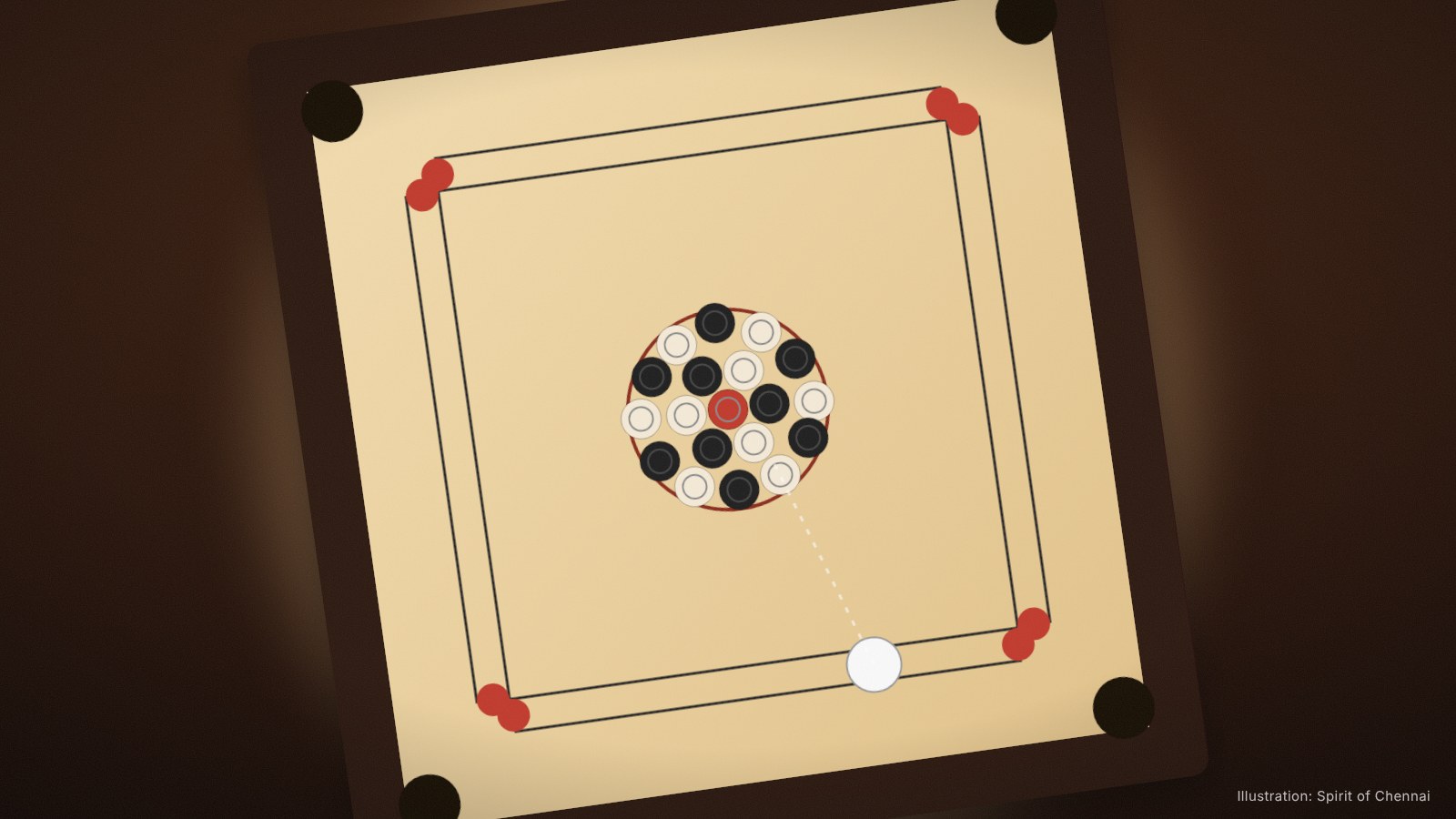
- Pieces: nine white, nine black and one red queen. The striker can be no wider than 4.13 cm and no heavier than 15 g.
- Striking: the striker must be struck with a finger, not pushed.
- The queen: worth 3 points, but only once covered, meaning you pocket one of your own pieces on the same or the next stroke. It counts only for the winner of the board, and stops scoring once a player reaches 22 points.
- Scoring: a game goes to 25 points or eight boards, whichever comes first, and a match is the best of three games. One board can be worth no more than 12 points.
- Fouls: pocketing the striker loses your turn, and one of your pieces is taken out as a penalty, called a due, for placing back on the board.
- Time: 15 seconds for each stroke once play is called.
The laws are revised from time to time, so check the current version with your club or the association before a tournament.
How to start
- Visit a neighbourhood club. Outlook found clubs charging about ₹5 a game to cover boards, pieces and boric powder; ask about current rates.
- For coaching, look for academies run by former champions, or ask about the coaching camps at the carrom hall in Jawaharlal Nehru Stadium.
- Children in government and aided schools can enter the annual SDAT school carrom competitions through their school.
- Join a club affiliated to the district association to play the ranking tournaments that lead to state selection.
Quick answers
Who are Chennai’s carrom world champions?
They include A. Maria Irudayam, Ilavazhagi, M. Khazima and L. Keerthana, all from the city.
How many points is the queen worth?
Three points under the ICF laws, but only if covered, and not once a player has reached 22.
Where can I play carrom at a government facility in Chennai?
Jawaharlal Nehru Stadium at Periamet has a dedicated carrom arena, according to the state’s sports policy note.
How long is a carrom game?
Twenty-five points or eight boards, whichever comes first; matches are best of three games.
Information checked against official sources on 23 October 2026. Fees, dates and rules can change; confirm on the linked official pages before acting.
Sources
- India’s L Keerthana wins triple gold at Carrom World Cup 2025 in Maldives (The Logical Indian)
- ‘Appa was our coach’: auto driver guides daughter Khazima to world carrom title (South First)
- Meet Maria, Chennai’s ‘Carrom Man’ and a two-time world champion (The Quint)
- Striker’s Code (Outlook)
- Carrom: growth ‘minus’ since 2009 (Madras Musings)
- Youth Welfare and Sports Development Department Policy Note 2024-25 (Government of Tamil Nadu)
- Laws of Carrom, adopted by the International Carrom Federation, 1993 (carrom.co.uk)