Two pieces of news arrived a week apart and were reported separately: Chennai’s lakes gained almost 1,000 million cubic feet in nine days of rain, and IMD then forecast a below-normal November. Put together, they set the real question for the city’s water: how far the stored water goes if the sky stays stingy.
The numbers
What was reported. An IANS report carried by Telangana Today on 25 October said combined storage in Chennai’s six reservoirs rose from 4,485.68 mcft on 15 October to 5,470.66 mcft on 24 October, 41.38% of their 13,222 mcft capacity. On 31 October, DT Next reported IMD’s forecast of deficient November rain and that the second cyclone of the season, Murasu, was expected to head for the Andhra Pradesh coast with limited effect on Tamil Nadu.
A forecast that changed in a month
On 30 September, IMD’s seasonal outlook said October to December rainfall over south peninsular India was most likely to be normal, 88% to 112% of the long-period average of about 334.1 mm. That is the forecast most residents heard as the monsoon set in. A month later, IMD’s November outlook said rain over the same region was most likely to be below normal, under 77% of the November average of about 118.7 mm. It said very strong El Niño conditions prevail over the Pacific and are likely to continue through December.
The two are not contradictory: a season can still end near normal if December is wet. But November is normally one of the wetter months of the season, and a weak one shifts more of the burden onto December, the month when cyclones can bring a lot of rain very quickly or miss the city altogether.
Where the water stands, lake by lake
| Reservoir | 15 Oct (mcft) | 24 Oct (mcft) | Gain (mcft) | Capacity (mcft) |
|---|---|---|---|---|
| Puzhal (Red Hills) | 1,876 | 2,415 | 539 | 3,300 |
| Chembarambakkam | 1,319 | 1,497 | 178 | 3,645 |
| Veeranam | 526.68 | 677.56 | 150.88 | n/a |
| Poondi | 412 | 490 | 78 | 3,231 |
| Kannankottai Thervoy Kandigai | 232 | 247 | 15 | n/a |
| Cholavaram | 120 | 144 | 24 | n/a |
| All six | 4,485.68 | 5,470.66 | 984.98 | 13,222 |
Source: storage figures as reported by IANS in Telangana Today, 25 October 2026; capacities for Chembarambakkam and Poondi as reported by DT Next, 29 November 2025, and for Red Hills and the total by IANS. n/a: capacity not in the reports we used.
The headline rise hides an uneven picture. Puzhal took more than half the gain and is 73% full. Chembarambakkam, the city’s largest reservoir and the source for its biggest treatment plant, is about 41% full. Poondi, the first stop for Krishna water from Andhra Pradesh and the upstream feeder for the others, is about 15% full. For comparison, on 29 November 2025, as Cyclone Ditwah approached, the Water Resources Department was releasing surplus water from Poondi, Chembarambakkam and Puzhal, which together held 8,422 mcft. On 24 October 2026 the same three held 4,402 mcft.
How long 5,470 mcft lasts
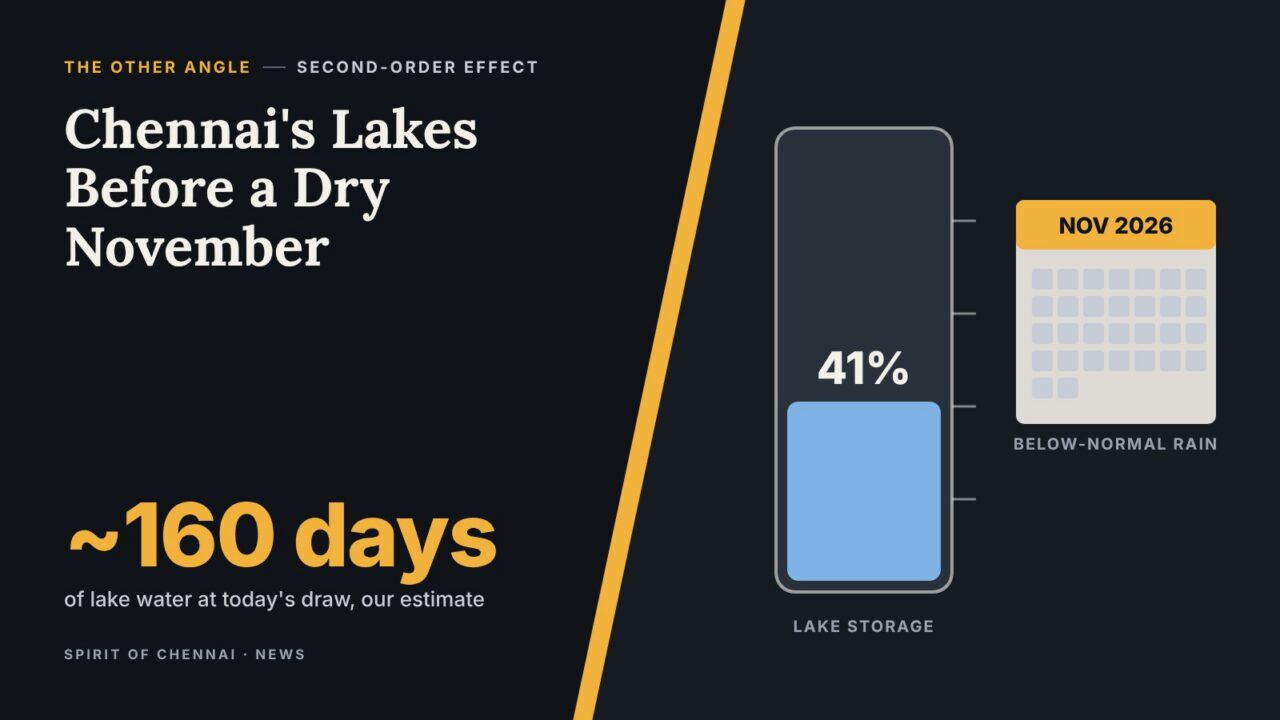
IANS cited Chennai Metro Water figures showing the city drew 968.41 million litres a day (MLD) from its reservoirs, about 78% of a total supply of 1,237.71 MLD. One mcft is about 28.3 million litres, so 5,470.66 mcft is roughly 1,54,900 million litres. Divided by the daily draw, that is about 160 days, or into early April 2027 if not a drop more fell.
Stored lake water on 24 October divided by the reservoir draw of 968.41 MLD reported by IANS. Our arithmetic; it ignores evaporation and water that cannot be pumped out.
That figure is a ceiling, not a promise. It counts every litre in the lakes as usable, when evaporation through a hot dry season takes a share and the bottom layer of each reservoir cannot be drawn. It also assumes the city’s draw stays flat into summer, when demand rises. The real cushion is smaller, which is why the next eight weeks of rain matter so much.
It’s often said a big jump in lake levels after a week of rain means Chennai is safe for summer.
The record shows After the rise, the six lakes were 41% full on 24 October, Poondi only about 15%. At the same point in late 2025, the three biggest lakes held almost twice as much water and were spilling.
The part of the supply that does not need rain
Desalination is the city’s hedge. The IANS breakdown listed 200 MLD from the Nemmeli plants, with smaller amounts from quarries (28 MLD), wells and borewells (16 MLD), sources in added areas (14 MLD) and Porur (5 MLD). Chennai Metro Water’s Annual Performance Report says a 150 MLD plant at Nemmeli was in trial commissioning and a 400 MLD plant at Perur is scheduled for completion around February 2027, which on its own would cover a large slice of the reservoir draw. The same report puts present demand at about 1,400 MLD against roughly 1,040 MLD supplied, a gap of about 360 MLD.
Longer-term storage is also on paper. The 2025-26 state budget announced a sixth reservoir in the Kovalam sub-basin with a capacity of about 1.6 TMC (1,600 mcft) at an estimated ₹350 crore. That would add roughly an eighth to the current combined capacity, but it does not help this season.
Who feels a short November first
A dry spell rarely shows up first as dry taps in central Chennai. It shows up in the areas on the edges of the network and in those served by lorries, where households already store water in drums and sumps, and in tanker prices. It also shows up in the Water Resources Department’s choices: with Poondi low, transfers through the link canals that keep Chembarambakkam and Puzhal topped up depend on fresh inflow or Krishna water. None of this is a shortage today. It is the arithmetic that sets how much room there is if the forecast holds.
What this means for you
- Do not read one week’s rise as the season’s result: the lakes were at 41% on 24 October.
- If you rely on lorry water or a borewell, a weak November is the time to fix rooftop rainwater harvesting and check sump storage.
- Watch Poondi and Chembarambakkam, not the combined figure; they decide how much water reaches the main treatment plants.
- Desalination capacity due in 2027 eases the dependence on rain, but not for this dry season.
What to watch
November 2026
IMD’s below-normal outlook for south peninsular India runs through the month. Lake levels by 30 November will show whether the forecast held.
December 2026
The last month of the northeast monsoon season. Any cyclone or depression near the coast could change the storage picture quickly.
Around February 2027
The 400 MLD Perur desalination plant is scheduled for completion, per Chennai Metro Water’s annual report.
Checked against official sources on 4 November 2026. Details may change; confirm on the linked official pages.
Sources
- Monthly outlook for November 2026, India Meteorological Department press release, 31 October 2026
- Seasonal outlook for October to December 2026, India Meteorological Department press release, 30 September 2026
- Annual Performance Report, Chennai Metropolitan Water Supply and Sewerage Board
- Budget Speech 2025-26, Finance Department, Government of Tamil Nadu
- Chennai reservoirs record significant boost in storage after nine days of rain, Telangana Today (IANS), 25 October 2026
- November forecast for Tamil Nadu: Softer Murasu, deficient rainfall, DT Next, 31 October 2026
- WRD begins water release from Chennai reservoirs, DT Next, 29 November 2025