Chennai Metro Phase 2 is the biggest single public works project the city has seen, and since October 2024 it has been paid for in a very different way. Here is where the ₹63,246 crore comes from, on what terms, and what the lenders expect in return.
The numbers
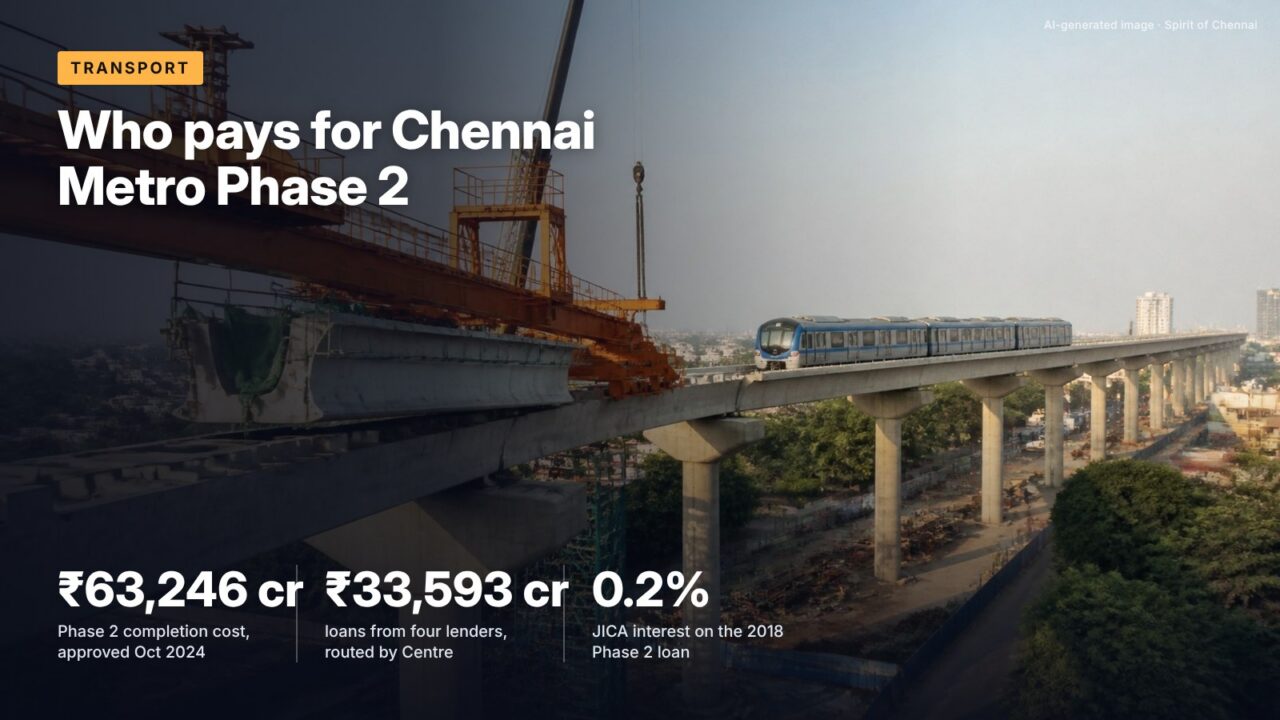
The single most important fact about Chennai Metro Phase 2 is a change of ownership on paper. On 3 October 2024 the Union Cabinet approved the 118.9 km, 128-station project as a central sector project, with a completion cost of ₹63,246 crore and a target of 2027, according to the PIB release on the Cabinet decision. Two days later the Union government said it would now finance almost 65 per cent of the cost.
Until then Tamil Nadu had been carrying about 90 per cent of the bill. The PIB note of 5 October 2024 says the state had been paying for the project as a state sector scheme, with the Centre limited to about 10 per cent (excluding land and some other items) under the Metro Rail Policy 2017. Most of the money in either arrangement is borrowed, at low interest and over very long periods, from four lenders: Japan’s JICA, the Asian Development Bank, the Asian Infrastructure Investment Bank and the New Development Bank.
How the cost is split after 2024
The central share has two parts. The Centre takes on the entire loan requirement of ₹33,593 crore and adds ₹7,425 crore as equity and subordinate debt (a loan that is repaid only after senior lenders), the October 2024 note says. Adding the two gives ₹41,018 crore, which is 64.9 per cent of ₹63,246 crore. Subtracting that from the total leaves about ₹22,228 crore for Tamil Nadu, close to the 35 per cent the note describes.
| Component | Amount | Share of cost |
|---|---|---|
| Bilateral and multilateral loans (JICA, ADB, AIIB, NDB) | ₹33,593 crore | 53.1% |
| Central equity and subordinate debt | ₹7,425 crore | 11.7% |
| Central share, total | ₹41,018 crore | 64.9% |
| Tamil Nadu share (by subtraction) | about ₹22,228 crore | 35.1% |
| Completion cost | ₹63,246 crore | 100% |
Source: Press Information Bureau, releases of 3 and 5 October 2024; shares calculated by Spirit of Chennai
The same note records that before the switch, the Centre had helped the state line up ₹32,548 crore of external loans, of which about ₹6,100 crore had been used. That figure matters because it shows how much of the borrowing was already arranged, corridor by corridor, before the Union government took it over.
Which lender pays for which line
The lenders did not share the network evenly. JICA, the largest, signed its first Phase 2 tranche in December 2018 for ¥75,519 million at 0.2 per cent interest, repayable over 40 years with a 12-year grace period, according to JICA’s loan signing note. A second tranche of ¥73,000 million, about ₹4,710 crore at the exchange rate JICA used, was signed on 31 March 2022 for Corridor 3 (Madhavaram Milk Colony to Sholinganallur) and Corridor 5 (Madhavaram to CMBT), together about 51 km, JICA said.
Corridor 4’s three-bank package
Corridor 4, Lighthouse to Poonamallee Bypass, was carved into packages for the three other banks. The AIIB project document of September 2021 sets out a plan in which AIIB funds the elevated viaduct, ADB the underground section and NDB the electrical, mechanical and systems work.
| Corridor 4 component | Funder | US$ million | Share |
|---|---|---|---|
| A: elevated viaduct | AIIB | 356.67 | 15.7% |
| B: underground section | ADB | 467.46 | 20.6% |
| C: systems, electrical and mechanical | NDB | 346.72 | 15.2% |
| D and E: land, other costs | Government of Tamil Nadu | 1,101.08 | 48.5% |
| Total | 2,271.93 | 100% |
Source: Asian Infrastructure Investment Bank, Project Document PD000301-IND, financing plan, September 2021
That 2021 plan still had the state paying nearly half of Corridor 4. It predates the 2024 central sector decision, so the state’s final share on this corridor will differ, and the published releases do not give a revised corridor-wise split.
Repayment period on JICA’s first Phase 2 loan, with a 12-year grace period before repayments start, per JICA.
Why the fare box cannot repay it
Lenders judge a metro on two returns. The economic return counts time saved, fuel and emissions avoided and fewer accidents. The financial return counts only the cash the line earns. In the AIIB appraisal, Corridor 4’s economic internal rate of return is 12.48 per cent against a 9 per cent hurdle, with an economic net present value of US$953 million. Its financial internal rate of return is 3.02 per cent, the document shows.
Put simply, the line is worth building for the city, but the fares will not cover the cost of the money. That gap is why metros in India are built with concessional loans, public equity and long grace periods, and why the question of which government carries the debt is not a technicality. The AIIB loan itself runs 30 years with a 9.5-year grace period.
It’s often said the Centre is now paying for Chennai Metro Phase 2.
The record shows The Centre’s share is about 65 per cent, and most of it is the ₹33,593 crore borrowed from the four lenders, which the Union government arranges and routes. Tamil Nadu still carries about 35 per cent, roughly ₹22,228 crore, according to the PIB note.
Ridership against the projections
The AIIB appraisal projected 5,08,881 daily boardings on Corridor 4 alone in 2026, rising to 7,75,491 in 2035 and 10,51,525 by 2055. Those numbers assumed a finished corridor. Phase 2 passenger service has only just begun, with the Poonamallee to Vadapalani stretch inaugurated on 11 October 2026, so a fair comparison is not yet possible.
What can be read is the base the new lines feed into. CMRL’s monthly ridership file shows the network carrying 1,04,04,098 trips in August 2026, about 3.36 lakh a day when divided by 31 days. July 2026 was the highest month on record at 1,06,28,926 trips.
| Month | Trips | Average per day |
|---|---|---|
| August 2023 | 85,90,212 | 2.77 lakh |
| August 2024 | 95,52,680 | 3.08 lakh |
| August 2025 | 98,96,230 | 3.19 lakh |
| August 2026 | 1,04,04,098 | 3.36 lakh |
Source: Chennai Metro Rail Limited, media-wise ridership details, April 2023 to August 2026; daily averages calculated over 31 days
August ridership grew 21 per cent between 2023 and 2026. The whole existing network therefore carries fewer riders today than the AIIB document expected Corridor 4 alone to carry in its first year. That is not a failure yet: projections for new lines assume connected corridors, feeder buses and interchanges that are still being built. But it is the number to track as each stretch opens.
What this means for you
- The 2027 completion target is the Cabinet’s figure from October 2024; treat stretch-by-stretch opening dates as separate announcements.
- Because most funding is long-term concessional debt, fare decisions and non-fare revenue (advertising, property) will matter to the project’s finances for decades.
- When a new stretch opens, compare its traffic with the DPR or lender projections; CMRL publishes monthly figures on its website.
- Corridor 4 in the 2021 AIIB plan was split three ways among lenders, so delays in one package (for example the underground section) can hold up a stretch even when others are ready.
What to watch
2027
Target completion for all three corridors, per the Cabinet approval.
Monthly
CMRL’s ridership file, now including Phase 2 stretches as they open, on the CMRL website.
Pending
A revised corridor-wise split of funding after the central sector switch; none has been published in the documents reviewed here.
Checked against official sources on 23 October 2026. Figures and rules change; confirm on the linked official pages before relying on them.
Sources
- Cabinet approves Chennai Metro Rail Project Phase II, PIB, 3 October 2024
- Central Government to finance almost 65 per cent of Chennai Metro Phase 2, PIB, 5 October 2024
- Chennai Metro Rail Phase 2 Corridor 4, Project Document, AIIB, September 2021
- JICA extends ODA loan of INR 4,710 crore for Chennai Metro Phase 2 (II), JICA, 31 March 2022
- Signing of Japanese ODA loan agreements with India: Chennai Metro Project (Phase 2) (I), JICA, December 2018
- Media-wise ridership details, April 2023 to August 2026, Chennai Metro Rail Limited, 2026