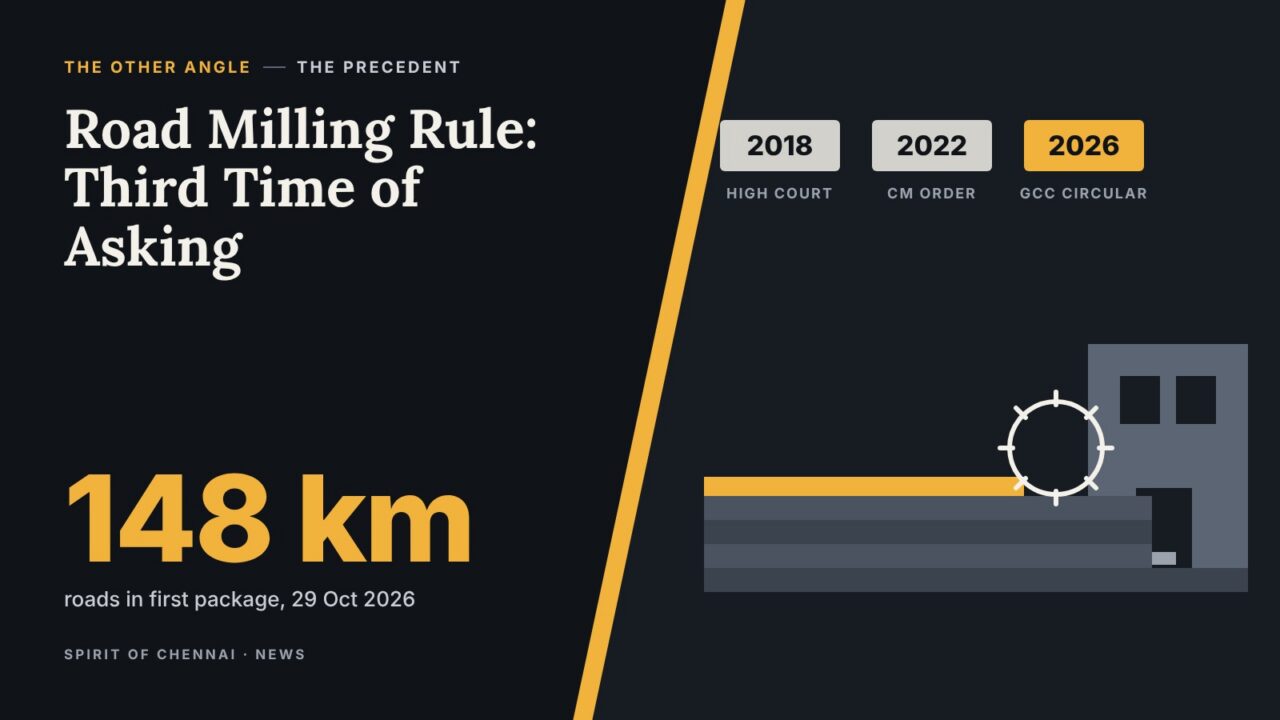
The Corporation’s circular requiring old road surfaces to be milled before relaying was reported as a fix for roads rising above homes. The same instruction has been given at least twice before, by the Madras High Court in 2018 and by a Chief Minister in 2022. This piece looks at what is different this time, what is still missing, and the 148 km of new road work it will first be tested on.
The numbers
What was reported. DT Next reported on 31 October that a Corporation circular bars repeated relaying that raises road levels. Under the circular, existing surfaces must be milled to roughly the thickness of the new layer, and engineers must record road and adjoining property levels before work starts. The report followed a protest by the anti-corruption group Arappor Iyakkam in Egmore on 25 October. The group says rising roads send rain and sewage into homes.
The precedent: a 2018 court order and a 2022 warning
On 9 March 2018, a Madras High Court bench of Chief Justice Indira Banerjee and Justice Abdul Quddhose heard a public interest case from Chitlapakkam. Citizen Matters reported that the bench directed milling during relaying in line with Indian Roads Congress guidelines, and that the direction was read as applying across Tamil Nadu, including Chennai. The bench said the public could not be expected to raise their foundations to keep up with the road.
In January 2022, DT Next reported, the then Chief Minister publicly asked all officials on road works to mill compulsorily before relaying and warned of stringent action, after a night inspection with the Chief Secretary. Neither instruction appears to have been followed by a published penalty regime. In the meantime, the problem drew a fresh protest in October 2026.
| When | Who | What was said |
|---|---|---|
| 9 March 2018 | Madras High Court (Chitlapakkam PIL) | Mill before relaying, following IRC guidelines |
| January 2022 | Chief Minister, after a night inspection | Milling compulsory; stringent action warned |
| 25 October 2026 | Arappor Iyakkam protest, Egmore | Rising roads flooding homes; asked for penalties |
| Reported 31 October 2026 | GCC circular | Milling to match new layer; level records; photos at site |
Sources: Citizen Matters, 13 March 2018; DT Next, 15 January 2022 and 31 October 2026.
What the circular adds
The new text goes further than “mill the road”. As reported, it requires engineers to inspect and record pavement condition, road levels, camber, cross-fall and adjoining property levels before relaying. Milling depth and quantity have to be verified and recorded. Mechanical brooming is mandatory, manhole covers and footpaths must be brought to the approved finished level, and photographs of milled surfaces must be shown at the worksite. It is addressed to every rank from Superintending Engineer to Junior Engineer, and contractors and project management consultants are on the circulation list.
Two of these steps are new and can be checked. A recorded level before work and a photo of the milled surface give residents something to ask for. Earlier instructions only told engineers what to do. These create records that can show whether it was done.
The thing that did not change
It’s often said the new rule will bring raised roads back down to house level.
The record shows the circular covers future bituminous relaying only. According to DT Next, it does not order existing raised roads to be lowered, and it does not include the penalties Arappor sought, such as withholding contractor payments or blacklisting.
So a house that is already a step below the road stays there unless that road is relaid and the engineer chooses to mill deeper than the new layer. The circular sets milling depth to “generally” match the new layer, which keeps the level steady but does not bring it down.
Where it will be tested first
Two days before the circular was reported, the Corporation announced its first road package under the State’s new Chief Minister’s Integrated Urban Development Mission. Press release No. 626 of 29 October sanctioned 148.10 km of roads across all 15 zones for ₹130.19 crore, against a project report estimate of ₹154.16 crore. It said about ₹300 crore had been set aside for GCC road improvement under the mission.
| Road type | Roads | Length | Cost |
|---|---|---|---|
| Bituminous (tar) | 595 | 136.57 km | ₹120.65 crore |
| Cement concrete | 58 | 8.47 km | ₹7.33 crore |
| Interlocking paver block | 25 | 3.06 km | ₹2.21 crore |
| Total | 678 | 148.10 km | ₹130.19 crore |
Source: Greater Chennai Corporation press release No. 626, 29 October 2026.
Bituminous roads in the first package, the type the milling circular covers. They make up 136.57 km, or 92%, of the length in release No. 626.
The bituminous roads in the package average about ₹88 lakh per km, which is ₹120.65 crore divided by 136.57 km. Milling adds work, and the circular does not say whether contractors’ rates already allow for it. The package is also small next to the network. The Roads department page lists 471 bus route roads totalling 387 km and 34,640 interior roads totalling 5,270.33 km, about 5,657 km in all. The first package covers about 2.6% of that.
The money trail has a history too. A 2015 State order, G.O.(Ms) No. 80 of the Municipal Administration and Water Supply Department, sanctioned ₹1,000 crore for restoring roads in urban local bodies. It does not mention milling or road levels. That gap is the reason the circular’s site records matter.
What this means for you
- When your street is being relaid, look for the photograph of the milled surface at the site. The circular requires it.
- Ask the ward Assistant Engineer for the recorded pre-work road level and your plot’s level. The circular says both must be recorded.
- If a crew lays new tar over the old surface without milling, report it on the 1913 helpline with a photo, date and street name.
- Do not expect an already raised road to come down. The circular does not require that, so raise it in writing with the zonal office if it affects you.
What to watch
Pending
Tenders and work orders for the 595 bituminous roads in the 29 October package, the first large test of the milling rule.
Pending
Whether the Corporation adds penalties for contractors who skip milling, which the circular as reported does not include.
Checked against official sources on 4 November 2026. Details may change; confirm on the linked official pages.
Sources
- Press release No. 626: road works under CMIUDM, 148.10 km at ₹130.19 crore, Greater Chennai Corporation, 29 October 2026
- Roads Department: bus route and interior roads, Greater Chennai Corporation
- G.O.(Ms) No. 80, Municipal Administration and Water Supply Department, 24 May 2015
- GCC mandates milling of old road surfaces to prevent road levels from rising, DT Next, 31 October 2026
- Why Chennai should cheer Madras HC order on Chitlapakkam roads, Citizen Matters, 13 March 2018
- Will take action if roads laid sans milling, DT Next, 15 January 2022