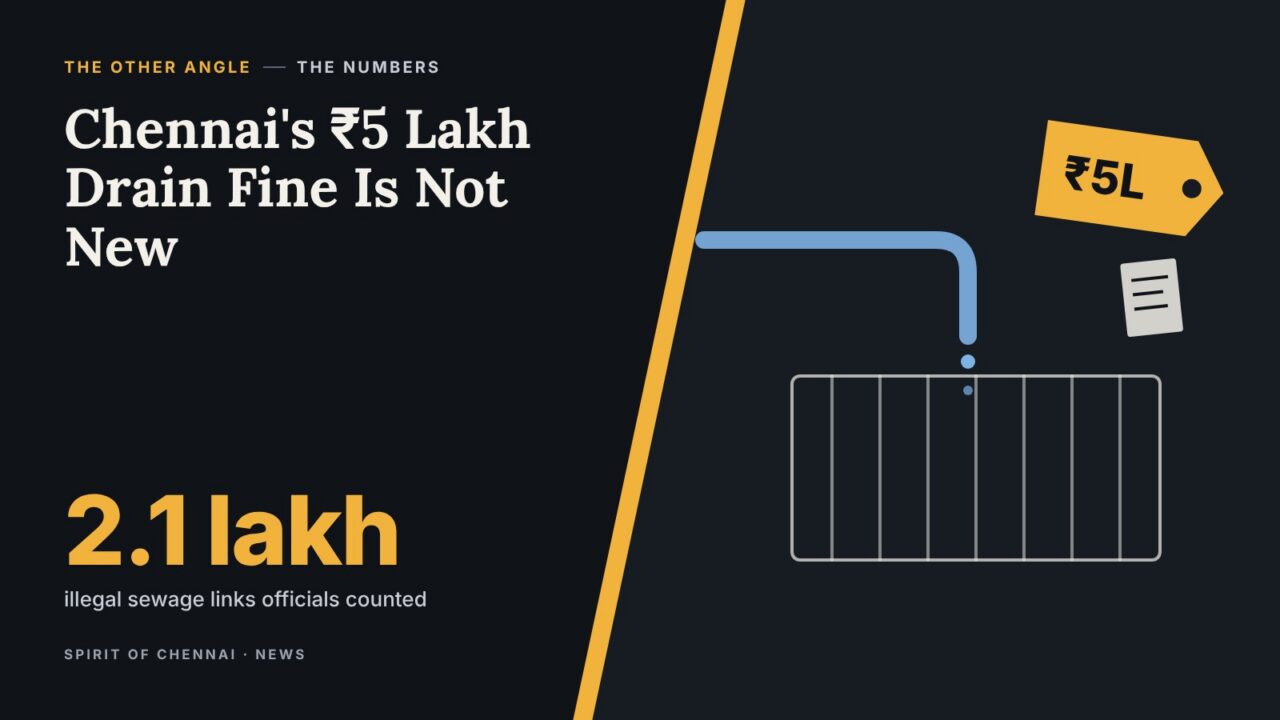
Greater Chennai Corporation’s warning this week that sewage pipes into stormwater drains can cost a building up to ₹5 lakh made headlines. The fines are not new. The council set them in June 2025, and the official numbers since then show how few have actually been collected.
The numbers
What was reported. On 3 November 2026 the Corporation issued press release No. 646, saying the Commissioner had sent a circular ordering joint action with Chennai Metro Water against illegal sewage outlets into drains and onto roads. DT Next reported on 4 November that Commissioner G S Sameeran had warned of legal action, with fines going up to ₹5 lakh for multi-storeyed commercial buildings. Most coverage led with that top figure.
The fines date to June 2025
The penalty table is older than the headlines suggest. DT Next reported on 30 June 2025 that the council had passed a resolution raising fines for letting sewage into stormwater drains and streets, with by-laws framed under the Chennai City Municipal Corporation Act, 1919. That 2025 schedule already ran from ₹10,000 for a house to ₹5 lakh for a commercial complex. The November 2026 release itself cites only “relevant legal provisions” and a council resolution, and gives no new resolution number or date.
What the November circular adds is the paperwork and the chain of responsibility. Set side by side, the two look like this.
| Building type | June 2025 resolution (as reported) | November 2026 circular |
|---|---|---|
| Ordinary residential | ₹10,000 | ₹10,000 |
| Ordinary commercial | ₹25,000 | ₹25,000 |
| Special residential | Not listed separately | ₹50,000 |
| Special commercial | Not listed separately | ₹1,00,000 |
| Multi-storeyed residential | ₹2 lakh (apartment) | ₹2,00,000 |
| Multi-storeyed commercial | ₹5 lakh (commercial complex) | ₹5,00,000 |
Source: GCC press release No. 646, 3 November 2026; DT Next report of the council meeting, 30 June 2025. “Special” and “multi-storeyed” are building categories under Tamil Nadu’s building rules.
It’s often said Chennai has just brought in a ₹5 lakh fine for sewage in drains.
The record shows the ₹5 lakh ceiling was in the council’s June 2025 schedule. The 2026 circular adds named categories for “special” buildings and sets out how inspections, records and collections must be handled.
The numbers nobody ran
The Corporation’s own figures, as given to reporters, show the size of the gap. In May 2025, officials told IANS that illegal household and commercial connections into stormwater drains had risen from 1.3 lakh in 2023 to 2.1 lakh in 2025 (report carried by Lokmat Times, 28 May 2025). The same report said 1,833 illegal outlets were disconnected in 2024 and ₹5.98 lakh collected in fines. That works out to about ₹326 per disconnection, well below even the old minimum.
After the higher fines took effect on 1 July 2025, DT Next reported in September 2025 that the Corporation had collected ₹4.40 lakh: 39 residential connections fined ₹10,000 each and two commercial buildings at ₹25,000 each. Teynampet zone led with ₹90,000.
Roughly 41 fines against the 2.1 lakh illegal connections officials had counted, based on DT Next’s September 2025 tally and the May 2025 official estimate.
A simple calculation shows how far collections sit from what the schedule allows. If every one of the 2.1 lakh connections paid only the lowest ₹10,000 fine, the total would be about ₹210 crore. Actual collections across two reported periods add up to just over ₹10 lakh. Neither the November release nor the 2025 reports say how many notices were issued or how many outlets were simply plugged without a fine.
Who pays when there is no sewer to join
The circular tells building owners to take a legal sewage connection from Chennai Metro Water. For much of the city that is a realistic instruction. For some of it, it is not yet possible.
CMWSSB’s sewerage system page says 82% of the city area was covered as of March 2022, with 4,093 km of sewers, 302 pumping stations and 9,30,531 connections. About 18% was not covered. Its page on the added areas lists 42 former local bodies merged into the Corporation: underground sewerage is complete in 17, under way in 10, and still to be taken up in 15, plus left-out parts of Madhavaram.
In those 15 areas, a household that runs grey water or septic overflow into a roadside drain has no Metro Water sewer to switch to. The circular gives no separate route for them, such as a desludging schedule or a grace period linked to sewer works. The fine schedule applies city-wide. That is the group most of the coverage did not mention.
Why drain sewage is more than a smell
The Corporation’s case rests on flooding and health. Release No. 646 says illegal connections threaten public health and choke drains before the monsoon. The drains are expensive. The stormwater drain department page lists 345 km built in the core city under JnNURM for ₹640 crore, another 225 km after the 2021 floods for ₹699 crore, and 406 km in the Adyar and Cooum basins under a World Bank project for ₹1,387 crore. Those drains were designed for rain, not for sewage and the silt and grease that come with it.
The problem is also old and on the record. In a 2022 status report to the National Green Tribunal (O.A. No. 41 of 2020, taken up on the tribunal’s own motion), the Corporation said it was already inspecting with CMWSSB, plugging illegal connections and fining offenders. There is a safety side as well. After two workers died in a 20-foot stormwater sump in Kodungaiyur on 12 October 2026, officials told reporters they suspected sewage from illegal connections had entered that drain.
What is actually new in the circular
- A joint register kept by GCC and CMWSSB, recording each outlet, the owner or occupier, inspection findings, blocked connections, and fines levied and collected.
- A nodal officer in every zone, appointed by the zonal officer, to coordinate with Metro Water and report to the Commissioner.
- Upload of every fine collected to the GCC app straight away.
If the register and app data are published, residents will for the first time be able to compare fines with the official count of illegal connections. The release does not say whether they will be.
What this means for you
- If any pipe from your building, including a kitchen or washing-area outlet, runs into a roadside drain, the fine starts at ₹10,000 for an ordinary house and ₹2 lakh for a multi-storeyed residential block.
- Apartment associations carry the higher multi-storeyed rate, so check common outlets and plumbing changes made by individual flats.
- If your street has a Metro Water sewer, apply for a legal connection through CMWSSB before an inspection reaches you.
- If your area has no sewer yet, keep septic tank desludging records and raise it with your ward office. The circular itself offers no exemption.
- To report sewage in a drain, the Corporation’s 1913 helpline and app remain the routes.
What to watch
November 2026
Zonal officers are to name nodal officers and begin joint GCC and CMWSSB inspections under the circular. Watch for the first zone-wise fine totals.
Pending
Underground sewerage in the 15 added areas still listed as “to be taken up” by CMWSSB. No completion dates are given on its page.
Checked against official sources on 4 November 2026. Details may change; confirm on the linked official pages.
Sources
- Press release No. 646: action against illegal sewage connections into stormwater drains, Greater Chennai Corporation, 3 November 2026
- Sewerage system at a glance, Chennai Metropolitan Water Supply and Sewerage Board
- Underground sewerage schemes in added areas, CMWSSB
- Storm Water Drain Department, Greater Chennai Corporation
- GCC status report in O.A. No. 41 of 2020, National Green Tribunal (Southern Zone), 2022
- Linking sewage to stormwater drains may cost you Rs 5 lakh fine, DT Next, 4 November 2026
- Chennai Corporation hikes penalty for sewage discharge into SWDs, DT Next, 30 June 2025
- Chennai to penalise illegal sewage discharges into storm drains (IANS), Lokmat Times, 28 May 2025