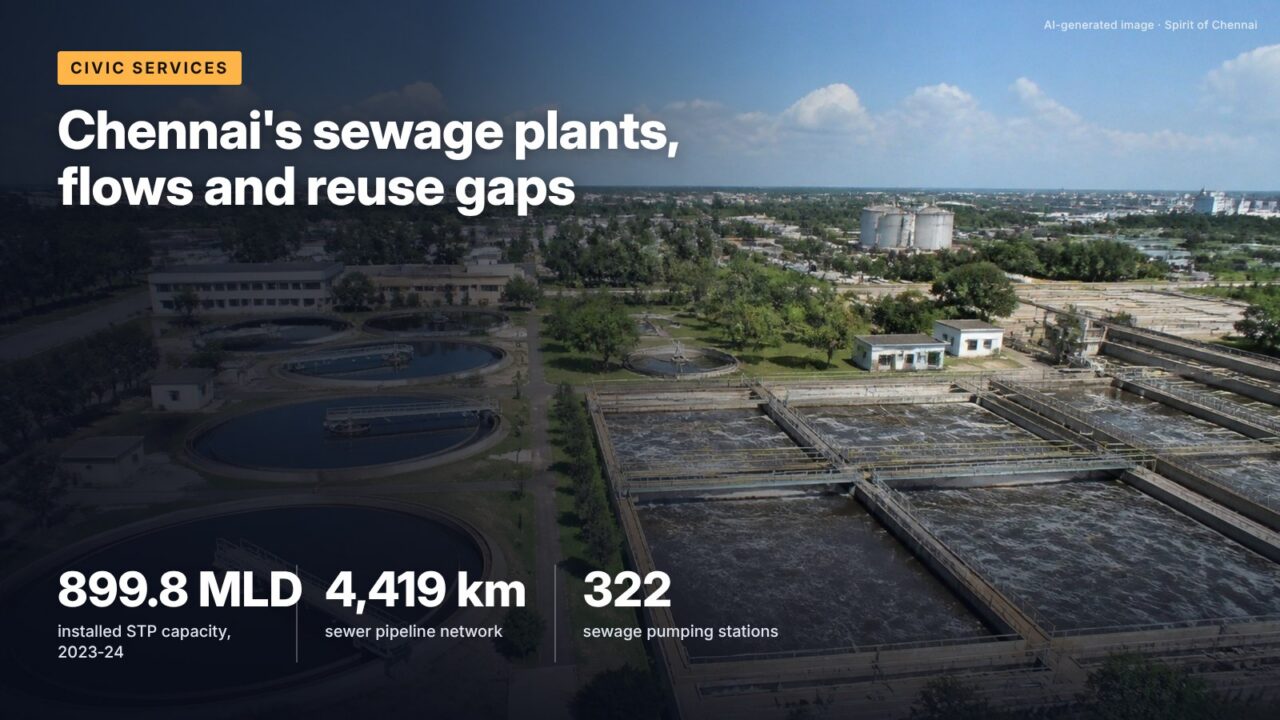
Chennai’s sewage treatment capacity has grown to about 900 million litres a day, but the official record still has two conflicting totals, recycled water plants running at less than half their capacity, and hundreds of outfalls still feeding sewage into the rivers.
The numbers
Metro Water’s Annual Performance Report for 2023-24 puts the city’s installed sewage treatment capacity at 899.80 million litres a day (MLD), spread across five large plant clusters and four small modular units. The sewage reaches them through 4,419 km of pipes and 322 pumping stations. In 2021, the Board’s own report to the National Green Tribunal gave 727 MLD across 12 plants, 3,529 km of sewers and 266 pumping stations.
The growth is real, but so are the loose ends. The same 2023-24 report repeats the 727 MLD figure and a 3,597 km sewer length in a later section, and it does not state how much sewage actually arrives at the plants. Capacity is therefore known; actual flows are not published.
The plants and what they can treat
| Plant | Units (MLD) | Capacity (MLD) |
|---|---|---|
| Kodungaiyur | 110 + 120 + 120 | 350 |
| Koyambedu | 34 + 60 + 120 | 214 |
| Nesapakkam | 54 + 40 + 50, plus 10 TTUF | 154 |
| Perungudi | 60 + 54 + 12 | 126 |
| Thiruvottiyur | not split | 31 |
| Sholinganallur I | not split | 18 |
| Modular (Chetpet, Choolaimedu, Todd Hunter Nagar, Kotturpuram) | 1 + 1.2 + 4 + 0.6 | 6.8 |
| Total | 899.8 |
Source: CMWSSB, Annual Performance Report 2023-24, STP capacity table
Kodungaiyur in the north and Koyambedu in the west account for nearly 63% of the total (564 of 899.8 MLD). The modular plants are small but deliberate: they treat sewage close to where it is generated in the old city, where laying new trunk sewers is costly and slow.
How the network grew
| Measure | c. 2008 | 2021 | 2023-24 |
|---|---|---|---|
| Installed treatment capacity | not stated | 727 MLD (12 plants) | 899.8 MLD |
| Sewer network | not stated | 3,529 km | 4,419 km |
| Sewage pumping stations | 188 | 266 | 322 |
Source: CMDA seminar paper (c. 2008); CMWSSB report in NGT O.A. 171 of 2021; CMWSSB Annual Performance Report 2023-24
The 2021 filing gives a sense of how the added capacity arrived. It listed three modular plants under construction: 1 MLD near College Road, Chetpet (95% complete), 1.2 MLD in Nungambakkam (66%) and a 10 MLD ultrafiltration plant at Langs Garden (34%). The 2023-24 list includes a 1 MLD Chetpet unit, a 1.2 MLD Choolaimedu unit and a 10 MLD tertiary unit at Nesapakkam. The 2021 report also put the population served at 74.38 lakh across 426 sq km, projected from the 2011 Census figure of 67.27 lakh.
Capacity against demand
The Board says city water demand is 1,400 MLD against about 1,040 MLD supplied. A planning rule used in a CMDA seminar on the Second Master Plan (around 2008) assumed 80% of water supplied returns as sewage. On that rule, 1,040 MLD of piped supply would produce roughly 830 MLD (1,040 × 0.8), within today’s installed capacity. That calculation leaves out groundwater drawn by households and businesses, which also ends up in sewers, so actual flows are likely higher.
The same 2008 planning paper projected sewage of 1,690 MLD by 2026 and proposed treatment capacity to match. Installed capacity in 2023-24 was a little over half of that projection. The gap partly reflects the fact that the Corporation’s area expanded in 2011 and many added areas were still being sewered.
Sewage treatment capacity the CMDA-era planning paper projected Chennai would need by 2026, against 899.8 MLD installed in 2023-24.
Where untreated sewage still goes
The 2021 tribunal case (O.A. 171 of 2021) was opened on the tribunal’s own motion over sewage being diverted into stormwater drains. Metro Water’s filing listed 385 outfalls into the Cooum, Adyar, Buckingham Canal and associated drains to be dealt with in the first phase, with 46 interception-and-diversion works and 39 infrastructure-strengthening works worth ₹1,001 crore. The wider Cooum eco-restoration project was costed in principle at ₹2,371 crore. Interception means catching sewage before it reaches the river and sending it to a treatment plant.
On the Cooum alone, the filing said 37 outfalls would be plugged once the listed works were finished, and it identified 61 more between Paruthipattu and the river mouth. Ten interception-and-diversion systems along the Cooum formed part of the 15 sub-projects of the eco-restoration project. Underground sewerage for Nerkundram, one of the added areas, was then scheduled for completion in 2023.
It’s often said all of Chennai’s sewage goes to treatment plants.
The record shows Metro Water’s own 2021 report to the National Green Tribunal listed 385 outfalls into the city’s rivers and canals for phased plugging, and 61 additional outfalls on the Cooum alone. Some sewage still reaches waterways through stormwater drains.
Recycling: built, but underused
Chennai was early to recycle sewage for industry. Two tertiary treatment reverse osmosis (TTRO) plants, each 45 MLD, take treated sewage from Koyambedu and Kodungaiyur and polish it for industrial users. The Union housing ministry told the Lok Sabha in August 2025 that the Koyambedu plant cost ₹440 crore and the Kodungaiyur plant ₹330 crore under AMRUT, both listed as completed.
Use is the weak point. The 2023-24 performance report says Kodungaiyur was supplying 23 MLD and Koyambedu 15 MLD, a combined 38 MLD from 90 MLD of capacity, about 42%. Metro Water now prices treated sewage at ₹28.35 per kilolitre, according to its tariff schedule, compared with ₹99 to ₹194 per kilolitre for metered commercial and industrial fresh water.
Across Tamil Nadu, the ministry said 18 AMRUT sewerage and septage projects worth ₹5,670.8 crore had created 289.97 MLD of treatment capacity, with another 210.03 MLD under implementation.
What this means for you
- If you see sewage in a stormwater drain on your street, it is a reportable violation; the tribunal case shows the Board and Corporation are expected to trace and plug such connections.
- Apartment complexes and large buildings are often required to run their own treatment plants; the city network does not replace that obligation.
- Industries near Kodungaiyur and Koyambedu can buy recycled water at a lower tariff than fresh water for most commercial categories.
- Treat official capacity figures with care: the same report gives 899.8 MLD and 727 MLD in different sections.
What to watch
Pending
Remaining outfall plugging and interception works under the Cooum, Adyar and Buckingham Canal programmes, reported periodically to the National Green Tribunal.
Pending
Chennai’s AMRUT underground sewerage package of ₹245 crore, listed as under implementation in August 2025.
Checked against official sources on 23 October 2026. Figures and rules change; confirm on the linked official pages before relying on them.
Sources
- Annual Performance Report 2023-24, Chennai Metropolitan Water Supply and Sewerage Board
- CMWSSB report in O.A. 171 of 2021 (SZ), National Green Tribunal, September 2021
- Lok Sabha Unstarred Question 3133, Status of Sewage Treatment Plants in Tamil Nadu, 7 August 2025
- Session III: Water Supply, Sanitation, Solid Waste and Flood Alleviation, CMDA Second Master Plan seminar, c. 2008
- Water and sewerage tariff, CMWSSB, 2025