

When a family member dies with money in a bank, the heirs or the nominee can claim it at the branch, and the bank must settle the claim within 15 calendar days of receiving all the documents. That deadline comes from the RBI’s Settlement of Claims in respect of Deceased Customers of Banks Directions, 2025, which banks had to implement by 31 March 2026. If the bank is late, it owes you interest for the delay.
What you need depends on one question: did the account have a nominee or a surviving joint holder? If yes, the claim needs little more than a form, the death certificate and ID. If not, commercial banks must still use a simplified procedure for claims up to ₹15 lakh, with no court papers or third-party surety.
Before you start
| Document | Who needs it | Notes |
|---|---|---|
| Claim form | Every claimant | Annex I-A with a nominee or survivor; Annex I-B without |
| Death certificate | Every claimant | Issued by Greater Chennai Corporation or the local body where the death was registered |
| Officially valid ID of each claimant | Every claimant | Aadhaar, passport, voter ID or similar |
| Bond of indemnity | Legal heirs with no nominee | Annex I-C; no third-party surety up to the limit |
| No-objection letter from other heirs | Legal heirs with no nominee, if some heirs are not claiming | Annex I-D |
| Legal heir certificate, or a declaration by an independent person | Legal heirs with no nominee, up to the limit | Annex I-E is the declaration format |
| Succession certificate, legal heir certificate or sworn affidavit | Claims above the limit with no nominee | Bank may also ask for a surety |
Source: RBI Directions on deceased customers’ claims, 26 September 2025.
In Tamil Nadu, the legal heir certificate is a Revenue Department service that can be applied for through e-Sevai centres, as listed on the National Government Services Portal. Under the RBI rules, though, you do not have to wait for it for smaller claims: a declaration from an independent person who knows the family is enough.
The steps
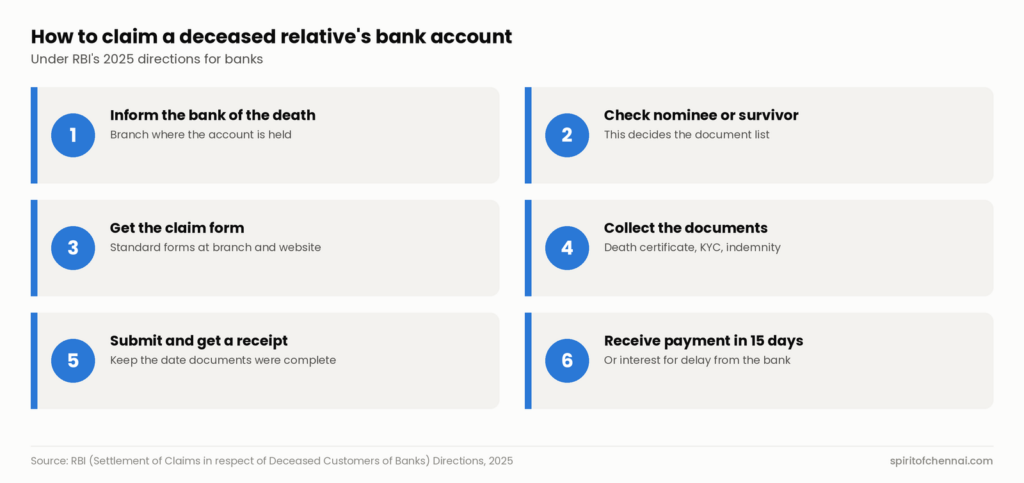
- Tell the branch about the death. Give a copy of the death certificate. The bank will stop operations that need the deceased’s mandate.
- Ask whether there is a nominee or survivor. The branch can tell you if a nomination was recorded or if the account was joint with an either-or-survivor mandate.
- Collect the standard claim forms. Banks must keep the RBI’s annexed forms at every branch and on their websites, along with a list of the documents they need.
- Prepare the documents for your case. Use the table above. Joint claimants each sign and each give ID.
- Submit and get an acknowledgement. Make sure the bank records the date it received a complete set; the 15-day clock starts from then.
- Handle any locker separately. A nominee can open the locker after an inventory is taken in the bank’s presence (Annex I-F). Without a nominee, the contents are valued by an independent valuer and released against an indemnity.
- Receive the money. The bank pays the nominee, survivor or heirs. A nominee receives it as a trustee for the legal heirs, and the bank must say so in writing.
Which route applies
| Situation | Key documents | Limit |
|---|---|---|
| Nominee or surviving joint holder | Claim form, death certificate, ID | No limit |
| No nominee, commercial bank | Form, death certificate, IDs, indemnity, heir declaration | Up to ₹15 lakh |
| No nominee, co-operative bank | Same simplified set | Up to ₹5 lakh |
| No nominee, above the limit | Succession or legal heir certificate, or sworn affidavit | Bank may seek surety |
Source: RBI Directions, 2025. Banks may set a higher simplified limit.
If a deposit claim is delayed beyond 15 days through the bank’s fault, it must pay interest of at least the Bank Rate plus 4% a year for the delay, under the RBI’s 2025 directions.
Common mistakes
It’s often said that the nominee becomes the owner of the money.
In fact the RBI directions say the nominee receives it as a trustee of the legal heirs. The bank’s payment to the nominee discharges the bank, but heirs keep their rights under succession law.
Families also lose time by assuming a succession certificate from court is always needed. For a commercial bank claim up to ₹15 lakh with no nominee, it is not.
If it goes wrong
If the branch asks for documents beyond the RBI list for a claim under the limit, or misses the 15-day deadline, write to the bank’s grievance cell and keep a copy. After 30 days without a fair reply you can complain to the RBI Ombudsman at cms.rbi.org.in, under the Integrated Ombudsman Scheme, 2026. Where heirs disagree among themselves, or the estate is large, take advice from a lawyer.
Quick answers
How long does a bank have to pay a deceased person’s deposits?
15 calendar days from receiving all required documents, under RBI’s 2025 directions.
Do I need a succession certificate?
Not if there is a nominee or survivor, and not for no-nominee claims up to ₹15 lakh at a commercial bank or ₹5 lakh at a co-operative bank.
What if the bank delays the claim?
It must pay interest of at least Bank Rate plus 4% on deposits, and ₹5,000 a day for locker or safe-custody claims.
Information checked against official sources on 19 October 2026. Fees, dates and rules can change; confirm on the linked official pages before acting.