

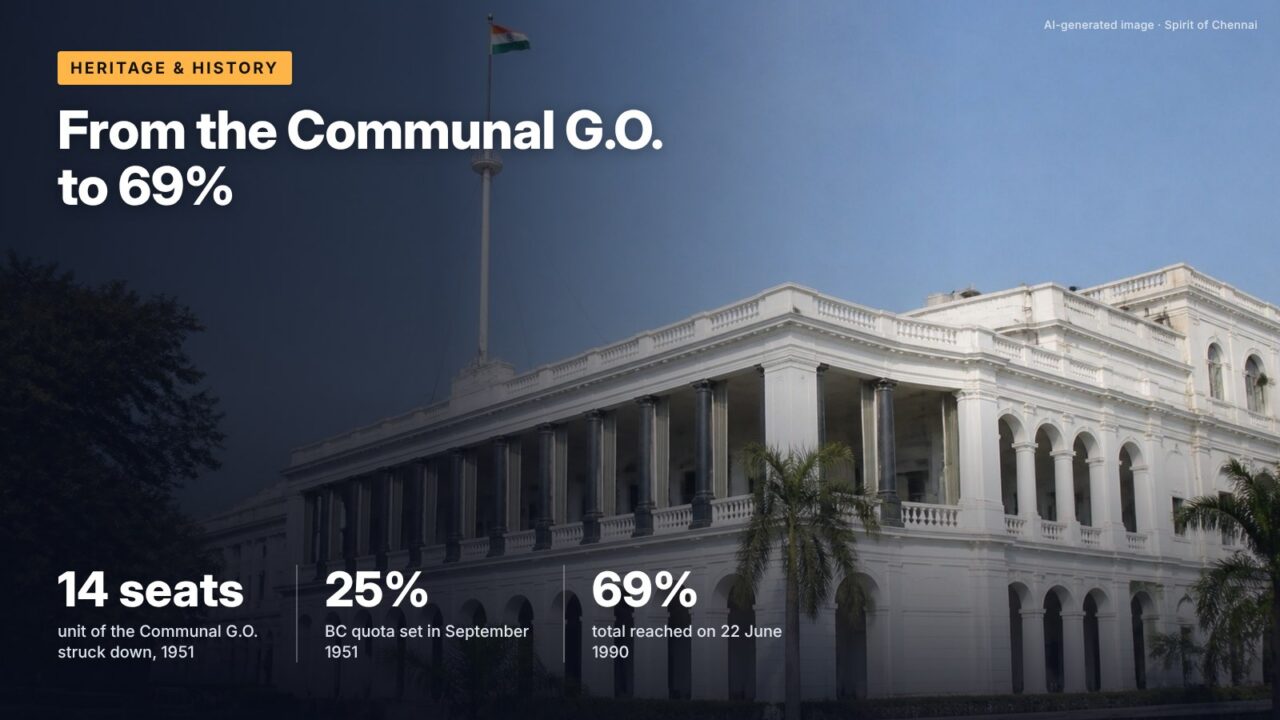
Tamil Nadu reserves 69 per cent of government jobs and college seats, well above the 50 per cent ceiling the Supreme Court set in 1992. The figure was reached one government order at a time, and the legal record shows each step.
The numbers
The most detailed official account of how the quota grew is in an unexpected place: the Supreme Court’s 2022 judgment in Pattali Makkal Katchi v. A. Mayilerumperumal, which struck down a sub-quota for one community and, along the way, set out every government order since 1947. Read with the 1951 judgment that began the story and the state’s own Backward Classes department policy note, it gives a complete legal trail.
The trail runs from a communal formula for medical and engineering seats, through a constitutional amendment, to a state law placed beyond ordinary judicial review in 1994. Each stage was a response to a court ruling or a commission report.
The order the Supreme Court struck down
The Madras Presidency had distributed posts and seats by community since the 1920s; the department’s policy note describes the introduction of reservation in 1921 as an awakening moment. The version that reached the Supreme Court governed admissions to the state’s four medical colleges (330 seats) and four engineering colleges (395 seats). In State of Madras v. Champakam Dorairajan, decided by seven judges on 9 April 1951, the court quoted the formula: of every 14 seats, 6 went to non-Brahmin Hindus, 2 to backward Hindus, 2 to Brahmins, 2 to Harijans, 1 to Anglo-Indians and Indian Christians, and 1 to Muslims.
The court held that the order classified students on grounds only of religion and caste, violating Article 29(2), and was therefore void. It added that the Directive Principles could not override fundamental rights. An earlier order, G.O. Ms. No. 3437 of 21 November 1947, had already been struck down by the Madras High Court, as the 2022 judgment notes.
The amendment and the rebuild
The response came the same year. The state’s policy note records that mass protests led by Periyar preceded the First Amendment, which inserted Article 15(4) allowing special provision for socially and educationally backward classes. The new basis was class, not community. On 27 September 1951, G.O. Ms. No. 2432 set a 20-point roster with 15 per cent for Scheduled Castes and Tribes and 25 per cent for Backward Classes.
From there the quota rose in steps. The 2022 judgment lists them: SC/ST raised to 16 per cent on 30 December 1954; a “most backward” sub-list of 58 communities created on 31 January 1957; the Sattanathan Commission appointed on 13 November 1969, recommending 33 per cent for Backward Classes in November 1970; and the Backward Classes quota raised to 31 per cent and SC/ST to 18 per cent on 7 June 1971.
| Date | Order or event | Effect |
|---|---|---|
| 27 Sep 1951 | G.O. Ms. No. 2432 | BC 25%, SC/ST 15% |
| 30 Dec 1954 | G.O. Ms. No. 2643 | SC/ST 16% |
| 7 Jun 1971 | G.O. Ms. No. 695 | BC 31%, SC/ST 18% |
| 1 Feb 1980 | Government order | BC 50% |
| 28 Mar 1989 | Government order | 20% of the 50% for MBC and DNC |
| 22 Jun 1990 | Government order | Separate 1% for ST; total 69% |
| 31 Aug 1994 | 76th Amendment | Act 45 of 1994 placed in Ninth Schedule |
Source: Supreme Court of India, Pattali Makkal Katchi v. A. Mayilerumperumal, Civil Appeal No. 2600 of 2022, 2022
It’s often said Tamil Nadu has had 69 per cent reservation since the Justice Party era.
The record shows The total in 1951 was 40 per cent (25 for Backward Classes, 15 for SC/ST). It reached 50 per cent for Backward Classes in 1980 and 69 per cent overall only on 22 June 1990, according to the Supreme Court’s 2022 account.
Classifying communities
The quota percentages mean little without the lists behind them. The Ambasankar Commission, appointed on 13 December 1982, reviewed the classification, and orders of 30 July 1985 notified 201 Backward Classes, 39 Most Backward Classes and 68 Denotified Communities. On 28 March 1989 the state carved 20 percentage points out of the 50 per cent Backward Classes quota for MBCs and Denotified Communities together. The separate 1 per cent for Scheduled Tribes followed on 22 June 1990, bringing the total to 69 per cent: 30 for BCs, 20 for MBCs and DNCs, 18 for SCs and 1 for STs.
A later change split the BC share. Tamil Nadu Act 33 of 2007, in force from 15 September 2007, gave 3.5 per cent to Backward Class Muslims within the 30 per cent, according to the 2024-25 policy note, which gives the current break-up as BC 26.5, BC Muslims 3.5, MBC/DNC 20, SC 18 and ST 1.
The 1994 shield
In 1992 the Supreme Court’s Indra Sawhney judgment set a 50 per cent ceiling on reservation, which the state’s policy note cites as the reason for what followed. Tamil Nadu codified its 69 per cent in Act 45 of 1994, and the 76th Amendment of 31 August 1994 placed that Act in the Ninth Schedule as entry 257-A. Laws in the Ninth Schedule are protected by Article 31-B from challenge on the ground that they violate fundamental rights, although later Supreme Court rulings allow review of such laws against the Constitution’s basic structure.
The 76th Amendment records the sequence. Its statement of objects and reasons notes that the Indra Sawhney judgment of 16 November 1992 capped reservations under Article 16(4) at 50 per cent, that the Madras High Court allowed the existing policy for 1993-94 but required a cut to 50 per cent for 1994-95, and that the Tamil Nadu Assembly unanimously asked the Centre to amend the Constitution. The state law received the President’s assent and was notified as Act 45 of 1994 on 19 July 1994; the amendment followed on 31 August.
Year of the caste data relied on for the 2021 Vanniyar sub-quota, which the Supreme Court found was not contemporaneous enough to justify it.
The limits of sub-classification
The 2022 case shows where the courts now draw lines. Tamil Nadu’s 2021 Act, passed on 24 February 2021 and assented to on 26 February, split the 20 per cent MBC/DNC quota into 10.5 per cent for the Vanniakula Kshatriya community, 7 per cent for one group of MBCs and DNCs, and 2.5 per cent for the rest. For a few months it was the official position: the department’s 2021-22 policy note printed the 20 per cent as 10.5, 7 and 2.5. The Madras High Court struck the Act down on 1 November 2021.
The Supreme Court, in a judgment by Justice L. Nageswara Rao, disagreed with the High Court on some points: it held that the state had legislative competence and that Article 31-B did not bar laws ancillary to the 1994 Act, and that sub-classification of backward classes is permissible. But it held that caste can be a starting point and not the sole basis, that population share alone cannot justify an internal quota, and that the Janarthanam report relied on 1985 data. The 2021 Act did not survive.
Who decides next
The Tamil Nadu Backward Classes Commission, a permanent body functioning since 15 March 1993, was reconstituted on 17 November 2022 for three years under Justice V. Bharathidasan, a former High Court judge. On 12 January 2023 it was asked to examine internal reservation within the MBC/DNC quota, with its deadline later extended to 11 July 2024, according to the policy note. Any new sub-classification will need the contemporaneous data the 2022 judgment demanded.
What this means for you
- The 69 per cent applies to state government jobs and to seats in state institutions; central institutions follow central reservation rules.
- Your community certificate places you in a specific list (BC, BC Muslim, MBC/DNC, SC or ST); the list decides which share you compete in.
- Internal quotas within a category must now be backed by current data, so changes are likely to follow a commission report rather than an order alone.
- The department’s annual policy note is the quickest official check on the current break-up.
What to watch
Pending
The Backward Classes Commission’s report on internal reservation within the MBC/DNC quota; its publication and any government decision on it.
Pending
Any fresh law on sub-classification would be tested against the 2022 Supreme Court standard of contemporaneous, quantifiable data.
Checked against official sources on 23 October 2026. Figures and rules change; confirm on the linked official pages before relying on them.
Sources
- Policy Note 2024-25, Backward Classes, Most Backward Classes and Minorities Welfare Department, Government of Tamil Nadu
- State of Madras v. Srimathi Champakam Dorairajan, AIR 1951 SC 226, Supreme Court of India
- Pattali Makkal Katchi v. A. Mayilerumperumal, Civil Appeal No. 2600 of 2022, judgment, Supreme Court of India, 2022
- Policy Note 2021-22, Backward Classes, Most Backward Classes and Minorities Welfare Department, Government of Tamil Nadu
- The Constitution (Seventy-sixth Amendment) Act, 1994, National Portal of India


