On 15 October 2026 the Supreme Court upheld the Madras High Court’s decision to strike down a March 2024 Tamil Nadu order that let converts to Islam from backward or Scheduled Caste backgrounds obtain Backward Class Muslim certificates. The headline was that converts cannot carry their quota with them. The larger part of the system, which the ruling left alone, got less attention.
The numbers
What was reported
A Bench of Justices Prashant Kumar Mishra and Shree Chandrashekhar dismissed the State’s special leave petition in a case brought by a man who converted to Islam in 2015 and was refused a certificate as a Labbai, The News Minute reported. Verdictum reported that the Court described the 2024 order as creating an “artificial route” into a notified group. On 29 October the State Cabinet decided to seek a review, DT Next reported.
What the 2024 order tried to do
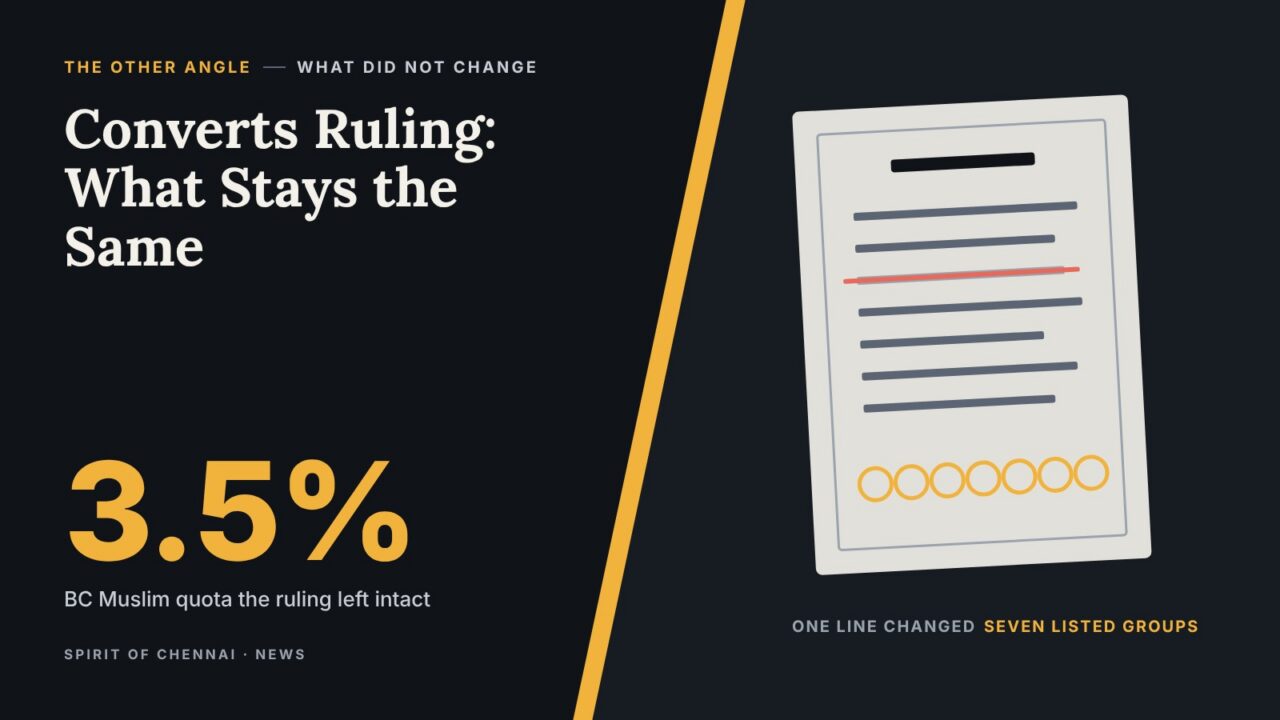
Tamil Nadu has a statutory 3.5% reservation for Backward Class Muslims in education and State jobs. Seven groups are notified for it: Ansar, Dekkani Muslims, Dudekula, Labbais (including Rowthar and Marakayar), Mapilla, Sheikh and Syed, as listed in the News Minute report.
The order of 9 March 2024 was issued on the recommendation of the Tamil Nadu Backward Classes Commission, according to Verdictum. It said a person converting to Islam from a Backward Class, Most Backward Class, Denotified Community or Scheduled Caste could be given a certificate as one of the seven groups. In practice a Jamath certificate of conversion, followed by a revenue certificate, would have moved the convert into the Muslim quota.
Why it fell: a class, not a personal right
Article 16(4) of the Constitution allows reservation for any backward class of citizens that the State finds inadequately represented. The Court’s reasoning, as reported, was that the benefit attaches to the class, not to the individual as something portable. Backwardness experienced inside the Hindu social order cannot by itself be carried into another religion’s list. A Jamath can certify that a person has embraced Islam, but cannot decide whether that person belongs to a notified backward group; that is a statutory question for the competent authority.
The Court also said a community certificate only declares a status that already exists. It cannot create one. That line matters for anyone holding a certificate issued under the 2024 order, though the reports do not say what the State will now do with such certificates.
The year the petitioner converted; his certificate was refused by the Kayathar taluk office on 13 November 2020, before the 2024 order existed, as reported by The News Minute.
The thing that did not change
Read narrowly, the ruling removes one route into the quota. It does not touch the 3.5% share, the list of seven groups, or the position of people born into those groups. A Labbai or Dekkani Muslim applicant whose family has always belonged to the group stands where they stood before 15 October.
Nor is the Scheduled Caste rule new. On 24 March 2026 another Supreme Court Bench, hearing an Andhra Pradesh case, held that only Hindus, Sikhs and Buddhists can claim Scheduled Caste status under paragraph 3 of the Constitution (Scheduled Castes) Order, 1950, and that conversion to another religion ends it, All India Radio reported. The October ruling applies similar logic to backward class status, where the 1950 Order does not apply and the question had been left to State orders.
It’s often said that the ruling ends reservation for Muslims in Tamil Nadu.
The record shows the Court dealt only with the 2024 order on converts. The 3.5% quota for the seven notified Backward Class Muslim groups was not under challenge and remains in force.
Who stands where now
| Applicant | Position after 15 October 2026 | Basis |
|---|---|---|
| Born into one of the seven notified Muslim groups | Unchanged; eligible under the 3.5% quota | Quota and list not challenged |
| Hindu BC or MBC who converts to Islam | Cannot join a notified Muslim group by conversion alone | Supreme Court, 15 Oct 2026 |
| Scheduled Caste person who converts to Islam or Christianity | Loses Scheduled Caste status | Para 3, SC Order 1950; Supreme Court, 24 Mar 2026 |
| Person who converts and later returns to Hinduism | Case-by-case decision by the competent authority | Supreme Court, 15 Oct 2026, as reported |
Source: The News Minute and Verdictum reports of the 15 October 2026 judgment; All India Radio report of the 24 March 2026 judgment.
The reconversion question
The Court did not say a person who returns to Hinduism automatically recovers their earlier caste status. As reported, it said entitlement in that case needs an independent, fact-specific decision on whether the original caste identity has genuinely revived. That leaves tahsildars and verification committees with a judgement call that has no written State procedure yet. It is the part of the ruling most likely to produce fresh litigation.
What the State can still do
A review petition, which the Cabinet approved on 29 October, asks the same Bench to reconsider; review petitions are normally considered by the judges in chambers and succeed only on a narrow set of grounds, such as an error apparent on the record. The other route runs through the Backward Classes Commission, a permanent body since 15 March 1993, which advises on whether a group should be added to a list. The ruling leaves open a study of whether converts as a group are socially and educationally backward, which is a different question from carrying an individual’s old status across.
What this means for you
- If you belong by birth to a notified Backward Class Muslim group, your certificate and quota are unaffected.
- If you converted and hold a certificate issued under the 2024 order, keep your papers and watch for a State circular; none had been reported by 4 November.
- A Jamath letter proves conversion only. It is not proof of membership in a backward group.
- Scheduled Caste status ends on conversion to Islam or Christianity under the 1950 Order; this was settled before the October ruling.
What to watch
Pending
Filing and listing of the State’s review petition, approved by the Cabinet on 29 October 2026.
Pending
Any State circular to revenue offices on certificates already issued under the March 2024 order.
Checked against official sources on 4 November 2026. Details may change; confirm on the linked official pages.
Sources
- Constitution of India (2024 edition), Article 16(4), Legislative Department, Ministry of Law and Justice
- SC status only for Hindus, Sikhs, Buddhists; conversion to other religions ends SC status: Supreme Court, All India Radio News, 24 March 2026
- Permanent Commission and previous commissions, Tamil Nadu Backward Classes Commission
- Hindu backward class person converting to other religion not entitled to reservation: SC, The News Minute, 16 October 2026
- Supreme Court upholds HC striking down order on reservation benefits for religious converts, Verdictum, 15 October 2026
- TN Cabinet approves formation of Social Justice Commission to conduct survey, DT Next, 29 October 2026