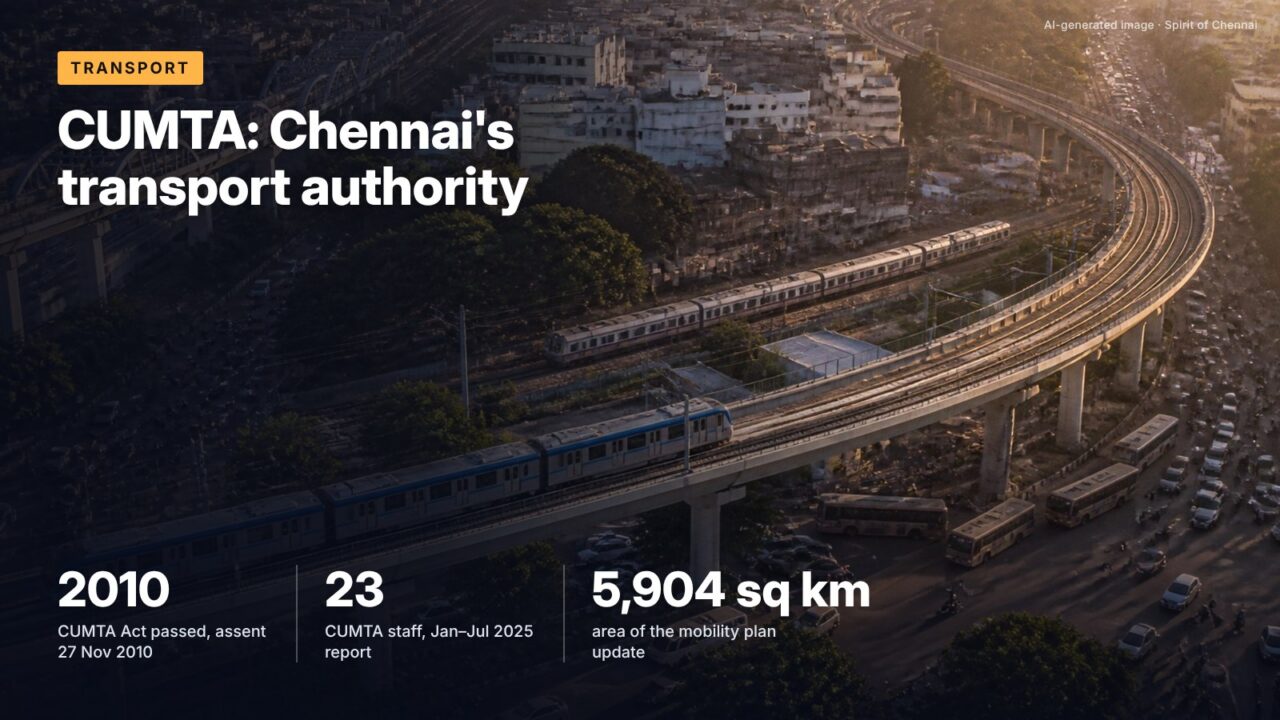
Chennai has had a law for a single transport authority since 2010. It took a 2024 rewrite, a World Bank programme and a staff of a few dozen to give it a working shape. What CUMTA can and cannot do, and where its mobility plan stands.
The numbers
The Chennai Unified Metropolitan Transport Authority is meant to do something no single agency in the city does: decide, across buses, metro, suburban rail, roads and footpaths, what gets built and in what order. The law creating it, Tamil Nadu Act 44 of 2010, received assent on 27 November 2010. Eleven years later, the World Bank’s 2021 appraisal still described it as “not yet operationalized”, with more than ten agencies running pieces of the transport system.
The change came in two steps. A 2024 amendment, introduced as L.A. Bill No. 13 of 2024, rewrote the authority’s membership, powers and funding. Alongside it, a results-based loan programme with the World Bank and AIIB tied disbursements to CUMTA hiring staff and taking control of transport budgets. Its central task, an updated Comprehensive Mobility Plan, was still unapproved at the last published review.
What the 2024 amendment changed
Under the Act as amended, the Chief Minister chairs the authority, with the minister in charge of the authority as vice-chair and the Transport Minister as co-vice-chair. Members include the Mayor of Greater Chennai Corporation, the Chief Secretary, the CMDA vice-chairperson, eight department secretaries and the General Manager of Southern Railway. The member-secretary is its chief executive.
Section 10 now lists its functions: framing urban transport policy and regulations, coordinating passenger and goods transport with land use, approving the Comprehensive Mobility Plan, five-year transport investment programmes and annual budgets, approving fares (including parking charges) recommended by its executive committee, and making recommendations to the Union government on railways, national highways, ports and airports. A new section 10A creates an executive committee chaired by the Chief Secretary, with the heads of CMRL, MTC, the Corporation, the police, Southern Railway and NHAI, which prepares the plans, runs a road safety cell and settles disputes between agencies.
Limits written into the law
Three provisions limit the authority. It must meet at least once a year (the original Act said quarterly). Under section 11 the government may exempt an agency from its decisions in the public interest. Under a new section 20(2), the government, not the authority, settles disputes between CUMTA and other bodies, after hearing them. Money flows through an Urban Transport Fund that the government may fund each year.
| Item | Figure | Source and year |
|---|---|---|
| Chennai City Partnership programme, total | US$701 million | TNIDB, 2021–2026 |
| World Bank (IBRD) share | US$150 million | TNIDB |
| AIIB co-financing | US$150 million | TNIDB |
| Tamil Nadu counterpart | US$401 million | TNIDB |
| Mobility plan update contract (Systra MVA) | ₹4,06,55,141 | TNIDB |
| CUMTA staff in post | 23 (2 more sanctioned) | AIIB report, Jan–Jul 2025 |
| Budget for urban mobility under the programme | ₹500 crore | Demand 48, BE 2024-25 |
Source: Tamil Nadu Infrastructure Development Board; AIIB Project Implementation Monitoring Report No. 7, November 2025; Finance Department, Demand No. 48, 2024-25
Money tied to results
The Chennai City Partnership is a US$701 million programme in which lenders release money only when agreed results are met. Results Area 1 aims to make CUMTA the coordinator for bus, metro, rail, road and pedestrian services, with staff and oversight of the sector budget. One of its disbursement-linked indicators is CUMTA’s operationalisation itself.
The AIIB’s November 2025 monitoring report shows how that is going. CUMTA had 23 staff, meeting the year-2 target of 20; it asked to split the year-4 target of 40 into 30 by year 3 and 40 by year 4. The end target includes CUMTA approving the sector’s overall funding allocation every year; the report gives no status for that. The indicator was rated on track. Across the whole programme, US$66.35 million had been disbursed, 44.23 per cent of the total, with civil works contracts on the mobility side stuck at 47 per cent awarded.
Share of the population that could reach only 30 per cent of jobs within a 45-minute public transport trip, per the World Bank appraisal of 2021.
The mobility plan and why it matters
A Comprehensive Mobility Plan is the document that sets mode-share targets and ranks projects for a city. Systra MVA Consulting was hired for ₹4,06,55,141 to update the plan for the full 5,904 sq km Chennai Metropolitan Area, according to TNIDB. The AIIB report says completion had slipped to August 2025 and that the plan needed revision to prioritise projects against projected financing and performance indicators. It was not approved at that point, and no approval has been published in the documents reviewed for this article.
The baseline the plan has to move is sobering. In 2018, the World Bank’s appraisal recorded, walking made up 25 per cent of trips, buses 22 per cent and cycling 3 per cent, while personal motor vehicles, mainly two-wheelers, accounted for 30 per cent. The bus and non-motorised share had been falling. The appraisal also noted that sector spending did not reflect current or target mode shares, which is precisely the problem a budget-approving authority is meant to fix.
It’s often said CUMTA now runs Chennai’s buses, metro and trains.
The record shows CUMTA plans, approves and coordinates. MTC, CMRL and Southern Railway still run services, and the government can exempt agencies from CUMTA decisions and settles disputes itself, under sections 11 and 20 of the amended Act.
First results on the bus side
The clearest change so far is in how buses are paid for. A Public Transport Service Contract between the state and MTC was issued by G.O. in October 2023, and 50 per cent of existing buses had come under its viability gap funding mechanism against a 30 per cent target, the AIIB report says. A gross cost contract for 625 low-floor electric buses was issued in March 2025, with 120 deployed by June 2025. In the state budget, the programme’s urban mobility line rose from ₹1 crore in 2023-24 to ₹500 crore in the 2024-25 estimate, according to Demand No. 48.
What this means for you
- If you want to influence which transport projects come first, the Comprehensive Mobility Plan is the document to follow; consultation and approval stages decide priorities for years.
- Fares, including parking charges, now formally pass through CUMTA’s approval under section 10 of the amended Act.
- Road safety has a home: the executive committee runs a road safety cell, so area-wide safety complaints can be raised beyond the traffic police.
- CUMTA must report annually to the government, and the report is laid before the Legislative Assembly under section 19.
What to watch
Pending
Approval and publication of the updated Comprehensive Mobility Plan for the 5,904 sq km metropolitan area.
Pending
CUMTA’s first annual approval of the sector-wide transport budget, an end target of the Chennai City Partnership.
Annually
CUMTA’s statutory report to the Legislative Assembly under section 19 of the Act.
Checked against official sources on 23 October 2026. Figures and rules change; confirm on the linked official pages before relying on them.
Sources
- Chennai Unified Metropolitan Transport Authority Act, 2010 (Act 44 of 2010), as amended, PRS Legislative Research copy
- L.A. Bill No. 13 of 2024: CUMTA (Amendment) Bill, Tamil Nadu Legislative Assembly, PRS copy
- Chennai City Partnership programme, Tamil Nadu Infrastructure Development Board
- Project Implementation Monitoring Report No. 7, Chennai City Partnership, AIIB, November 2025
- Program Appraisal Document PAD4225, Chennai City Partnership (P175221), World Bank, September 2021 (copy)
- Demand No. 48, Transport Department, Budget Estimate 2024-25, Finance Department, Government of Tamil Nadu