In mid-October 2026 the Madras High Court told the Directorate of Vigilance and Anti-Corruption (DVAC) to hand a retired police chief the records of a corruption inquiry against him. The coverage framed it as a win for one officer. The bigger story is the list of Tamil Nadu agencies taken outside the Right to Information Act, how it has grown since 2005, and the single proviso that limits every name on it.
The numbers
What was reported
Justice Hemant Chandanagoudar dismissed a writ petition filed by DVAC’s Public Information Officer and upheld a State Information Commission order of 30 May 2024 directing disclosure to retired DGP S.R. Jangid, with names of other officers masked, DT Next reported on 14 October. Bar and Bench summarised the holding: DVAC cannot claim a blanket exemption where the information concerns allegations of corruption.
How an agency leaves the RTI Act
Section 24(4) of the Right to Information Act, 2005 lets a State government, by notification in the Gazette, declare that the Act does not apply to an intelligence or security organisation it has set up. There is no hearing and no prior approval. Section 24(5) only requires that each notification be laid before the State Legislature.
Two provisos travel with every such notification. Information about allegations of corruption and human rights violations is not excluded. And where the request concerns human rights violations, the information can be given only after the State Information Commission approves, but must then be supplied within 45 days of the request, overriding the usual 30-day timetable in Section 7.
The gap between the State Information Commission’s disclosure order of 30 May 2024 and the High Court ruling reported in October 2026, according to DT Next.
The list since 2005
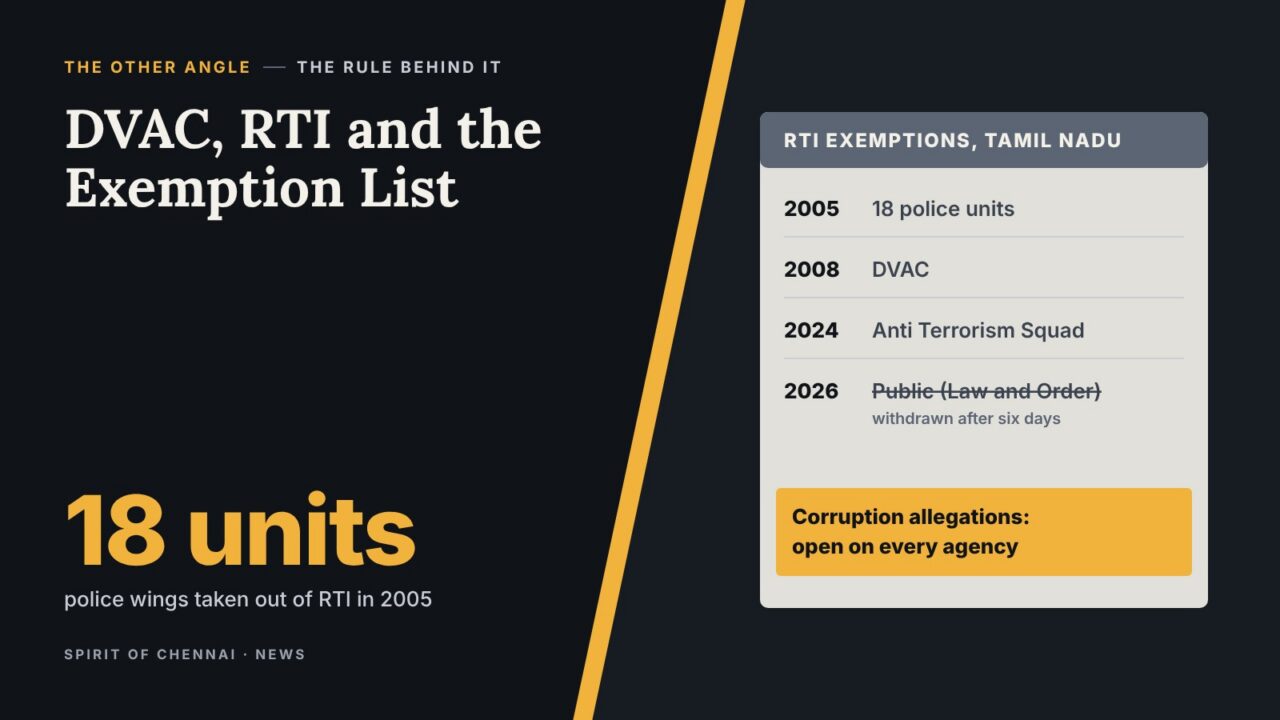
Tamil Nadu used the power within months of the Act coming into force. G.O.Ms.No.1043 of 14 October 2005 named 18 police units, from the Crime Branch CID and Economic Offences Wing to the Idol Wing, Cyber Crime Cell, Finger Prints Bureau and Police Radio Branch. DVAC followed through a Government Order of 26 August 2008, as recounted in the High Court case. The Anti Terrorism Squad was added on 23 February 2024.
| Date | Order | What it did |
|---|---|---|
| 14.10.2005 | G.O.Ms.No.1043, Public Dept | 18 police units notified, including CB-CID, EOW, Idol Wing, Cyber Crime Cell |
| 26.08.2008 | G.O. (number not given in reports) | DVAC notified |
| 23.02.2024 | G.O.Ms.No.30, HRM (AR-III) Dept | Anti Terrorism Squad notified |
| 21.09.2026 | G.O.Ms.No.57, HRM (R) Dept | Public (Law and Order) Department notified |
| 27.09.2026 | Fresh order (number not reported) | G.O.Ms.No.57 revoked |
Source: Government of Tamil Nadu G.O.Ms.No.1043 (2005); Tamil Nadu Government Gazette Extraordinary No. 59 (2024); DT Next reports of 14 and 27 September 2026 for the 2008 and 2026 rows.
The 2026 entry is the unusual one. On 21 September the government notified the Public (Law and Order) Department, a Secretariat department, describing it as an intelligence and security organisation. A fresh order on Sunday 27 September withdrew it after criticism, including from CPI(M) MP S. Venkatesan, DT Next reported. The report did not give an official reason for the withdrawal.
What the High Court added
DVAC argued that disclosure would endanger witnesses and sources, that third-party material was involved, that masking names across voluminous files was impractical, and that inquiry details were confidential under Rule 29 of its own manual. According to DT Next’s account, the court held that an internal manual is an administrative instruction and cannot create an exemption the Act does not contain, and that administrative difficulty is not a ground to refuse.
That point reaches beyond DVAC. Police units on the 2005 list also work under standing orders and internal manuals. If those orders cannot add secrecy beyond the RTI Act, the only lawful grounds for refusing corruption-related information are the Act’s own exemptions in Section 8, applied record by record.
It’s often said that DVAC and the police wings on the list are completely outside the RTI Act.
The record shows the Act itself keeps corruption allegations within reach for every notified body. The exemption covers other information, and even human rights information must be supplied within 45 days once the Commission approves.
What can still be withheld
The ruling is not an open door. Section 8(1)(g) still lets an officer withhold information that would endanger a person’s life or physical safety, or identify a confidential source given for law enforcement. The court told DVAC to mask the names and particulars of other officers, and to follow the Section 11 third-party procedure where it applies, without holding back the rest. The applicant here was the subject of the inquiry, which ended in his favour; a stranger seeking the same file might face a stronger privacy objection under Section 8(1)(j).
Why the 2026 episode matters
Section 24(4) is drafted for agencies that gather intelligence or protect security. The September order applied it to a Secretariat department rather than a field intelligence unit, which is why it drew objections. Its quick withdrawal left the 2005 to 2024 list as it was. The High Court’s reasoning on manuals and blanket refusals now sits alongside that list, and any future notification would carry the same corruption proviso.
What this means for you
- If you seek DVAC or police-wing records about corruption allegations, cite the first proviso to Section 24(4) in your application.
- For information on human rights violations by a notified body, the request goes to the State Information Commission for approval, with a 45-day outer limit.
- A refusal citing only an internal manual or confidentiality rule can be challenged in first appeal and then before the Commission.
- Expect names of third parties to be masked; ask for the rest of the record rather than accepting a refusal of the whole file.
What to watch
Pending
Whether the State appeals the single judge’s order to a Division Bench; no appeal had been reported by 4 November 2026.
Next Assembly session
Section 24(5) requires every 24(4) notification, including the September 2026 order and its withdrawal, to be laid before the Legislature.
Checked against official sources on 4 November 2026. Details may change; confirm on the linked official pages.
Sources
- The Right to Information Act, 2005 (text), Tamil Nadu State Information Commission
- G.O.Ms.No.1043, Public (Estt.I & Leg.) Department, 14 October 2005: organisations notified under Section 24(4), Government of Tamil Nadu
- G.O.Ms.No.30, Human Resources Management (AR-III) Department, 23 February 2024: Anti Terrorism Squad notified under Section 24(4), Tamil Nadu Government Gazette Extraordinary No. 59
- Follow Info Commission’s order, share inquiry records with ex-DGP Jangid: Madras High Court to DVAC, DT Next, 14 October 2026
- DVAC cannot claim blanket exemption from RTI Act in corruption cases: Madras High Court, Bar and Bench, 12 October 2026
- TN govt revokes RTI exemption for Public (Law and Order) department, DT Next, 27 September 2026