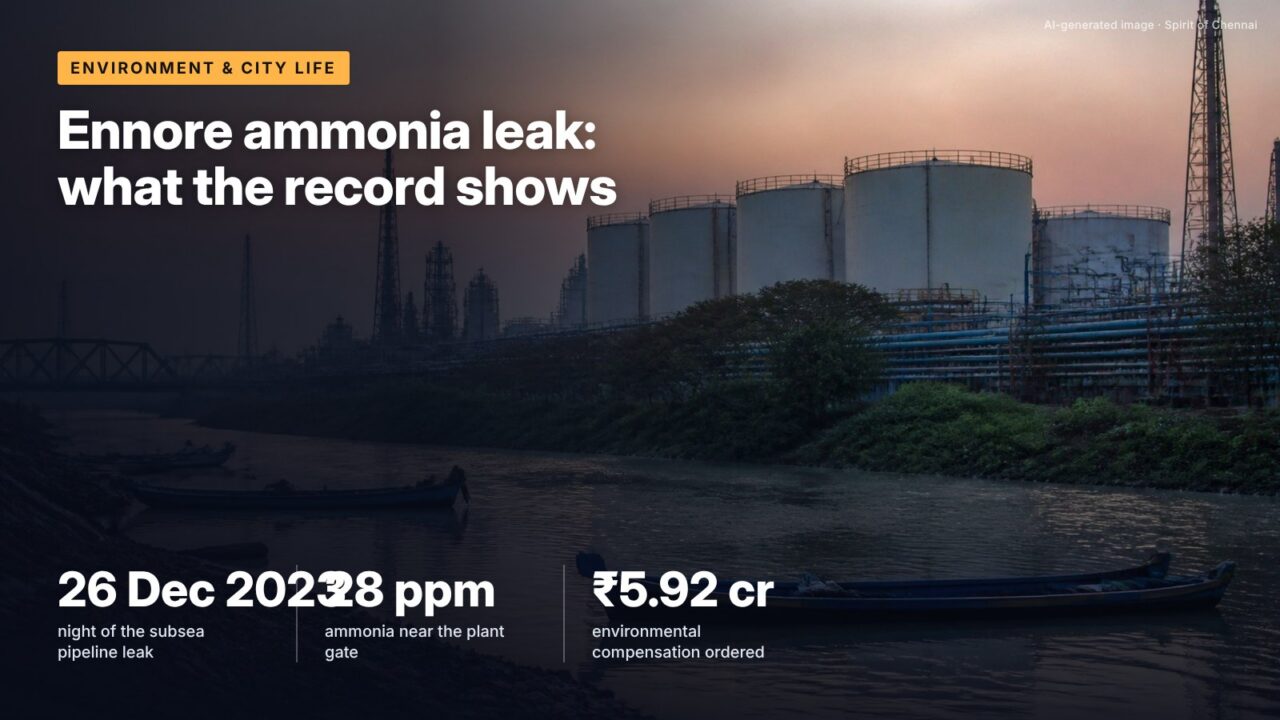
On the night of 26 December 2023, ammonia escaped from a fertiliser company’s undersea pipeline off Ennore. The official record now spans a state technical committee, a ₹5.92 crore compensation order, 18 safety conditions and a tribunal case. It shows what happened and what was required afterwards.
The numbers
The ammonia came from Coromandel International’s subsea pipeline, which carries liquid ammonia from ships to its plant at Ennore. The state government’s technical committee found the leak was in the pipeline near the shore and that heavy granite boulders shifted during Cyclone Michaung, three weeks earlier, may have damaged it, according to a government press release of 4 February 2024. The government accepted all 18 of the committee’s recommendations and directed the Tamil Nadu Pollution Control Board (TNPCB) to recover ₹5.92 crore as environmental compensation.
The company disclosed to stock exchanges on 13 March 2024 that it had received a TNPCB direction under Section 5 of the Environment (Protection) Act for ₹5,92,50,888 and would pay it under protest. The National Green Tribunal’s Southern Zone bench took up the incident on its own motion as Original Application 195 of 2023.
What happened that night
Reports filed with the tribunal set out the timeline. The Tamil Nadu Maritime Board’s report of 5 January 2024 says pre-cooling of the pipeline began around 8 pm on 26 December. The TNPCB account it encloses records that the unit noticed a pressure drop at about 11:45 pm, and that its telephone message reached the Board at 12:45 am on 27 December. Gas bubbles were seen about two feet from the shore.
| Reading | Location and time | Reference value |
|---|---|---|
| 28 ppm | Near the material gate, during the incident (hand-held monitor) | |
| 3 ppm | Near the material gate, about 3:30 am | 0.57 ppm, 24-hour standard cited |
| 3 ppm | Near the leak area, 3:51 am | |
| 0 ppm | Several villages, 4:02 to 4:24 am | |
| 49 mg/L | Sea water at the leak point | 5 mg/L marine discharge standard |
Source: TNPCB readings enclosed in the Tamil Nadu Maritime Board report in NGT O.A. 195 of 2023 (SZ), 5 January 2024
Reading these numbers needs care. The 0.57 ppm figure is a 24-hour average standard, and the 28 ppm and 3 ppm readings were short spot measurements, so they cannot be compared directly. They do show that concentrations near the plant were many times the long-term limit for a period, and that sea water at the leak point held nearly ten times the discharge standard.
The pipeline was depressurised through the flare in about 20 minutes, the ammonia plant was stopped and sulphuric acid production cut back. The TNPCB issued directions under Section 33A of the Water Act and Section 31A of the Air Act on 27 December. The documents record people receiving first aid for eye irritation and breathing difficulty, and buses and ambulances arranged for residents; the Maritime Board report does not record hospital admissions.
Capacity of the ammonia storage tank at the plant, with 3,000 to 8,000 tonnes typically shipped in each month, the Maritime Board report states. The amount released was not stated.
The technical committee
The committee was chaired by the TNPCB’s Member Secretary and included representatives of the Central Pollution Control Board, IIT Madras, CSIR’s leather and environmental engineering institutes and the Directorate of Industrial Safety and Health. Its recommendations, in short:
- replace the offshore pipeline with a new one with advanced monitoring, automatic control and accident prevention;
- carry out a nitrogen pressure test before every pre-cooling and transfer;
- install ammonia sensors around the plant, at the highway crossing and in nearby villages, plus loud sirens;
- monitor ambient ammonia hourly within 2 km and sea water daily during unloading, reporting to the safety directorate and TNPCB;
- publish safety audits on the company website and complete a full hazard audit before restarting.
The committee also asked the TNPCB to take legal action for breaches of the consent order issued under the Air Act.
It’s often said the company was simply fined and allowed to carry on.
The record shows The government’s order required a safety audit by a credible agency before the ammonia plant restarted, a new pipeline with automatic controls, and village-level ammonia monitoring, in addition to the ₹5.92 crore compensation, according to the February 2024 press release.
The tribunal case
In O.A. 195 of 2023, the tribunal called for reports from several departments. The index pages on its website list a report by the Directorate of Industrial Safety and Health filed on 5 January 2024 and one by the Animal Husbandry, Dairying and Fisheries department dated 30 January 2024, reflecting the concern for fishing communities. The Maritime Board told the tribunal the company had not applied to it to resume transfers and asked to be removed from the case. The TNPCB’s conditions for restarting the pipeline included approval from the Indian Register of Shipping and the Maritime Board, repair of the damage and a no-objection certificate from the safety directorate.
The legal tools used
Three laws did the work. Within hours, the TNPCB used Section 33A of the Water Act and Section 31A of the Air Act, which let a pollution control board issue binding directions to any unit, up to closure or stopping its power and water. The compensation order came later under Section 5 of the Environment (Protection) Act, a similar direction-making power held by government and delegated to the Board. Separately, the committee recommended prosecution for breaching the plant’s Air Act consent order, the permission that sets conditions on what a unit may emit.
The tribunal’s role is different. Acting on its own motion, it can call for reports, set compensation and direct agencies, and its orders can be appealed to the Supreme Court.
Why it matters beyond one plant
Ennore is home to a cluster of hazardous industries, a port and power plants. The incident tested the off-site emergency plan that hazardous units and district authorities are required to keep, and the committee’s call for sirens, mock drills and village briefings suggests those arrangements were not adequate that night. The company told exchanges the Ennore unit accounts for about 10% of its monthly production, so its restart was a commercial as well as a safety question.
What this means for you
- If you live within a few kilometres of the plant, ask for the off-site emergency plan and the timing of mock drills, which the committee asked the company to conduct with the district.
- Ammonia’s sharp smell is a warning; move away from the coast and upwind, cover your face with a damp cloth and follow official instructions.
- The company was asked to publish safety audit reports on its website; check that they appear.
- Compensation was paid under protest, so the amount may still be argued before the tribunal or a court.
What to watch
Pending
Further hearings and any final order in NGT O.A. 195 of 2023 (SZ), which will settle the compensation dispute and compliance.
Pending
Installation of the replacement pipeline and village ammonia sensors recommended by the technical committee.
Checked against official sources on 23 October 2026. Figures and rules change; confirm on the linked official pages before relying on them.
Sources
- Press Release No. 225: Government accepts Technical Committee report on Ennore ammonia leak, DIPR Tamil Nadu, 4 February 2024
- Tamil Nadu Maritime Board report with TNPCB enclosures, NGT O.A. 195 of 2023 (SZ), 5 January 2024
- Directorate of Industrial Safety and Health report, NGT O.A. 195 of 2023 (SZ), January 2024
- Fisheries Department report, NGT O.A. 195 of 2023 (SZ), 30 January 2024
- Coromandel International disclosure on TNPCB environmental compensation, BSE filing, 13 March 2024