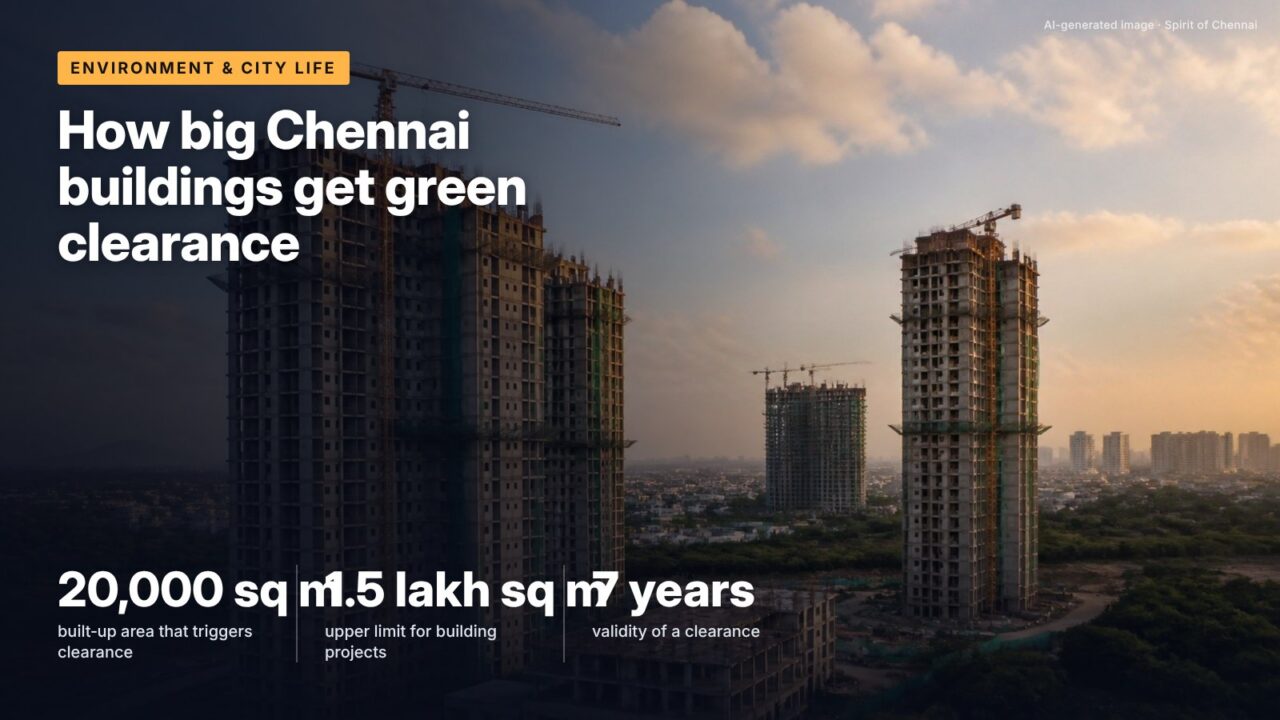
Any building in Chennai with more than 20,000 square metres of built-up area needs environmental clearance from the State Environment Impact Assessment Authority before work starts. Two recent clearance letters show what the process asks of a developer, and what it leaves to other agencies.
The numbers
Under the Environment Impact Assessment Notification of 2006, a building and construction project with more than 20,000 and less than 1,50,000 square metres of built-up area falls under item 8(a) and needs prior environmental clearance. Townships and area development projects of 50 hectares or more, or above 1,50,000 square metres, fall under item 8(b). Both are Category B projects, appraised by a state expert committee and approved by the State Environment Impact Assessment Authority (SEIAA), as the Union environment ministry’s regional office set out in a tribunal affidavit in 2022.
In Tamil Nadu, the authority works with two State Expert Appraisal Committees (SEAC-1 and SEAC-2), each with seven expert members and chaired by a retired IAS officer, according to the SEIAA-TN website. Applications, agendas, minutes and clearance letters now run through the Union government’s PARIVESH portal.
The thresholds
| Item (EIA Notification 2006) | What it covers | Who appraises |
|---|---|---|
| 8(a) Building and construction | Built-up area above 20,000 and below 1,50,000 sq m | SEAC, then SEIAA (Category B) |
| 8(b) Townships and area development | 50 ha or more, and/or built-up area above 1,50,000 sq m | SEAC, then SEIAA (appraised as B1) |
Source: MoEF&CC Regional Office affidavit in NGT O.A. 84 of 2021 (SZ), February 2022, quoting the EIA Notification 2006 schedule
Built-up area includes basements and covered parking, not just saleable floor space, so a project with a modest plot can cross the line. A 21-floor residential tower on 1.56 hectares in Athipattu, Ambattur taluk, for example, had a built-up area of 92,701 square metres.
What a Chennai clearance actually requires
That Athipattu project, 588 flats in two towers with a project cost of ₹178.18 crore, received its clearance letter on 2 April 2024 after the appraisal committee met on 18 March. The letter is a useful template for what the authority looks at.
| Item | Athipattu residential towers (Chennai district) |
|---|---|
| Built-up area / plot | 92,701 sq m on 15,552 sq m |
| Expected population | 3,543 |
| Water requirement | 460 KLD, fresh water from CMWSSB |
| Sewage / STP | 408 KLD generated; 430 KLD on-site plant |
| Treated water reused | 148 KLD flushing, plus gardening and open space |
| Rainwater harvesting | 70 KL sump and 24 recharge pits |
| Green cover | 2,335 sq m, 500 trees |
| Corporate environment responsibility | ₹180 lakh |
| Flood condition | WRD inundation certificate before consent to establish |
Source: SEIAA-TN environmental clearance, file 10569, 2 April 2024 (PARIVESH)
The pattern is clear: the clearance sizes the water demand, forces sewage to be treated and partly reused on site, and fixes rainwater harvesting and green cover. The ₹180 lakh corporate environment responsibility figure is about 1% of the project cost (₹1.8 crore divided by ₹178.18 crore). The flood condition is telling: the developer must get an inundation certificate from the Water Resources Department before seeking consent to establish from the Pollution Control Board.
Corporate environment responsibility spend as a share of project cost in the Athipattu clearance: ₹1.8 crore on ₹178.18 crore.
The same rules on an industrial shed
A second clearance of 1 October 2024 shows the rules apply to industrial buildings too. Two industrial blocks of 23,177 square metres in Athur village, Ponneri taluk, Tiruvallur district, were appraised at the committee’s 495th meeting on 6 September and approved at the authority’s 758th meeting on 25 September. Conditions included a 30 KLD sewage plant, a 600 cubic metre rainwater pond, 15% green cover, solar panels on half the roof and ₹32 lakh in school spending. Both clearances are valid for seven years.
How the process runs
A developer applies on PARIVESH with project details, water and waste estimates and plans. The expert committee appraises the proposal, can ask for clarifications or a site visit, and recommends approval, rejection or further study. The authority then decides at its own meeting and issues the clearance letter. Timelines in the two 2024 cases were short once appraisal was done: the Athur project moved from the committee on 6 September to a letter on 1 October, and the Athipattu towers from appraisal on 18 March to a letter on 2 April.
Both letters label the projects B2. Under the 2006 notification, B2 projects do not need a full environmental impact assessment report or a public hearing, which is why most Chennai building clearances turn on conditions rather than detailed studies. Township projects under 8(b) are appraised as B1, a heavier track.
What the authority does not decide
Environmental clearance is one permission among several. Building plan approval comes from CMDA or the local body, consent to establish and operate from the Pollution Control Board, and flood clearance from the Water Resources Department. The authority does not check whether a site is a wetland or a water body on its own: it relies on documents from those agencies. Minutes of the authority’s 341st meeting on 21 March 2019 show it deferring a Chennai housing project pending clarification from the District Collector, and citing a PWD inundation note that set a minimum floor level of +6.600 metres with stilt parking for a slum tenement project at Kargil Nagar, Thiruvottiyur.
It’s often said environmental clearance means a site has been checked as flood-safe.
The record shows The clearance letters reviewed make flood safety a condition to be met through a separate Water Resources Department inundation certificate before consent to establish. SEIAA relies on that certificate rather than assessing flooding itself.
What this means for you
- If a large project is coming up near you, its clearance letter and conditions are public on PARIVESH; search by project name or proponent.
- Check the stated water source: if a project says CMWSSB will supply it, the letter will say so, and that affects local supply.
- Conditions such as on-site sewage treatment, recharge pits and green cover are enforceable; complaints about violations go to TNPCB and SEIAA.
- Flat buyers can ask the builder for the clearance letter; projects that needed one and lack it face legal risk.
What to watch
Pending
SEIAA-TN meeting agendas and minutes are posted on PARIVESH as meetings are held; residents can track projects in their area there.
Pending
Compliance reports, which clearance holders must file periodically, for projects cleared in 2024.
Checked against official sources on 23 October 2026. Figures and rules change; confirm on the linked official pages before relying on them.
Sources
- MoEF&CC Regional Office affidavit on EIA Notification 2006 items 8(a) and 8(b), NGT O.A. 84 of 2021 (SZ), 2022
- Environmental clearance for residential complex, Athipattu, Chennai district, SEIAA-TN, 2 April 2024 (PARIVESH)
- Environmental clearance for industrial buildings, Athur, Tiruvallur district, SEIAA-TN, 1 October 2024 (PARIVESH)
- Minutes of the 341st meeting of SEIAA-TN, 21 March 2019
- State Environment Impact Assessment Authority, Tamil Nadu, official website, 2026