

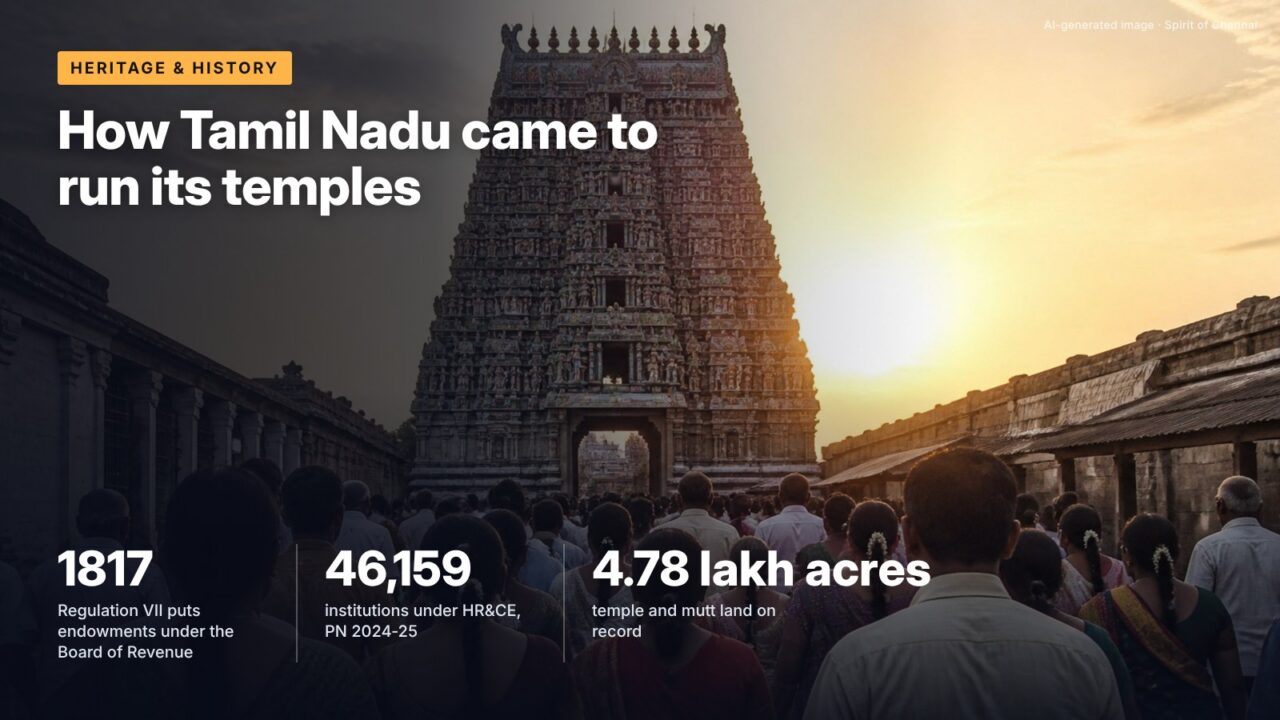
The Hindu Religious and Charitable Endowments (HR&CE) Department did not appear from nowhere in 1959. It is the end point of five laws over 140 years, shaped by a 1954 Supreme Court ruling that still defines how far the state can go inside a temple.
The numbers
State supervision of temple endowments in the Madras region began with Regulation VII of 1817, which gave the Board of Revenue general superintendence. The department’s policy note for 2024-25 sets out the chain that followed: Act XX of 1863, which handed oversight to local committees whose members sat for life; the Madras Hindu Religious Endowments Act of 1926 (Act II of 1927), which created a statutory Board and executive officers for temples; the 1951 Act, which abolished the Board and created a government department under a Commissioner; and the Tamil Nadu HR&CE Act of 1959 (Act 22 of 1959), which governs today.
The numbers have grown with each policy note, partly because of how they are counted. The 2024-25 note lists 46,159 religious institutions, including 43,631 temples, 45 mutts and 22 Jain temples; the 2021-22 note listed 38,667. Much of the gap is the inclusion of 6,453 sub-temples in the newer total, not a sudden expansion of control.
Five laws in 140 years
Each law answered a problem the previous one created. The 1817 regulation made revenue officials responsible for temple endowments. The 1863 Act withdrew the government from direct management and left temples to local committees, whose members were appointed for life. The 1926 Act reversed course by creating a statutory Board that could appoint executive officers to run individual temples, putting a layer of professional management between the trustees and the shrine.
The 1951 Act, Act XIX of that year, turned the Board into a department headed by a Commissioner. The 2021-22 policy note says it placed administration under a hierarchy of officers. That shift, from an arm’s-length board to government officers, is what was tested in court.
The Shirur Mutt test
In The Commissioner, Hindu Religious Endowments, Madras v. Sri Lakshmindra Thirtha Swamiar of Sri Shirur Mutt, decided on 16 March 1954 with the judgment written by Justice B.K. Mukherjea, the Supreme Court examined sections 21, 30(2), 31, 55, 56, 63 to 69 and 76 of the 1951 Act against the rights to property, religious freedom and freedom from religious taxes in Articles 19(1)(f), 25, 26 and 27. One central question was whether the annual payment demanded from institutions was a tax or a fee. The department’s policy note summarises the result: the Act’s validity was upheld but certain sections were struck down.
The ruling’s lasting contribution was its reading of religion. In Sri Venkataramana Devaru v. State of Mysore (8 November 1957), the court relied on Shirur Mutt for the point that matters of religion cover practice as well as belief, so rituals and the employment of priests can fall within protected religious affairs. That reading has defined the boundary between secular administration, which the state may regulate, and religious practice, which it may not, in every later temple case.
What the 1959 Act charges
The 1959 Act funds the department through levies on institutional income under Section 92. The rates have stayed the same across the policy notes for 2018-19, 2021-22 and 2024-25.
| Annual income of institution | Contribution, s.92(1) | Audit fee, s.92(2) |
|---|---|---|
| Up to ₹5,000 | Nil | Nil |
| ₹5,000 to ₹20,000 | 4% | 1.5% |
| ₹20,000 to ₹60,000 | 5% | 1.5% |
| ₹60,000 to ₹2 lakh | 6% | 1.5% |
| ₹2 lakh to ₹5 lakh | 7% | 1.5% |
| ₹5 lakh and above | 12% | 4% |
Source: HR&CE Department, Policy Notes 2021-22 and 2024-25, Government of Tamil Nadu
The structure is progressive: a village temple with a few thousand rupees a year pays nothing, while a large shrine pays 16 per cent of its income in contribution and audit fee combined. The distinction the Supreme Court drew in 1954 between a tax and a fee is why these levies are tied to the services of supervision and audit rather than framed as a general charge.
Who is under the department
The Act sorts institutions by annual income. Sections 46(i) to 46(iii) cover “listed” institutions, which get closer supervision, while those under Section 49(1) earn less than ₹10,000 a year.
| Income class | 2018-19 | 2021-22 | 2024-25 |
|---|---|---|---|
| Below ₹10,000, s.49(1) | 34,093 | 34,111 | 34,660 |
| ₹10,000 to ₹2 lakh, s.46(i) | 3,550 | 3,528 | 3,795 |
| ₹2 lakh to ₹10 lakh, s.46(ii) | 672 | 492 | 620 |
| ₹10 lakh and above, s.46(iii) | 331 | 536 | 586 |
Source: HR&CE Department Policy Notes 2018-19, 2021-22 and 2024-25
Share of institutions earning under ₹10,000 a year in 2021-22 (34,111 of 38,667), according to the HR&CE policy note. Most temples the state oversees are small.
The number of institutions earning ₹10 lakh or more rose from 331 to 586 between the 2018-19 and 2024-25 notes. The notes do not explain the rise; reclassification after income reviews is one possible reason, and the department has not published a reconciliation.
It’s often said the state “took over” temples only after Independence.
The record shows Government superintendence dates to Regulation VII of 1817, and a statutory Board with power to post executive officers existed from the 1926 Act, as the 2018-19 policy note records. The 1951 and 1959 Acts changed the form of control, from a Board to a department, rather than starting it.
Land, rent and the reconciliation problem
All three notes give the same land figure: 4.78 lakh acres, of which 4.22 lakh acres belong to temples and 0.56 lakh acres to mutts. The 2024-25 note flags it as subject to ongoing reconciliation, and reports that 1,63,612 acres in 650 villages were measured by DGPS survey between September 2021 and March 2024. It also records 4,840.92 acres of 542 temples retrieved under one scheme and 4,043.38 acres restored after correcting revenue records.
Rent is where the change shows. The 2018-19 note put income from immovable assets at ₹120.48 crore for 2017-18. The 2024-25 note reports ₹310.32 crore collected in the nine months from July 2023 to March 2024. The periods are not identical, so the comparison is indicative rather than exact.
Priests, schools and money for old temples
The 2024-25 note records the appointment of 56 archakas (temple priests) on 14 August 2021, 24 of them from communities outside the traditional priestly groups and trained in the department’s six archaka schools at Madurai, Palani, Tiruchendur, Tiruvannamalai, Srirangam and Triplicane. A seventh has been sanctioned at Sriperumbudur. The note also lists a government fund of ₹100 crore a year for temples more than 1,000 years old and an annual Thiruppani grant of ₹6 crore.
What this means for you
- If you lease temple land or a temple building, your landlord in law is the institution under HR&CE supervision, and rent revisions follow department rules.
- A temple’s income class decides how closely it is supervised; ask the local HR&CE office which section your temple falls under.
- Disputes over religious practice and over administration are treated differently in court, following the Shirur Mutt reading of religion.
- The policy notes are tabled each year with the department’s demand for grants; they are the best single source for current figures.
What to watch
Pending
The department says its land figure of 4.78 lakh acres is still being reconciled through DGPS surveys; a revised total would be the first change in years.
Pending
A seventh archaka training school has been sanctioned at Sriperumbudur; its opening has not yet been reported in a policy note.
Checked against official sources on 23 October 2026. Figures and rules change; confirm on the linked official pages before relying on them.
Sources
- Policy Note 2024-25, Hindu Religious and Charitable Endowments Department, Government of Tamil Nadu
- Policy Note 2021-22, HR&CE Department, Government of Tamil Nadu
- Policy Note 2018-19, HR&CE Department, Government of Tamil Nadu
- The Commissioner, Hindu Religious Endowments, Madras v. Sri Lakshmindra Thirtha Swamiar of Sri Shirur Mutt, [1954] 1 SCR 1005, Supreme Court of India
- Sri Venkataramana Devaru v. State of Mysore, AIR 1958 SC 255, Supreme Court of India


