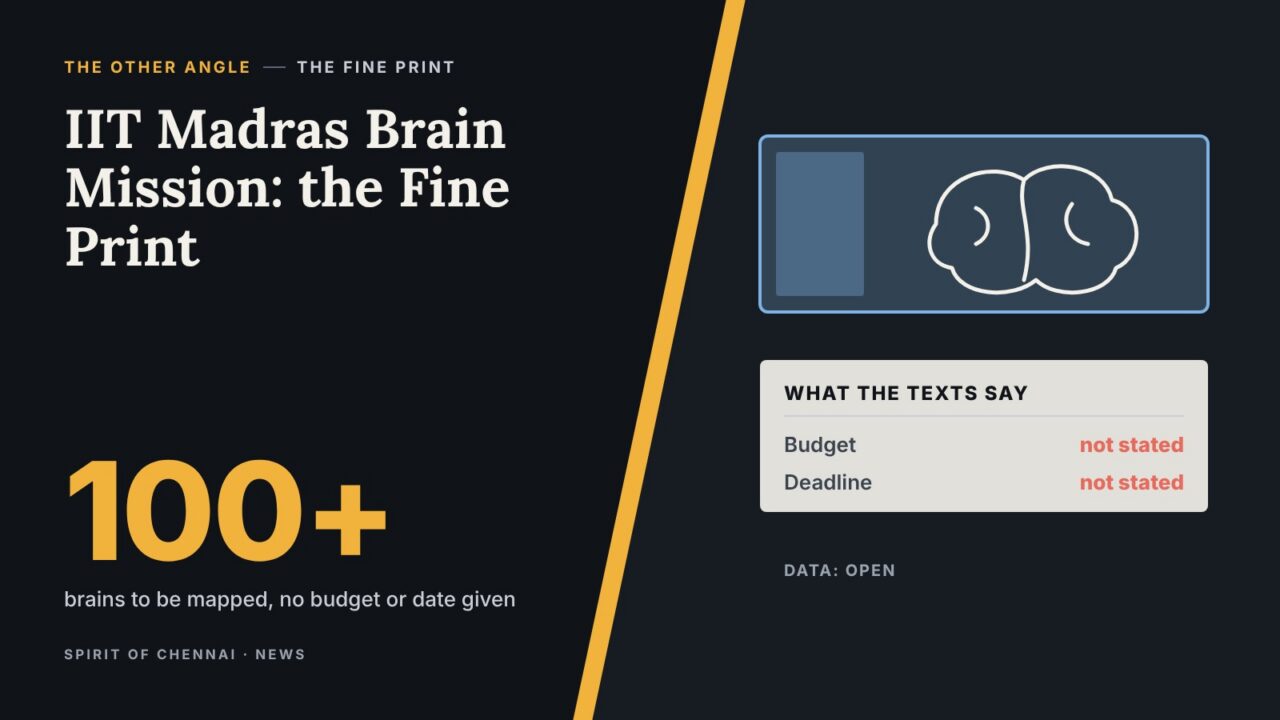
On 11 October 2026 the Prime Minister dedicated IIT Madras’s Sudha Gopalakrishnan Brain Centre and launched a mission to map more than 100 human brains in 3D at cell resolution. The headlines called it a global first. Read the official texts closely and they commit to less than the coverage implied: no budget, no completion date, private donors rather than a sanctioned scheme, and computing borrowed from a supercomputer in Kharagpur.
The numbers
What was reported
The Prime Minister, accompanied by Chief Minister C. Joseph Vijay, dedicated the centre to the nation and released C-STROKE, a human ischaemic stroke atlas, as part of a Chennai programme of projects worth over ₹13,000 crore, DT Next reported. The Prime Minister’s Office preview on 10 October described the mapping work as a “global scientific mission” covering the human lifespan from the foetal stage to old age. Coverage focused on the scale and the visit. This piece reads the two official documents for what they actually promise.
What the official texts commit to
The IIT Madras press release of 12 October sets out the scope. The centre will map more than 100 human brains into 3D atlases at cellular resolution, covering the lifespan from foetus to old age, including brain-related diseases. Its imaging platform processes whole post-mortem brains into digital 3D maps. The work involves more than 200 researchers, engineers and technicians at the centre, more than 10 medical institutions in India, and more than 30 researchers from over 10 countries. The release calls the planned set the largest collection of whole-brain 3D maps at cell resolution.
C-STROKE, released on the day, is described as the first human ischaemic stroke atlas. It links millimetre-scale MRI scans taken before death with micron-resolution tissue sections of the whole brain, and contains over 1,000 annotated sections from a single stroke-affected brain. It marks features such as neuronal health, inflammation, damage to the blood-brain barrier, oxygen starvation and injury to nerve fibres.
What the texts leave out
Neither the press release nor the PMO preview gives a budget, a funding source for the 100-brain mission as a whole, or a date by which the maps will be complete. There is no list of the partner medical institutions, and no figure for how many brains have already been collected. This matters because “launch” in a press release can mean anything from a funded programme with milestones to a statement of intent.
It’s often said that IIT Madras has mapped 100 human brains.
The record shows that 100+ is the target of a mission launched on 11 October 2026. What was released that day was C-STROKE, built from one stroke-affected brain. The official texts give no timeline for the rest.
Who pays, on paper
The release names private philanthropy, not a government scheme. C-STROKE research is supported by Prem Watsa, chairman of Fairfax Financial and an IIT Madras distinguished alumnus. Infosys co-founder Kris Gopalakrishnan, also a distinguished alumnus, is described as having played a key role in setting up the centre and as a major donor; the centre carries the name of Sudha Gopalakrishnan. No amounts are given.
The one public input the release does name is computing. The 3D maps for C-STROKE were generated on PARAM Shakti, supported by the Union Ministry of Electronics and IT. So the funding picture visible from official texts is donor money for the centre and the stroke atlas, plus shared national computing.
Budget figures or completion dates in the official IIT Madras and PMO texts on the 100-brain mission, as published on 12 October and 10 October 2026.
The computer is in Kharagpur
PARAM Shakti is not at IIT Madras. According to the National Supercomputing Mission, it is installed at IIT Kharagpur under the mission’s first phase, with a theoretical peak of 1.66 petaflops, 384 CPU compute nodes, 22 GPU nodes carrying 44 NVIDIA V100 cards, and 1.5 pebibytes of usable primary storage. The National Portal of India notes that C-DAC designed and commissioned it, and that it also serves research institutions in the surrounding region.
That is the second-order question the coverage did not raise. One brain produced more than 1,000 annotated sections for C-STROKE. Scaling to a hundred brains across all ages means many times more images to stitch, store and serve, and the release does not say where that processing and storage will sit. A mission on this scale depends on national shared infrastructure, or on the centre building its own.
The precedent: DHARANI
The centre has done this before at a smaller scale. In December 2024 it released DHARANI, a 3D dataset of the second-trimester human foetal brain built from 5,132 digitised brain sections, which The Week reported was made openly available and was described by the institute as the largest public digital dataset of the human foetal brain. The project was reported to have cost less than a tenth of comparable efforts in Western countries, on a technology platform built in India between 2020 and 2022.
| Release | Date | Brains | Sections | Access |
|---|---|---|---|---|
| DHARANI (foetal atlas) | December 2024 | Second-trimester foetal brains | 5,132 | Open dataset |
| C-STROKE (stroke atlas) | 11 October 2026 | 1 | 1,000+ | Open-access viewer |
| 100-brain mission | Launched 11 October 2026 | 100+ planned | Not stated | Not stated |
Sources: IIT Madras press release, 12 October 2026; The Week, 10 December 2024 (DHARANI figures attributed to IIT Madras).
Open data, and who can use it
One commitment is clear. The release says the atlases are publicly available through the centre’s image visualisation and computing framework, with an open-access viewer and analysis tools that let researchers and clinicians explore damage to the brain’s blood vessels. For Chennai’s medical colleges and hospitals, that is the practical gain: a stroke dataset at this resolution, free to use, from a lab across the city. Whether the 100-brain maps follow the same open model is not stated, though both releases so far have.
The IIT Madras news listing lists the brain centre announcement among the institute’s October 2026 releases. Follow-up releases are where a budget, a partner list or a timeline would first appear.
What this means for you
- If you are a researcher or clinician, the C-STROKE atlas and its viewer are described as open access; check the brain centre’s platform for terms of use.
- Treat “100 brains” as a target. The only new dataset released on 11 October was built from one brain.
- Watch for any announcement of government funding for the mission; so far the named backers are private donors and shared national computing.
What to watch
Pending
A published budget, partner list or completion timeline for the 100-brain mission from IIT Madras or a Union ministry.
Pending
The next atlas release from the brain centre, and whether it is processed on PARAM Shakti or on new in-house computing.
Checked against official sources on 4 November 2026. Details may change; confirm on the linked official pages.
Sources
- Prime Minister launches IIT Madras Brain Centre’s mission of 3D mapping 100+ human brains, press release, 12 October 2026 (IIT Madras)
- PM to visit Chennai on 11 October, 10 October 2026 (PM India)
- PARAM Shakti system specifications (National Supercomputing Mission)
- IITM News listing, October 2026 (IIT Madras)
- PARAM Shakti, information page (National Portal of India)
- PM Modi inaugurates, lays foundation stones for projects worth over Rs 13,000 crore in Tamil Nadu (DT Next, 11 October 2026)
- IIT Madras releases detailed 3D high-resolution images of human fetal brain (The Week, 10 December 2024)