Every September IMD tells Tamil Nadu whether its main rainy season will be normal, above or below. The forecast is careful, broad and regional. Here is how it is built, how recent seasons turned out, and why a “normal” forecast says little about a Chennai flood.
The numbers
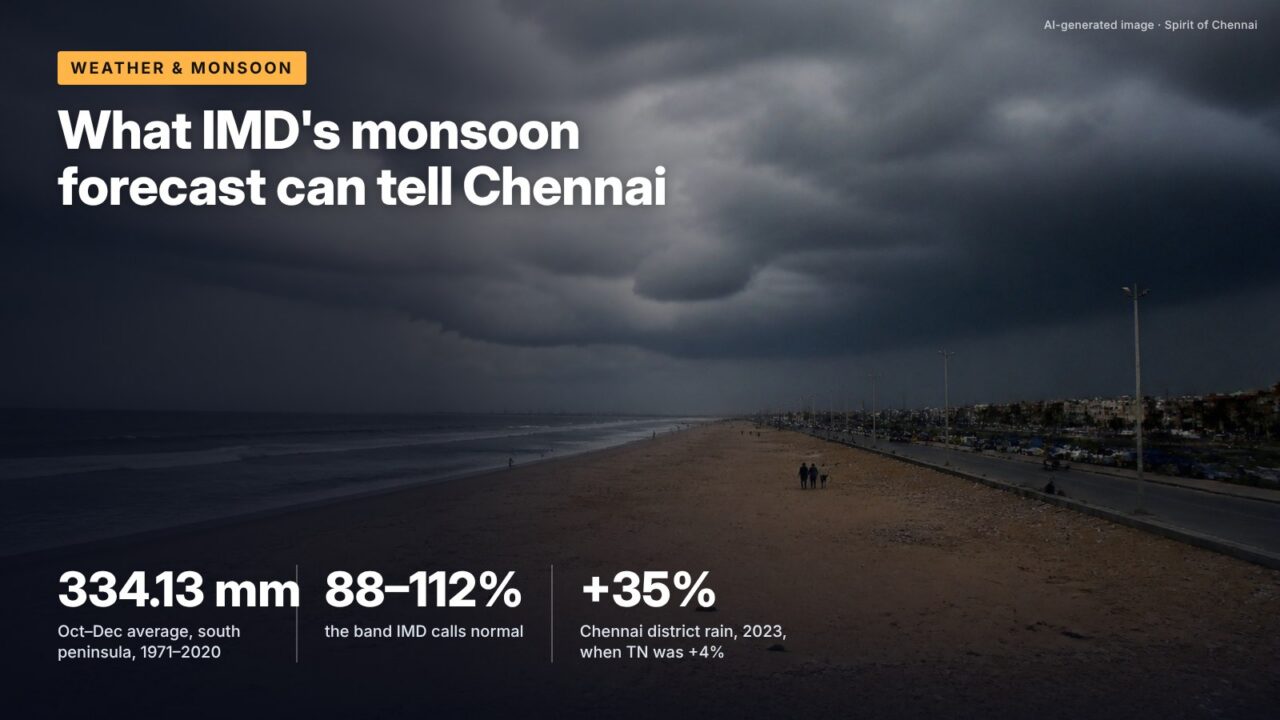
IMD’s northeast monsoon forecast is a statement about five meteorological subdivisions at once, not about a city. It covers south peninsular India (Tamil Nadu, Puducherry and Karaikal; coastal Andhra Pradesh and Yanam; Rayalaseema; south interior Karnataka; and Kerala and Mahe) and grades the coming October to December season against a long period average (LPA) of about 334.13 mm, based on 1971 to 2020, according to IMD’s 2023 post-monsoon forecast.
The categories are wide. “Normal” means anything from 88 to 112 per cent of that average, a 24-point band. For 2026 the forecast again puts the region most likely in the normal band. That is useful for farm planning and reservoir operators. It does not, and cannot, say whether Chennai will get a December deluge.
How the forecast is built
Since 2021, IMD has combined two methods for seasonal forecasts. One is a statistical system that relates past rainfall to predictors observed before the season. The other is a multi-model ensemble (MME): runs of several coupled ocean-atmosphere climate models, including IMD’s own Monsoon Mission Coupled Forecasting System (MMCFS), averaged so that the errors of individual models partly cancel. The 2023 forecast document describes this approach and names the main influences on the northeast monsoon: conditions in the Pacific (El Niño and La Niña) and Indian Ocean sea surface temperatures, especially a positive Indian Ocean Dipole.
The output is a probability across categories, not a single rainfall number. IMD issues it at the end of September and follows with monthly outlooks. On the observing side, the Ministry of Earth Sciences told Parliament in December 2025 that IMD’s high-performance computing rose from 1.1 to 28 petaflops between 2013-14 and 2024-25, Doppler radars from 15 to 47, automatic weather stations from 675 to 1,008 and rain gauge stations from 3,500 to 6,700.
How the last three seasons turned out
| Season | Onset over Tamil Nadu | Tamil Nadu subdivision, Oct–Dec | Chennai district, Oct–Dec | What stood out |
|---|---|---|---|---|
| 2023 | 16 October | 458.9 mm, +4% | 1,088.9 mm, +35% | Cyclone Michaung, 4–6 December |
| 2024 | 15 October | 589.9 mm, +33% | 1,077.6 mm, +33% | Cyclonic storms Dana and Fengal |
| 2025 | 16 October | 428.9 mm, −3% | 724.8 mm, −10% | Wet October, dry November and December |
Source: IMD Regional Meteorological Centre Chennai, northeast monsoon reports 2023, 2024 and 2025; normals 442.8 mm (Tamil Nadu subdivision) and 809.6 mm (Chennai district)
In 2023 IMD forecast a normal season for south peninsular India. Tamil Nadu’s subdivision ended at +4 per cent, inside the normal band, but Chennai district received 35 per cent above its normal of 809.6 mm, much of it when Severe Cyclonic Storm Michaung brought very heavy to extremely heavy rain to the city on 4 to 6 December while crossing the Andhra coast near Bapatla, according to the RMC Chennai report. Across the region, Kerala was 27 per cent above normal while Rayalaseema and south interior Karnataka were deficient, so the regional average hid large swings.
In 2024 Tamil Nadu’s subdivision ended 33 per cent above normal and Chennai district matched it, the 2024 report shows. Rayalaseema was +46 per cent and coastal Andhra −9 per cent. The season, IMD’s MAUSAM review recorded, ran from 15 October 2024 to 27 January 2025 and included cyclonic storms Dana and Fengal.
South peninsula rain in October, November and December 2025 as a share of average, which together made a near-normal 102 per cent season, per IMD’s Annual Report 2025.
Why “normal” can still mean a flood
The 2025 season shows the problem from the other side. Over south peninsular India it ended at 102 per cent of the long period average, squarely normal, but October was 143 per cent, November 57 per cent and December 65 per cent, according to IMD’s Annual Report 2025. Tamil Nadu’s subdivision finished at −3 per cent and Chennai district at −10 per cent, the 2025 RMC report shows.
For flooding, what matters is how much rain falls in a day or two over a small catchment, not the three-month regional total. A season can be normal on paper and still contain one cyclone that drops a month’s rain on Chennai in 48 hours, as 2023 did. Equally, an above-normal season can be spread across many moderate days and cause little damage. The seasonal forecast is the wrong tool for that question; short-range forecasts and nowcasts are the right ones.
It’s often said a ‘normal’ northeast monsoon forecast means Chennai is safe from floods this year.
The record shows In 2023, a forecast-normal year in which Tamil Nadu ended at +4 per cent, Chennai district received 35 per cent above normal and was hit by Michaung, according to the IMD RMC Chennai report.
How IMD grades itself
IMD publishes verification most fully for the southwest monsoon. In its December 2025 reply to Parliament, the ministry said the all-India forecasts for 2024 and 2025 (106 per cent in the late-May update both years) fell within model error against an actual 108 per cent in each year. It gave the model error as plus or minus 5 per cent of LPA for the April forecast and 4 per cent for the May update. For the south peninsula in 2024, the June to September forecast was above normal and the region received 114 per cent.
A comparable public table for the northeast monsoon forecast was not found in the IMD documents reviewed for this article. The seasonal reports from RMC Chennai record what fell, district by district, but do not set it against the September forecast. Anyone assessing the October to December forecast has to line up the two documents themselves, as the table above does for Tamil Nadu.
Reading the season as it unfolds
Three habits help. First, read the monthly outlook issued at the end of each month, which narrows the season into something more specific. Second, look at the subdivision and district tables in RMC Chennai’s weekly and seasonal statements, because the regional percentage blends Kerala and Karnataka with Tamil Nadu. Third, treat district-level warnings for the next few days as the real flood signal.
What this means for you
- Use the seasonal forecast for broad planning (water storage, crop decisions), not for judging flood risk in your street.
- Compare Chennai district figures, not only the Tamil Nadu subdivision, when you read IMD’s seasonal reports.
- Watch the end-of-month outlooks for November and December, which give a closer read than the September forecast.
- For floods, follow IMD Chennai’s district warnings and nowcasts in the days before a system arrives.
What to watch
End of October 2026
IMD’s outlook for November rainfall over south peninsular India.
Through December 2026
The rest of the northeast monsoon season, which set in over Tamil Nadu on 15 October 2026.
Early 2027
RMC Chennai’s northeast monsoon 2026 report, with district-wise seasonal totals.
Checked against official sources on 23 October 2026. Figures and rules change; confirm on the linked official pages before relying on them.
Sources
- Long range forecast for post-monsoon season 2023, India Meteorological Department, 30 September 2023
- Report on northeast monsoon 2023, Regional Meteorological Centre Chennai, IMD
- Report on northeast monsoon 2024, Regional Meteorological Centre Chennai, IMD
- Report on northeast monsoon 2025, Regional Meteorological Centre Chennai, IMD
- IMD Annual Report 2025, India Meteorological Department
- Parliament question: accuracy of forecast, Ministry of Earth Sciences, PIB, 18 December 2025
- Weather in India: post-monsoon season (October–December 2024), MAUSAM 76(4), IMD, 2025