When a child in Chennai is accused of a crime, the case goes not to an ordinary court but to a Juvenile Justice Board, and the child may be held at the Observation Home in Kellys. Official data on how that system performs is patchy; what exists shows capacity strain and long waits.
The numbers
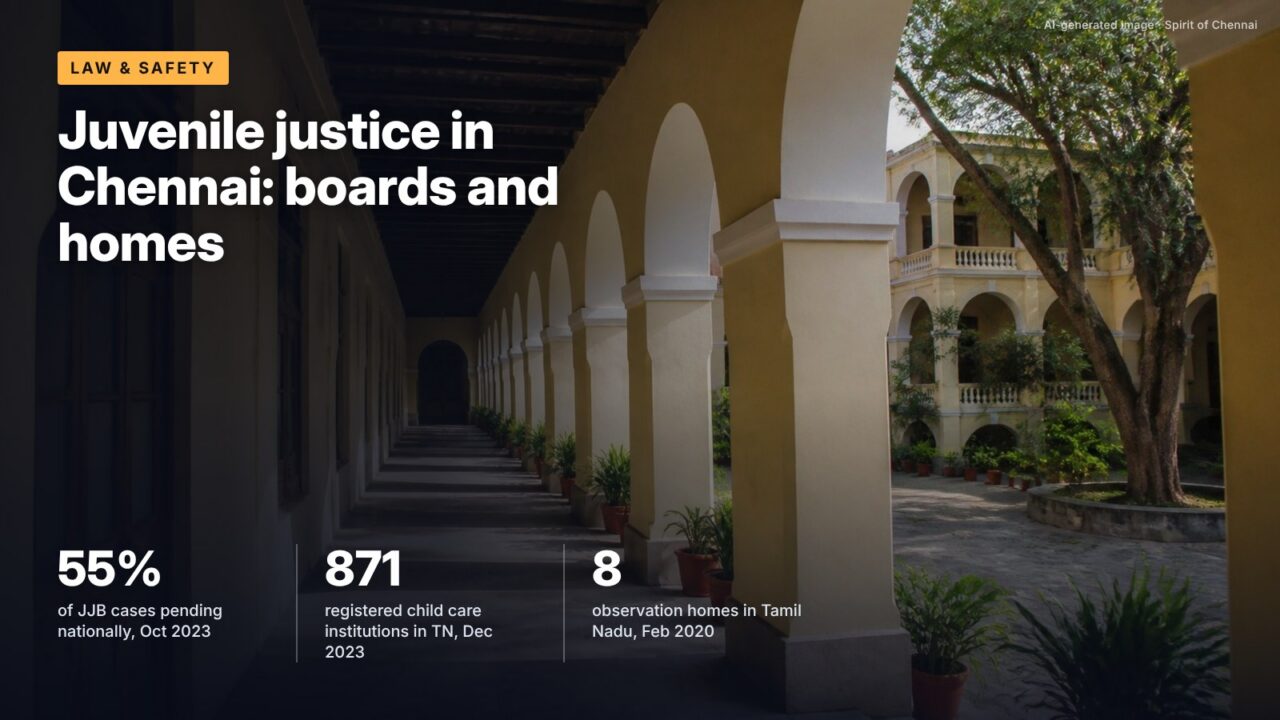
Across India, 55 per cent of the cases before 362 Juvenile Justice Boards were pending on 31 October 2023, according to the India Justice Report study released on 20 November 2025. Pendency ranged from 83 per cent in Odisha to 35 per cent in Karnataka. Tamil Nadu is one of 18 states that had a Board in every district, as the law requires, but the state did not appear among those whose RTI replies supplied disposal data, so its own pendency figure is not public in that study.
What is on the record for Tamil Nadu comes from Parliament answers and the state police. In February 2020 the state had 8 observation homes holding 309 children, 2 special homes with 75, and one place of safety with 30, according to a Lok Sabha reply. By December 2023 it had 871 registered child care institutions of all kinds, the Women and Child Development ministry said in February 2024.
How the juvenile justice system works
The Juvenile Justice (Care and Protection of Children) Act, 2015 treats anyone under 18 as a child. Offences fall into three bands: petty (punishable by up to three years), serious (three to seven years) and heinous, the gravest category. Every district must have at least one Juvenile Justice Board and one Child Welfare Committee, PRS notes. A Board, made up of a magistrate and two social workers, decides cases of children in conflict with the law; a Committee looks after children in need of care and protection.
The 2021 amendment, passed by the Rajya Sabha on 28 July 2021, redefined serious offences to include those with a maximum punishment above seven years and no minimum or a minimum below seven, moved all trials of offences under the Act to Children’s Courts, and barred people with a record of child rights violations, or who manage a child care institution in the district, from Committee membership. A child aged 16 or 17 accused of a heinous offence can, after a preliminary assessment by the Board, be sent to the Children’s Court; that is why places of safety exist to hold older children separately.
Where Chennai’s cases go
The city’s government Observation Home for Boys and Girls is at Kellys, near Purasawalkam. Under the PARAVAI programme, which began on 1 April 2022, 73 children in conflict with the law had been admitted to the Kellys home, and 281 first-time petty young offenders had gone through the programme at the Saidapet sub-jail, according to the Police Policy Note 2023-24. The state has 39 Special Juvenile Police Units under its Crime Against Women and Children wing, 194 child-friendly corners in police stations and 1,542 Child Welfare Police Offices. In 2022, Chennai’s Railway Police District rescued 1,267 children, including 150 girls, and produced 1,192 of them before a Child Welfare Committee.
| Institution (Feb 2020) | Tamil Nadu | Children | All India | Children |
|---|---|---|---|---|
| Observation homes | 8 | 309 | 301 | 9,524 |
| Special homes | 2 | 75 | 38 | 441 |
| Observation-cum-special homes | 0 | 0 | 16 | 1,160 |
| Place of safety | 1 | 30 | 13 | 304 |
Source: Ministry of Women and Child Development, Lok Sabha Unstarred Question No. 4422, 20 March 2020 (homes funded under the Child Protection Services scheme)
Observation homes hold children while their cases are pending; special homes hold those the Board has ordered to stay for rehabilitation. The 2020 ratio, 309 children in observation homes against 75 in special homes, reflects that most children in the system are waiting, not serving orders.
Boys who escaped from the Kellys Observation Home on 11 July 2016; police had found 26 when the NHRC issued notice to the state four days later, asking for a report within four weeks.
What the national study found about capacity
The India Justice Report gathered data through RTI and official records. About 24 per cent of responding Boards (111 of 470) lacked a full bench of three members, and about 30 per cent had no attached legal services clinic. Fourteen states had no place of safety for 16 to 18-year-olds accused of heinous offences. Mandated inspections of child care institutions fell well short: 810 visits against 1,992 required in the states that replied. In 2023, NCRB recorded 40,036 juveniles apprehended in 31,365 cases nationally, more than three in four of them aged 16 to 18.
It’s often said children accused of serious crimes simply walk free because of the juvenile law.
The record shows The 2015 Act allows a 16 or 17-year-old accused of a heinous offence to be sent to a Children’s Court after assessment, and Boards can order stays in special homes. The bigger problem in the national data is delay: more than half of all cases before Boards were pending in 2023.
The money behind it
Juvenile justice institutions are funded largely through the centrally sponsored Mission Vatsalya scheme, which received ₹1,500 crore in the 2025-26 Union budget, 0.03 per cent of the total. In Tamil Nadu, 7,785 children in need of care and protection were supported under the scheme as of 31 March 2023, according to the February 2024 answer. The state’s 871 registered institutions are spread unevenly: Thiruvallur had 65, Kanyakumari 63, and Chengalpattu and Tirunelveli 51 each, while Ramanathapuram had one. Uttar Pradesh, with a far larger population, had 146 registered institutions and 3,238 children supported.
What this means for you
- If a child in your family is apprehended, the police must produce them before the Juvenile Justice Board, not an ordinary magistrate, and inform a probation officer.
- Children have a right to legal aid before the Board; the District Legal Services Authority can assign a lawyer free of cost.
- Children found begging, working or alone at railway stations go to a Child Welfare Committee, not a Board; call 1098 for help.
- Ask the Board for the next hearing date at each sitting; long gaps are the most common complaint in the national data.
What to watch
Pending
Tamil Nadu’s own data on cases pending before its Juvenile Justice Boards, which the national study could not obtain.
Pending
Union budget allocations to Mission Vatsalya, which fund observation homes and special homes.
Checked against official sources on 23 October 2026. Figures and rules change; confirm on the linked official pages before relying on them.
Sources
- Juvenile Justice and Children in Conflict with the Law: A Study of Capacity at the Frontlines, India Justice Report, press release, 20 November 2025
- Lok Sabha Unstarred Question No. 4422, Juvenile Homes, Ministry of Women and Child Development, 20 March 2020
- Lok Sabha Unstarred Question No. 1163, Registered Child Care Institutions, Ministry of Women and Child Development, 9 February 2024
- Policy Note 2023-24, Police (Demand No. 22), Home, Prohibition and Excise Department, Government of Tamil Nadu
- The Juvenile Justice (Care and Protection of Children) Amendment Bill, 2021, PRS Legislative Research
- NHRC notice to Tamil Nadu over escape of 33 juveniles from an observation home in Chennai, National Human Rights Commission, 15 July 2016