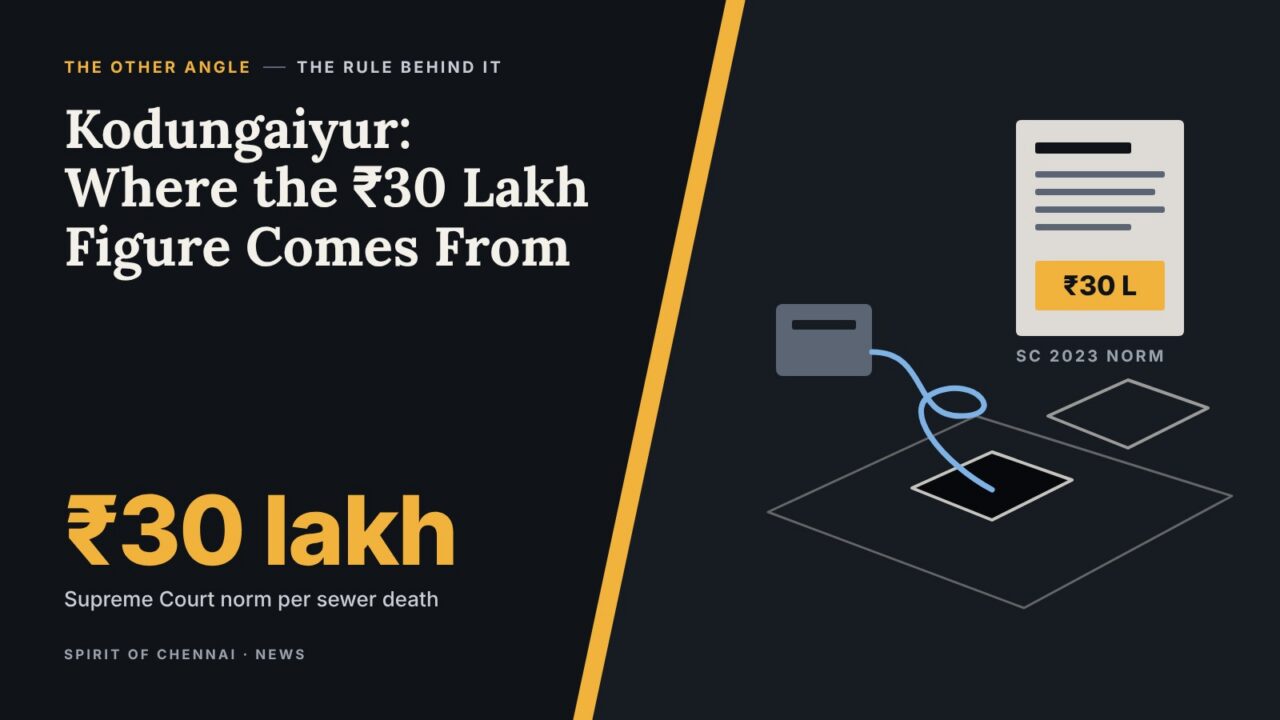
Two men died inside a stormwater drain sump in Kodungaiyur on 12 October 2026, and their families received ₹30 lakh each. That figure was not chosen by the Corporation. It comes from a 2023 Supreme Court judgment, and the rules around that judgment raise questions the coverage did not ask.
The numbers
What was reported. The News Minute reported on 13 October that two workers died while fixing a faulty motor in a sump nearly 20 feet deep on Thendral Nagar Third Street, Ward 34. One went in, struggled to breathe and collapsed, and the second collapsed trying to rescue him. Police registered a case of unnatural death under Section 194 of the Bharatiya Nagarik Suraksha Sanhita. DT Next reported on 14 October that each family received ₹30 lakh and that two Corporation assistant engineers had been suspended. A post-mortem was to establish the cause of death.
Where the ₹30 lakh comes from
On 20 October 2023, in Dr Balram Singh v Union of India (W.P.(C) No. 324 of 2020), the Supreme Court raised the compensation for a death in a sewer or septic tank to ₹30 lakh. It also set minimums for injuries. States then issued notices to put the ruling into effect. Odisha’s gazette notification, for example, sets out the scale.
| Outcome for the worker | Minimum compensation |
|---|---|
| Death in a sewer or septic tank | ₹30 lakh |
| Permanent disability leaving the victim economically helpless | Not less than ₹20 lakh |
| Permanent partial disability | Not less than ₹15 lakh |
| Temporary disability | Not less than ₹10 lakh |
Source: Housing and Urban Development Department, Government of Odisha, gazette notification implementing Balram Singh (judgment of 20 October 2023). Amounts apply from the judgment date, including to dependants not yet paid.
The Kodungaiyur payment matched the death figure exactly. The reports do not say which budget paid it, or whether it was treated as payment under the judgment or as a separate grant.
The definition the law turns on
India’s main law here is the Prohibition of Employment as Manual Scavengers and their Rehabilitation Act, 2013. As quoted in an Orissa High Court order of 2021, the Act defines “hazardous cleaning” as manual cleaning of a sewer or septic tank by an employee “without the employer fulfilling his obligations to provide protective gear and other cleaning devices”. Section 7 bars any person, local authority or agency from employing anyone, directly or indirectly, for such work. Under Section 9, a first offence can bring up to two years in prison, a fine of up to ₹2 lakh, or both.
Kodungaiyur does not fit that wording neatly. The site was a stormwater sump, not a sewer or septic tank. The job was repairing a pump, not cleaning. Whether the 2013 Act applies will be decided by the police and, if it comes to that, the courts. On the facts reported so far, the payout followed the Supreme Court’s sewer-death norm even though the work does not match the Act’s textbook case.
It’s often said confined-space deaths happen only in sewers, so stormwater drains are safe to enter.
The record shows stormwater drains can hold sewage too. After the Kodungaiyur deaths, officials told The News Minute they suspected sewage from illegal connections had entered the drain. On 3 November the Corporation separately said such connections threaten public health.
Who was the employer
The Supreme Court’s directions apply to work given out to contractors as well. A Delhi High Court order of 2 November 2023, quoting the judgment, records that where a sewer death happens in outsourced work, the contract is to be cancelled at once and money penalties imposed. The Union was also told to draft a model contract under which an agency involved in a mishap loses the contract and can be blacklisted.
At Kodungaiyur the chain had several links. According to The News Minute, the two men worked for a private motor firm. The Corporation had contracted another party, and that party had brought in the motor supplier. No Corporation official was present when the work began. Commissioner G S Sameeran said an FIR was being filed against the contractor for engaging workers without notice to the Corporation and without safety arrangements. Disciplinary action was taken against two assistant engineers, one from the electrical wing and one from the division, and an inquiry was opened under the Regional Deputy Commissioner (North).
Corporation, its contractor, and the supplier’s firm that sent the workers, as described by The News Minute. The Supreme Court’s model contract asks for accountability at the top of such a chain.
The register Tamil Nadu had not finished
The Centre’s NAMASTE scheme is meant to list every sewer and septic tank worker so that they can get safety kits, health cover and training. In a Parliament answer released by PIB on 17 December 2024, the Social Justice Ministry said 57,758 workers had been profiled and 54,574 validated across 33 States and Union Territories. It also said Tamil Nadu’s data integration with the central NAMASTE database had begun but was not complete. The same answer said 16,791 protective kits had been supplied nationwide.
Pump mechanics hired by a supplier probably fall outside such a register altogether. The register covers sanitation workers. People who go into drains, sumps and pump wells for repairs are a wider group, and the official framework says less about them.
What this means for you
- If you employ anyone to enter a sump, septic tank or drain at home or in an apartment, the 2013 Act bars hazardous manual cleaning without protective gear, and it makes no difference whether the worker was hired directly or through someone else.
- For septic tanks, use mechanised desludging operators and do not let anyone climb in.
- Families of anyone who dies or is injured in a sewer or septic tank are entitled to the Supreme Court’s minimum amounts. Ask the district administration or local body in writing.
- Report sewage entering a stormwater drain on your street. It is a flood risk and, as Kodungaiyur showed, it can also make the air inside drains dangerous.
What to watch
Pending
The post-mortem findings on cause of death and the outcome of the inquiry under the Regional Deputy Commissioner (North).
Pending
Whether the police case moves beyond unnatural death to specific charges, and against whom, as officially announced.
Pending
The families’ demand for government jobs, which DT Next reported would be decided after consulting the Chief Minister.
Checked against official sources on 4 November 2026. Details may change; confirm on the linked official pages.
Sources
- Gazette notification on ₹30 lakh compensation for sewer deaths under Balram Singh, Housing and Urban Development Department, Government of Odisha, 2024
- Order in W.P.(C) 14589 of 2021 quoting the 2013 Manual Scavengers Act, Orissa High Court, 19 April 2021
- Parliament Question: Welfare and Profiling of Sewer and Septic Tank Workers, PIB, Ministry of Social Justice and Empowerment, 17 December 2024
- Press release No. 646 on illegal sewage connections into stormwater drains, Greater Chennai Corporation, 3 November 2026
- Order in W.P.(C) 841 of 1998 and connected matters applying Balram Singh, Delhi High Court, 2 November 2023 (copy)
- Two workers die while repairing Chennai Corporation motor in Kodungaiyur, The News Minute, 13 October 2026
- Kodungaiyur asphyxiation deaths: families receive Rs 60 lakh, GCC suspends 2 officials, DT Next, 14 October 2026