Manali, the petrochemical and fertiliser belt on Chennai’s northern edge, has been on the Central Pollution Control Board’s list of critically polluted industrial areas through every assessment since 2009. Here is what the score measures, how it has moved, and what the tribunal cases found.
The numbers
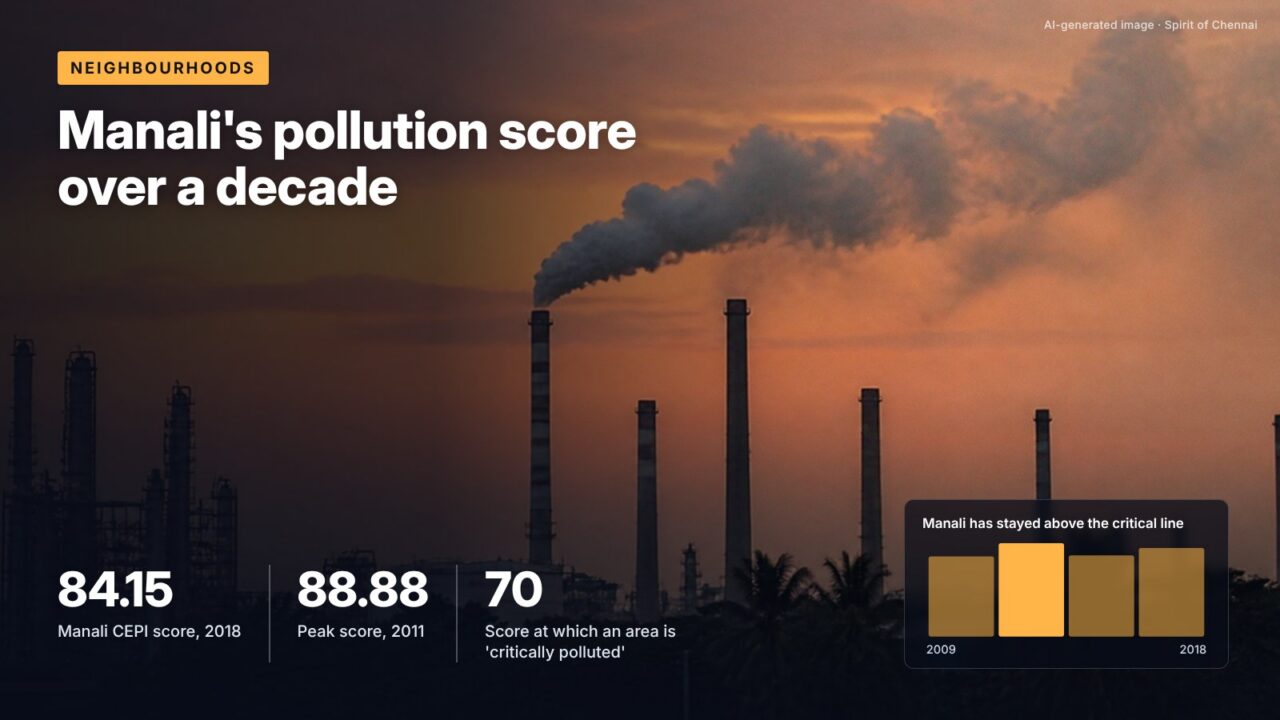
When the Central Pollution Control Board (CPCB) last ran its national assessment of polluted industrial areas in 2018, Manali scored 84.15 on its Comprehensive Environmental Pollution Index (CEPI) and was classed a Critically Polluted Area. The score had been 76.32 in 2009, 88.88 in 2011 and 77.26 in 2013, according to a CPCB affidavit filed before the National Green Tribunal in July 2021. In four rounds over nine years it never fell below the critical threshold of 70.
Manali is not a single factory but a cluster: a refinery, fertiliser and petrochemical plants, and the power stations to the north at Ennore and Vallur. The CEPI number compresses what they do to air, water and land into one figure. Reading it properly means knowing how that compression works.
How the index is built
CEPI scores an area from 0 to 100, with separate sub-indices for air, water and land, each worked out from monitoring data for that medium. The overall score is not an average. It starts from the worst sub-index and adds a share of the remaining distance to 100, scaled by the other two.
The CPCB affidavit shows the 2018 arithmetic for Manali. Water was the worst at 72.25, air was 59.75 and land 71.75. The score was 72.25 plus (100 minus 72.25) multiplied by 0.5975 and by 0.7175, which gives 84.15. One badly polluted medium sets the floor; the others push the score higher. An area cannot get off the list by cleaning only its air.
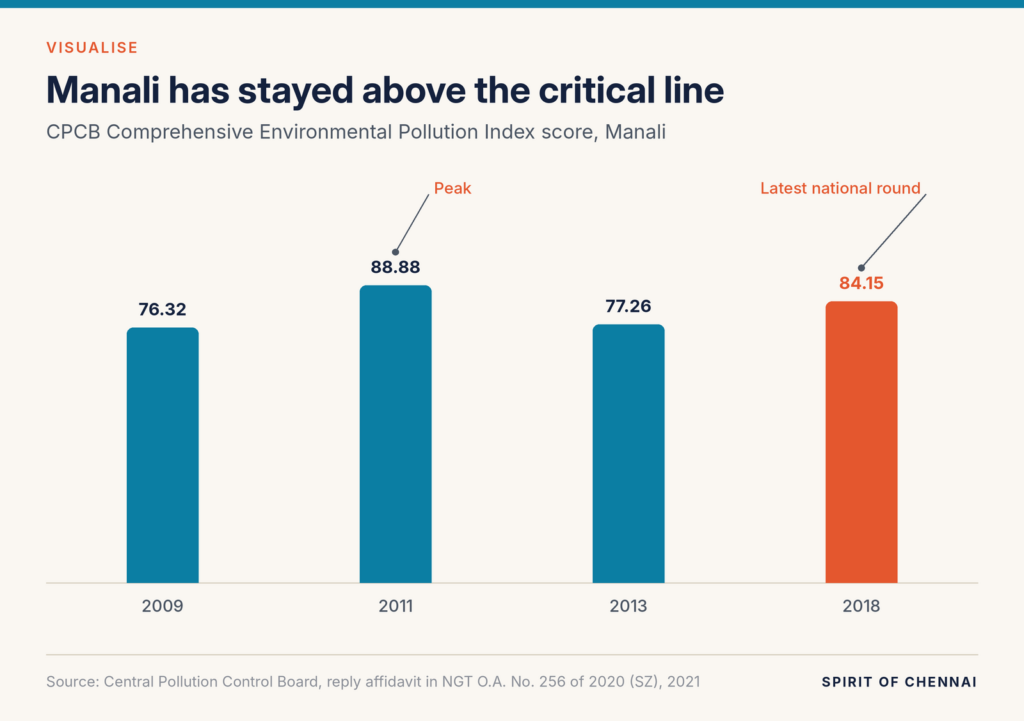
| Assessment | CEPI score | Air | Water | Land | Status |
|---|---|---|---|---|---|
| 2009 | 76.32 | – | – | – | Above 70 |
| 2011 | 88.88 | – | – | – | Above 70 |
| 2013 | 77.26 | – | – | – | Above 70 |
| 2018 | 84.15 | 59.75 | 72.25 | 71.75 | Critically Polluted Area |
Source: Central Pollution Control Board, reply affidavit in O.A. No. 256 of 2020 (SZ), NGT, 28 July 2021; sub-indices given only for 2018
Where Manali sits nationally
CPCB’s earlier rounds covered 88 prominent clusters, of which 43 in 16 states scored 70 or more and were labelled critically polluted, and 32 more scored between 60 and 70 and were labelled severely polluted, the affidavit says. The 2018 round widened the net to 100 polluted industrial areas in 21 states and union territories.
Tamil Nadu had four critically polluted areas in 2018, the environment ministry told the Lok Sabha on 19 December 2022: Manali, Vellore-North Arcot (the Ranipet SIPCOT estate), Tirupur and Mettur. The Tamil Nadu Pollution Control Board (TNPCB) sent remedial action plans for all four to the CPCB in January 2020. TNPCB’s CEPI page now lists eight areas with evaluation and action plan documents, Manali first among them.
Manali’s post-monsoon 2019 CEPI score as calculated by TNPCB and cited in the CPCB affidavit, with air at 14, water at 24 and groundwater at 21.25.
The 2019 score that looked like a turnaround
That 2019 figure would put Manali far below the critical line. It needs care. It covers one post-monsoon round, it was computed by the state board rather than in a national CPCB assessment, and it came after the 2018 score of 84.15. The same affidavit that reports it also records that the tribunal had, months earlier, set up a fresh joint committee to monitor air and assess Manali’s carrying capacity. The official classification on the national list remained the 2018 one.
It’s often said Manali’s pollution was cleaned up after 2019.
The record shows The 26.26 figure is a single-season TNPCB calculation. The last national CPCB assessment, in 2018, classed Manali critically polluted, and in 2021 the NGT’s joint committee said its carrying capacity study was still in progress.
What the tribunal’s committee did
In November 2020 the Southern Zone bench of the National Green Tribunal took up North Chennai’s industrial air pollution on its own motion, as O.A. No. 256 of 2020, after a magazine article. On 15 December 2020 it formed a joint committee of the Union environment ministry’s Chennai office, the CPCB, TNPCB and an Anna University professor. Its interim report named six plants: North Chennai Thermal Power Station Stage 1, NTECL Vallur, Chennai Petroleum Corporation, Tamil Nadu Petroproducts, Manali Petrochemicals and Madras Fertilizers. Inspections ran in January and February 2021.
By mid-2021 the committee had finished study reports for five plants and was still analysing the power station. It had not reached a view on carrying capacity, which would tell regulators whether the area can take more industry, and asked for six more weeks. The national orders on polluted areas, passed by the tribunal’s principal bench in O.A. No. 1038 of 2018 during 2019, had been stayed by the Supreme Court in March and September 2020.
One plant’s file, in detail
A separate case shows what compliance looks like close up. After an ammonia leak at Madras Fertilizers in May 2020, the tribunal opened O.A. No. 70 of 2020. A joint committee report dated 23 August 2021 found that ambient air at eight sites in March 2021 was within national standards, with PM10 between 56.9 and 87.3 µg/m³ and ammonia between 21.4 and 33.5 µg/m³. It recommended environmental compensation of ₹37.35 lakh for 83 days up to 17 November 2020, plus ₹45,000 a day until the plant met norms.
| MFL compliance item (August 2021) | Status |
|---|---|
| Committee suggestions | 17: 9 complied, 3 in progress, 5 at initial stage |
| Separate drains for process spillage and storm water | Not complied; spillage still percolating into land |
| Hazardous waste authorisation | Expired 23.11.2014; re-applied 07.07.2021 |
| Furnace oil to LNG in two 55 T/hr boilers | Target dates conflicting in report |
| Emission monitors linked to TNPCB and CPCB servers | Committed by December 2021 |
Source: Joint Committee report in O.A. No. 70 of 2020 (SZ), National Green Tribunal, 23 August 2021
The land item matters because Manali’s land sub-index was 71.75 in 2018, almost as bad as its water. Spillage seeping into soil feeds directly into the number that keeps the area on the list.
What this means for you
- If you live near the Manali cluster, TNPCB’s CEPI page is the place to read the action plan for the area.
- Treat a single favourable score with caution; the national classification depends on a full CPCB assessment across air, water and land.
- Groundwater near the cluster is part of the land sub-index; get a borewell tested before relying on it for drinking.
- Tribunal documents on North Chennai pollution are posted on the NGT website and can be read by anyone.
What to watch
Pending
A fresh national CEPI assessment by CPCB, which would be the first official update to Manali’s 2018 status.
Pending
The NGT joint committee’s final report on Manali’s carrying capacity in O.A. No. 256 of 2020.
Checked against official sources on 23 October 2026. Figures and rules change; confirm on the linked official pages before relying on them.
Sources
- Reply affidavit of the Central Pollution Control Board, 28.07.2021, O.A. No. 256 of 2020 (SZ), National Green Tribunal
- Interim report of the Joint Committee, O.A. No. 256 of 2020 (SZ), National Green Tribunal, 2021
- Joint Committee compliance report on Madras Fertilizers Limited, 23.08.2021, O.A. No. 70 of 2020 (SZ), National Green Tribunal
- Lok Sabha Unstarred Question No. 1918, 19 December 2022, Ministry of Environment, Forest and Climate Change
- Evaluation of CEPI score and action plan for CEPI areas of Tamil Nadu, Tamil Nadu Pollution Control Board