

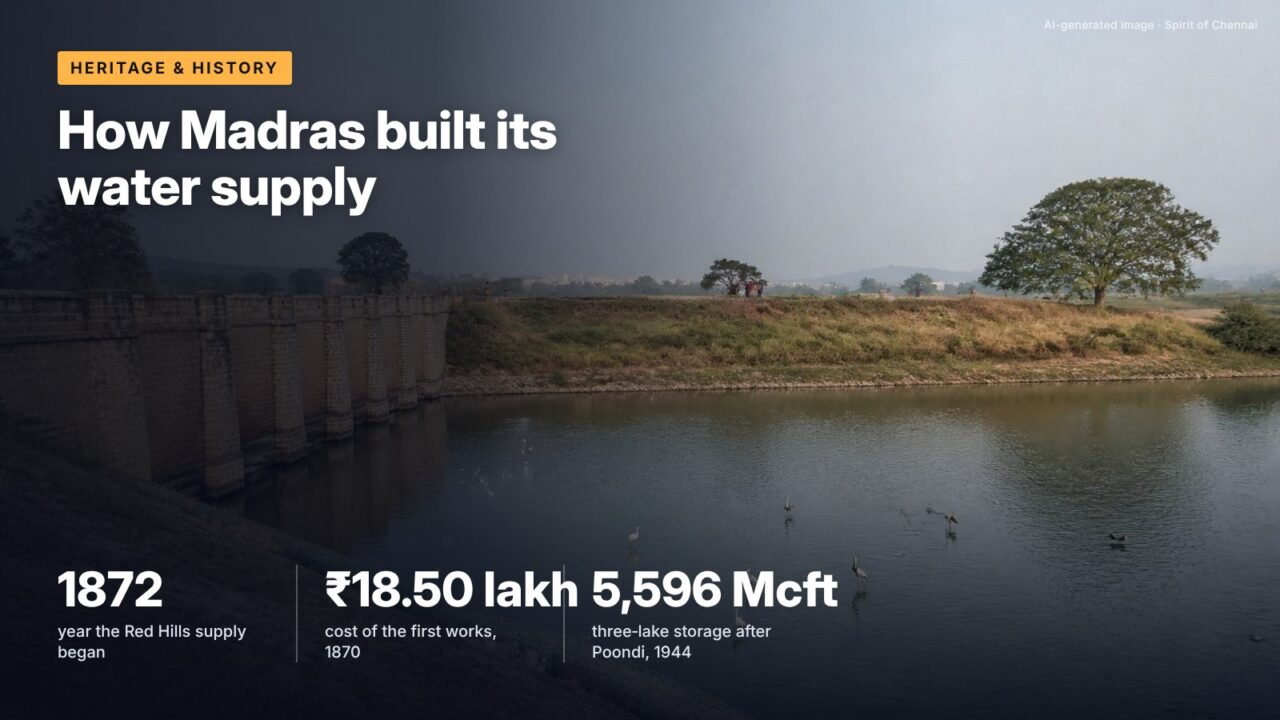
Chennai still drinks from a system laid out in the 1870s: a weir on the Kosasthalaiyar, a chain of lakes and a conduit to Kilpauk. The official record shows how each generation added storage, filters and new rivers to that spine.
The numbers
Before 1870, Madras had no protected water supply. Residents relied on shallow wells, public wells and tanks, which the water board’s own history of the system describes as unsatisfactory. The first organised scheme came in 1872: a masonry anicut, 1.8 metres high, across the Kosasthalaiyar river at Tamaraipakkam, about 28 km north-west of the city. Water ran by gravity along a 13 km upper channel to Cholavaram tank, a 4 km lower channel to Red Hills lake, and an 11 km open channel from Red Hills to a shaft at Kilpauk, from where cast iron pipes carried it into town.
The board’s organisational history puts the cost of the supply works, completed in 1870, at ₹18.50 lakh, and records the planning assumption behind them: a population of 6.6 lakh by 1961, supplied at 25 gallons per head per day, an estimate it credits to J.W. Madley. Twenty-five imperial gallons is about 114 litres (25 multiplied by 4.546), close to the 115 litres per head that engineers later used when Poondi was built. That figure, set in the nineteenth century, framed Chennai’s water planning for decades.
The first network: a weir, two lakes and a conduit
The 1872 layout explains why north-west Chennai still matters so much to the city’s taps. The Kosasthalaiyar was the only river near enough, and the Cholavaram and Red Hills tanks offered ready storage. The weak link was the open channel to Kilpauk, which lost water and was exposed to contamination.
The board’s history dates the improved intake at the deepest point of Red Hills, the Jones Tower, to 1881, and describes an 11 km underground masonry conduit, 1.52 m by 1.12 m, with a capacity of 104 million litres a day (MLD), or 23 million gallons. The page lists parts of this work under its 1914 milestone as well, so the exact sequence is not settled in the official text. What is clear is that by 1914 the city had treatment: slow sand filters of 60 to 70 MLD at Kilpauk, four underground pure-water tanks holding 29.50 million litres, steam-driven pumps, a 6.75 million litre elevated steel tank and a 48-inch steel pumping main.
Poondi and the arithmetic of storage
The second great step was the Poondi reservoir across the Kosasthalaiyar, completed in 1944 with a capacity of 2,573 million cubic feet (Mcft) and later named Sathyamoorthy Sagar. With Cholavaram (583 Mcft) and Red Hills (2,440 Mcft), the system could hold 5,596 Mcft. It was designed to give 115 litres per head per day to an expected 6.6 lakh people in 1961, the same population Madley had projected.
The lakes were not, at first, fully the city’s. The board’s history records that irrigation rights over Cholavaram and Red Hills were acquired only in 1962, which is when their full storage became available for drinking water. Later bund-raising in 1972 added 700 Mcft, and the Public Works Department raised storage again in 1991-92.
| Lake (Mcft) | 1944 | 1972 | After 1991-92 |
|---|---|---|---|
| Poondi | 2,573 | 2,573 | 3,231 |
| Cholavaram | 583 | 881 | 1,081 |
| Red Hills (Puzhal) | 2,440 | 2,842 | 3,300 |
| Three-lake total | 5,596 | 6,296 | 7,612 |
| Chembarambakkam | not part of system | not part of system | 3,645 |
| Grand total | 5,596 | 6,296 | 11,257 |
Source: CMWSSB, “History of Chennai Water Supply” (cmwssb.tn.gov.in/node/30), consulted October 2026
It’s often said Chennai’s northern lakes were built as drinking-water reservoirs.
The record shows Cholavaram and Red Hills were irrigation tanks drawn into the city scheme. Their irrigation rights were bought out only in 1962, according to the CMWSSB history, nine decades after the first supply.
From municipal works to a statutory board
Through the twentieth century the system grew by modules. Rapid gravity filters of 45 MLD came in 1959; a second conduit from Red Hills to Kilpauk added 146 MLD of raw-water capacity; a 135 MLD rapid sand filter plant opened at Kilpauk in 1969, when the city was divided into 12 distribution zones fed from there. The Southern Head Works at Thiyagaraya Nagar followed in 1973, and a 15 km lined channel from Poondi to Tamaraipakkam was built to cut transmission losses.
In 1978 the state created the Chennai Metropolitan Water Supply and Sewerage Board under Tamil Nadu Act 28 of 1978. Section 5 of the Act tasks it with planning, operating and regulating water supply and sewerage in the metropolitan area and with preparing long-term plans; Section 26 transferred the water assets of existing authorities, including the Corporation, to the new board on notified dates.
| Indicator | 1978 | March 2022 |
|---|---|---|
| Operational area | 176 sq km | 426 sq km |
| Population served | 30 lakh | 85 lakh |
| Water produced, normal year | 240 MLD | 1,000 MLD |
| Treatment capacity | 182 MLD | 1,494 MLD |
| Water mains | 1,250 km | 5,247 km |
| Consumers | 1,16,000 | 9,30,531 |
Source: CMWSSB, “History of Chennai Water Supply”, growth table, consulted October 2026
New rivers: Krishna, Veeranam and the sea
By the 1970s it was plain that the Kosasthalaiyar basin could not keep pace. Under a 14 April 1976 agreement, Maharashtra, Karnataka and Andhra Pradesh agreed to spare 15 TMC ft of Krishna water for Chennai. A 1983 accord between Andhra Pradesh and Tamil Nadu set the delivery at 12 TMC ft a year at the state border after 3 TMC ft of losses; the Water Resources Department policy note 2024-25 records that 8 TMC ft is due in July to October and 4 TMC ft in January to April.
Krishna water first reached Poondi in September 1996, through a 152 km canal from Kandaleru and a further 25 km to Poondi. The policy note puts total receipts from 1996 at 112.258 TMC ft, an average of well under the 12 TMC ft promised each year, and records only 2.412 TMC ft in the 2023-24 water year. Tamil Nadu had reimbursed ₹1,132.57 crore of the ₹1,261.84 crore share Andhra Pradesh had billed as of March 2021.
Krishna water Tamil Nadu received in 2023-24, against an entitlement of 12 TMC ft a year, according to the WRD policy note 2024-25.
The board’s history then lists the diversification that followed: 180 MLD from Veeranam lake in Cuddalore district from 2004, treated at Vadakuthu; a 530 MLD plant at Chembarambakkam in 2007; and, from 31 July 2010, a 100 MLD desalination plant at Kattupalli near Minjur. Treatment capacity now stands at 1,494 MLD, of which Kilpauk, the 1914 site, still supplies 270 MLD.
What the old system means for the new city
The 1870s geography still shapes risk. The CAG’s 2017 performance audit of flood management in Chennai named Poondi, Cholavaram, Red Hills and Chembarambakkam as the four large reservoirs needing emergency action plans, and found in December 2016 that none had been prepared. It also noted that development is restricted in the Puzhal and Red Hills catchments to keep the source clean, and said that reclassifying land there defeated that purpose.
Read as a long series, the official record shows a city that has always borrowed water from further away: first a river 28 km off, then lakes taken over from farmers, then a river in another state, then the sea. Each step added storage or supply, but the 1872 spine of Kosasthalaiyar, Red Hills and Kilpauk is still in daily use.
What this means for you
- If you are buying land in north-west Chennai, check whether it falls in the Puzhal or Red Hills catchment, where development is restricted to protect drinking water.
- Lake storage figures in daily bulletins are in Mcft; the table above gives each lake’s full capacity so you can read them as a share.
- Krishna water arrives in two windows, July to October and January to April, so mid-year shortfalls often depend on releases from Andhra Pradesh.
- For deeper research, the CMWSSB history page and the board’s 1978 Act are the primary starting points; older engineering files sit with the Tamil Nadu Archives.
What to watch
July to October each year
The first spell of 8 TMC ft of Krishna water is due under the 1983 accord; the state has asked Andhra Pradesh for releases in past years when reservoir levels were low.
January to April each year
The second spell of 4 TMC ft falls due; total receipts are reported in the WRD policy note.
Pending
The ₹3,108 crore Ring Main System, whose foundation was laid at Sholinganallur on 14 October 2026, is meant to link sources across the city; completion and commissioning dates have not been published on the board’s site.
Checked against official sources on 23 October 2026. Figures and rules change; confirm on the linked official pages before relying on them.
Sources
- History of Chennai Water Supply, Chennai Metropolitan Water Supply and Sewerage Board
- Particulars of Organisation, Functions and Duties, CMWSSB
- The Chennai Metropolitan Water Supply and Sewerage Act, 1978 (Tamil Nadu Act 28 of 1978), copy hosted by CAG of India
- Policy Note 2024-25, Water Resources Department, Government of Tamil Nadu
- Report No. 4 of 2017, Performance Audit of Flood Management and Response in Chennai, Chapter 2, CAG of India


