

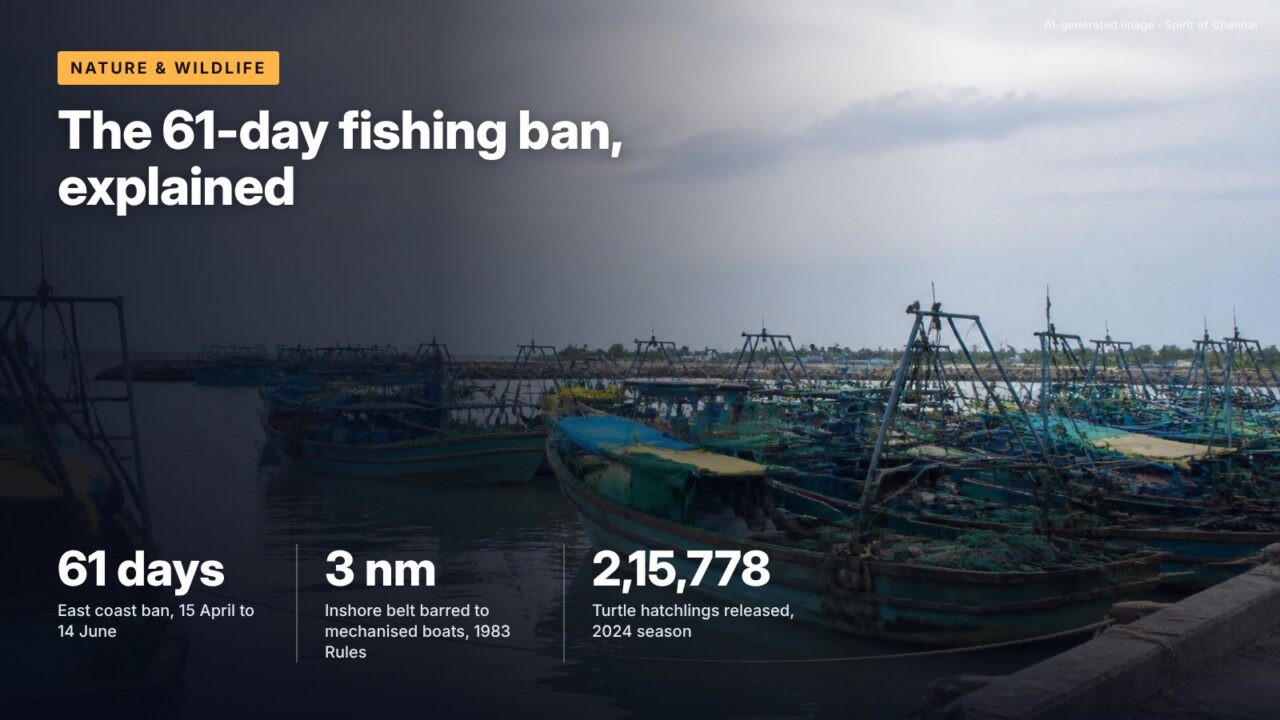
Every April, mechanised boats on the Tamil Nadu coast tie up for 61 days. The closure rests on two different legal powers, protects fish rather than turtles, and comes with a relief payment that has risen in steps. Here is how the rules at sea actually fit together.
The numbers
The annual fishing ban on Tamil Nadu’s east coast is often described as one rule. It is really two. Beyond territorial waters, in India’s Exclusive Economic Zone, the ban comes from a Union order: the Department of Fisheries’ order of 30 March 2023 closed the east coast from 15 April to 14 June, both days included, and the west coast from 1 June to 31 July. Inside territorial waters, the state acts under its own law, the Tamil Nadu Marine Fishing Regulation Act, 1983. Traditional non-motorised craft are exempt from both.
The two have not always lined up. A 2015 Tamil Nadu order, G.O.(Ms) No. 77 of 13 April 2015, describes a 45-day closure in state waters, from 15 April to 29 May on the east coast. The fisheries department’s welfare scheme sheet of June 2019 gives the state ban as 61 days, 15 April to 14 June from Tiruvallur to the eastern part of Kanniyakumari. The two seasons now match, so a trawler cannot simply move further out to keep fishing.
Two laws, one closed season
The Union order cites the conservation and management of fishery resources and sea safety. It does not name a statute. The state’s power is spelt out. Section 5 of the 1983 Act lets the government, by notification, regulate or prohibit fishing by classes of vessel in a specified area, cap the number of vessels, restrict the catch of particular species for set periods, ban gear and fix fishing hours. Section 5(2) tells it to weigh three things when it does so: the interests of fishers using traditional craft, the conservation of fish, and law and order at sea.
The 1983 Rules turn that into geography. Rule 6 keeps non-mechanised craft within three nautical miles of the shore using hook and line or boat seine, and bars mechanised boats from fishing inside that belt. Bottom trawling is barred within three nautical miles. Fishing within 100 metres of a river mouth is prohibited, and no net other than a trawl may have a mesh smaller than 10 mm. Closed seasons for breeding are declared under Section 5, and authorised officers may declare local close seasons or bar the catch of a species for a season.
What enforcement looks like
The Act works through officers rather than criminal courts. An authorised officer who believes a vessel is breaking the law may board, search and impound it and seize the fish on board (Section 15). Perishable catch can be sold and the proceeds held (Section 16). An adjudicating officer then holds an enquiry (Section 17).
Penalties under Section 18 scale with the catch: up to ₹5,000 where the fish involved is worth ₹1,000 or less, up to five times the value of the fish above that, and up to ₹5,000 in other cases. The officer may also suspend or cancel the boat’s registration or licence, and the vessel or catch can be forfeited unless the owner shows due care. Appeals lie within 30 days, extendable to 60, and the appellant must normally deposit the penalty first.
The maximum penalty when seized fish are worth over ₹1,000 is five times their value, under Section 18 of the Tamil Nadu Marine Fishing Regulation Act, 1983.
Where turtles come in
The ban is about fish. Olive ridley turtles, which nest on the Chennai coast, depend on different rules. In a Lok Sabha answer of 14 December 2018, the Union environment ministry said the state law requires turtle excluder devices on trawl nets during a specified period, with no trawl net to be used without one. A turtle excluder device, or TED, is a grid fitted inside a trawl net that steers a trapped turtle out through a flap while the catch passes on to the cod end.
How far that rule bites is another matter. At a three-day trial at Kasimedu fishing harbour in January 2015, organised by the TREE Foundation with the fisheries and forest departments and reported in the Indian Ocean Turtle Newsletter, the participants noted that no boats were using TEDs, although shrimp trawlers were required to fit them. In the sea trial, TED hauls caught no turtles while a nearby boat without one caught a live olive ridley. Estimated catch loss was 2 to 3 per cent, and fitting a device was put at about ₹1,000. Officials at the event said the device would be needed only from November to March, the turtle season. That is outside the April to June ban.
What the hatcheries count
The protection that is easiest to measure happens on land. Forest department hatcheries collect eggs from beach nests and release hatchlings. A state press release of 15 June 2024 reported the best season on record.
| Season | Hatcheries | Eggs collected | Hatchlings released |
|---|---|---|---|
| 2023 (to 7 May 2023) | 34 | about 2.17 lakh | about 1.71 lakh, rest still incubating |
| 2023 (final) | not stated | not stated | 1,82,917 |
| 2024 | 53, in 8 divisions and 13 districts | 2,58,775 from 2,363 nests | 2,15,778 (Chennai 38,230) |
Source: Tamil Nadu DIPR press releases No. 854 (7 May 2023) and No. 794 (15 June 2024)
The 2024 release put Cuddalore first with 89,648 hatchlings, then Nagapattinam with 60,438 and Chennai with 38,230. Dividing hatchlings released by eggs collected gives a survival rate of about 83 per cent in 2024. The 2023 release said about 20,000 volunteers took part in Chennai alone.
The relief money
Fisher families lose most of their income during the closure, so the state pays relief. The amount has moved in steps. G.O. 77 of 2015 records that a 2011 order raised it from ₹1,000 to ₹2,000 per family, and budgeted ₹33 crore for 1,65,000 families in 2015: the 1,49,855 families paid in 2014 plus an expected 10 per cent rise. By the June 2019 scheme sheet, ban relief was ₹5,000 per marine fisher family, paid by bank transfer, with a separate ₹5,000 for the lean months, which for Thiruvallur to Ramanathapuram are October to December.
| Year or edition | Ban relief per family | What the record says |
|---|---|---|
| Before 2011 | ₹1,000 | Raised by G.O. 54 of 2011 |
| 2015 | ₹2,000 | 1,65,000 families, ₹33.05 crore with contingencies |
| June 2019 scheme sheet | ₹5,000 | Plus ₹5,000 lean-period assistance |
Source: G.O.(Ms) No. 77, AH,D&F Department, 13 April 2015; Department of Fisheries, Tamil Nadu, welfare schemes sheet, June 2019
There is also a savings-linked scheme. Under the Pradhan Mantri Matsya Sampada Yojana, the Union fisheries ministry told the Lok Sabha on 3 December 2024, the Centre and state together pay ₹3,000 a year to each enrolled fisher who saves ₹1,500, and the ₹4,500 is paid out in three instalments during the ban or lean months. States may top this up. The 2019 sheet says the state runs a parallel scheme for fisherwomen. The ban relief has been revised since 2019; the current amount and the number of families paid are set each year in the fisheries department’s policy note.
It’s often said the 61-day ban is there to protect sea turtles.
The record shows The Union order gives fish conservation and sea safety as its reasons, and the ban runs from mid-April. Turtle protection rests on the TED requirement in trawl nets, the three-nautical-mile inshore belt and the forest department’s hatcheries, all of which matter most in the months before the ban.
What this means for you
- Fish sold in Chennai between mid-April and mid-June comes largely from traditional craft working inshore, which the ban exempts, so expect smaller supply and higher prices.
- If you see a mechanised trawler working within three nautical miles, the offence falls under the 1983 Act; the fisheries department’s authorised officers handle complaints.
- Fisher families should keep their bank details current with the fisheries department, because ban relief and the savings scheme instalments are paid by direct transfer.
- The forest department’s hatcheries rely on volunteers during the nesting season; the Chennai wildlife division runs the city’s beach programme.
What to watch
15 April 2027
The east coast closure runs from 15 April to 14 June each year under the state and Union rules, so the next ban should begin on this date.
Pending
The fisheries policy note for 2026-27 will give the current relief amount per family and the number of families covered.
Pending
A full forest department tally of the 2026 nesting season, to compare with the 2024 record of 2,15,778 hatchlings.
Checked against official sources on 23 October 2026. Figures and rules change; confirm on the linked official pages before relying on them.
Sources
- Uniform fishing ban order, 30 March 2023, Department of Fisheries, Government of India
- Lok Sabha Unstarred Question 1317, 3 December 2024, Ministry of Fisheries, Animal Husbandry and Dairying
- Welfare schemes for fishermen, Department of Fisheries, Tamil Nadu, June 2019
- Tamil Nadu Marine Fishing Regulation Act, 1983 (PRS Legislative Research copy)
- Tamil Nadu Marine Fishing Regulation Rules, 1983 (ICSF copy)
- Lok Sabha Unstarred Question 907, 14 December 2018, Ministry of Environment, Forest and Climate Change
- Press Release No. 794, 15 June 2024, DIPR, Government of Tamil Nadu (sea turtle season)
- Press Release No. 854, 7 May 2023, DIPR, Government of Tamil Nadu (sea turtle hatcheries)
- G.O.(Ms) No. 77, 13 April 2015, Animal Husbandry, Dairying and Fisheries Department, Tamil Nadu
- Demonstration and trials of CIFT turtle excluder devices in Tamil Nadu, Indian Ocean Turtle Newsletter


