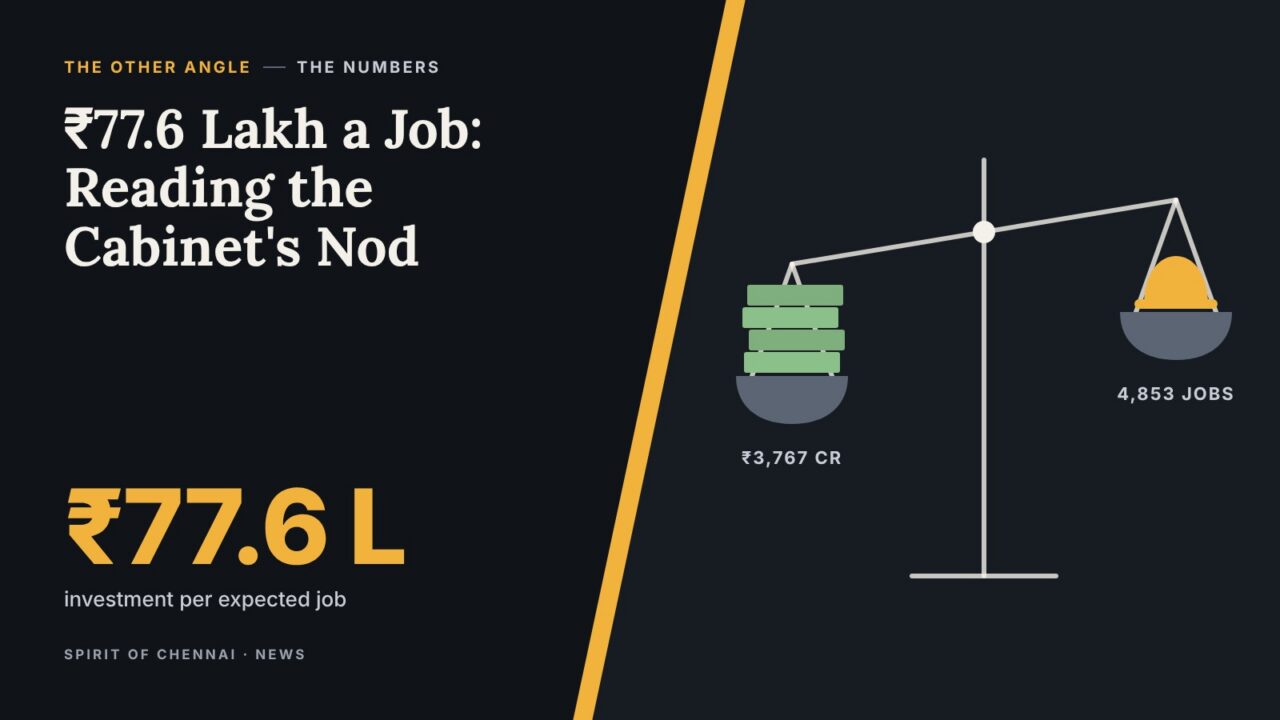
The State Cabinet cleared incentive packages for eight industrial projects worth ₹3,767 crore and about 4,853 jobs at the end of October. The coverage gave the totals. Dividing one by the other, and setting it beside the state’s own earlier announcements, shows how much capital each promised job now carries, and which rules decide who qualifies.
The numbers
What was reported
DT Next reported on 30 October 2026 that the Cabinet chaired by Chief Minister C. Joseph Vijay approved incentive packages for eight companies, including expansion plans of three of them, in Kancheepuram, Chengalpattu, Coimbatore, Krishnagiri and Erode districts. Sectors included technical textiles, aerospace and defence, life sciences and electronics. The companies were not named and no per-project figures were released.
The number per job
₹3,767 crore divided by 4,853 jobs is about ₹77.6 lakh of investment for each job. The average project is about ₹471 crore and about 607 jobs. Those averages hide the spread between projects, but the headline ratio can be set against the state’s own published announcements, using the same simple division.
| Announcement | Investment (₹ crore) | Jobs | Investment per job |
|---|---|---|---|
| Cabinet, 34 proposals, 29 Jan 2021 | 52,257 | 93,935 | ₹55.6 lakh |
| Industrial Policy 2021 target, 2020-2025 | 10,00,000 | 20,00,000 | ₹50 lakh |
| Global Investors Meet, Jan 2024 (direct jobs) | 6,64,180 | 14,54,712 | ₹45.7 lakh |
| MotiveLink, Pillaipakkam, Jul 2026 | 300 | 1,500 | ₹20 lakh |
| Cabinet, 8 projects, Oct 2026 | 3,767 | 4,853 | ₹77.6 lakh |
Sources: TN press release No. 065 (2021); TN Industrial Policy 2021; TN press release on GIM 2024; DT Next, 30 July and 30 October 2026. Per-job figures calculated for this article.
The sector mix explains most of the difference. In the January 2021 list, Pegatron’s electronics assembly plant in Chengalpattu promised 14,079 jobs on ₹1,100 crore, under ₹8 lakh a job, while Tata Electronics’ ₹5,763 crore Krishnagiri unit promised 18,250 jobs, about ₹31.6 lakh each, according to the government press release. Assembly lines employ many people per crore; aerospace parts, life-science manufacturing and technical textiles generally use more machinery per worker. A higher ratio is not a sign of a worse project, but it does mean fewer jobs for each rupee of incentive linked to investment.
Investment per job implied by the Industrial Policy 2021 targets of ₹10 lakh crore and 20 lakh jobs by 2025, set out in the policy document.
The rule that decides who gets a package
Cabinet approval is the visible step in a process laid down in the Tamil Nadu Industrial Policy 2021. The policy sorts projects by size: large projects of ₹300 crore to ₹500 crore need at least 150 jobs; mega projects of ₹500 crore to ₹5,000 crore need at least 400; ultra-mega projects above ₹5,000 crore need 2,000. It also sorts districts. Chennai, Chengalpattu, Kancheepuram and Tiruvallur are “A” districts; Coimbatore, Erode and Krishnagiri are among the 12 “B” districts; the remaining 22 are “C”.
Structured packages are open only to mega and ultra-mega projects in A districts, but to large projects as well in B and C districts. In other words, a ₹350 crore plant could qualify in Krishnagiri or Erode but not, under the general rules, in Kancheepuram. Sector policies for textiles, aerospace and life sciences can set their own terms, and the government has not said which policy each of the eight projects falls under.
Who pays for the incentive
Under the 2021 policy an investor picks one of four options at the start. The first is reimbursement of 100% of the SGST on final products sold within Tamil Nadu for 15 years, paid out of tax the state would otherwise keep. The others are a flexible capital subsidy of 5% to 10% of eligible fixed assets with boosters, capped at 35% to 40% depending on district; a fixed capital subsidy, for example 10% of assets for a mega project in an A district and 15% in a C district; or a turnover-based subsidy for very large employers. Training support is ₹4,000 a worker a month for six months, or ₹6,000 for women, transgender persons, persons with disabilities and SC/ST workers.
Every option is tied to investment or turnover rather than to the number of jobs, except the training subsidy and an employment booster within the flexible option. That is why the per-job ratio matters to the treasury: a capital-heavy project draws a larger subsidy for each job it creates.
It’s often said a Cabinet approval means the investment has arrived.
The record shows the January 2021 release noted that legally binding MoUs would be executed only after Cabinet approval. Under the 2021 policy, incentives are disbursed through SIPCOT and are calculated on assets, tax or turnover once a project is running, so the approval is a commitment by the state, not yet by the company.
Where the jobs land
Two of the five districts named, Kancheepuram and Chengalpattu, are in the Chennai belt, where workers commute from the city and its suburbs along the Sriperumbudur and GST Road corridors. The other three are in the west and north-west. With no district-wise split published, it is not possible to say how many of the 4,853 jobs will be within reach of Chennai residents.
What this means for you
- Treat job numbers from Cabinet approvals as expected, not created; they depend on the companies’ own investment schedules.
- If you are job-hunting in the Sriperumbudur or Chengalpattu belt, the sectors named (aerospace, life sciences, electronics, technical textiles) favour skilled technical roles.
- Training subsidies are higher for women, transgender persons, persons with disabilities and SC/ST workers, which can make employers keener to recruit them.
- Watch for company names: until they are public, the projects cannot be tracked.
What to watch
Pending
Release of the names of the eight companies and the policy under which each package was approved.
Pending
MoUs and land allotments for the approved projects, which come after Cabinet clearance.
Pending
Any updated official count of jobs actually created from earlier approvals, which the state has not published alongside this round.
Checked against official sources on 4 November 2026. Details may change; confirm on the linked official pages.
Sources
- Tamil Nadu Industrial Policy 2021 (Industries Department, Government of Tamil Nadu; copy hosted by the Embassy of India, Paris)
- Press Release No. 065: Cabinet approves 34 investment proposals and Industrial Policy 2021 (DIPR, Government of Tamil Nadu, 29 January 2021)
- Press release on Global Investors Meet 2024 outcomes (DIPR, Government of Tamil Nadu, 8 January 2024)
- CM Vijay-led Cabinet meeting clears 8 industrial projects worth Rs 3,767 crore (DT Next, 30 October 2026)
- Global firms line up investments in TN; to generate over 2,900 jobs (DT Next, 30 July 2026)