On 29 October 2026 the Tamil Nadu Cabinet approved a commission to run a statewide social justice survey, including a count by caste. The headlines covered the promise. This piece looks at the 2008 statistics law that decides when the survey can start, what it can compel, and why courts now ask for fresh data before any quota is touched.
The numbers
What was reported
After the Cabinet meeting chaired by Chief Minister C. Joseph Vijay, Energy and Law Minister R. Nirmalkumar said the commission would have a retired judge and IAS officers and would be constituted in February or March 2027, after the Union government completes its caste enumeration, DT Next reported. The Pioneer reported that the survey would look at income, occupation, land, schooling, dropout rates and access to welfare for each community, and ETV Bharat quoted the minister as saying the aim was to safeguard the existing reservation system.
Most reports treated the four-month wait as a scheduling detail. It is not. It follows from the wording of a central law.
The law that sets the order of events
The Collection of Statistics Act, 2008 lets an “appropriate Government”, which includes a State government department, notify in the Gazette that economic, demographic or social statistics be collected through a survey. A resolution adopted at a meeting of several parties on 5 June asked for the Tamil Nadu survey to be held under this Act, according to The Pioneer.
Section 3 carries three provisos. A State cannot issue directions on any matter in List I, the Union List. Once the Centre has directed collection of statistics on a matter, a State needs the Centre’s previous approval to order a similar collection until the Centre’s exercise is complete. And once a State has started, the Centre cannot launch a similar one until the State finishes, unless two or more States are involved.
The Union government announced in June 2025 that the next census would include caste enumeration, with the main phase across most of the country from 1 March 2027, All India Radio reported. Read with the second proviso, that makes a State caste survey running alongside the census dependent on Union approval. Waiting for the Union count to finish, as the minister described, removes that dependency. This is a reading of the Act; the government has not yet published the commission’s terms of reference.
The last door-to-door caste enumeration in Tamil Nadu, carried out by the Second Backward Classes Commission under J.A. Ambasankar, as reported by The Pioneer.
Why the word is survey, not census
Census is a Union subject, so the first proviso keeps a State from directing one. A State survey under the 2008 Act is a different instrument: it is notified by the State, run by State staff and governed by the Act’s own rules on confidentiality and penalties. Tamil Nadu’s Cabinet has used the word survey from the start, and the 5 June resolution named the 2008 Act as its basis.
It’s often said that a State can simply hold its own caste census.
The record shows the census is a Union matter. What a State can do under the 2008 Act is a notified survey, and while the Centre’s own collection on the same matter is under way, the Act requires the Centre’s prior approval.
What the courts have been asking for
The 69% reservation rests on a 1993 State law placed in the Ninth Schedule of the Constitution. The Pioneer reported that the 5 June resolution described the quota as resting largely on 1931 data, the last all-India caste census.
The risk of old data was shown on 31 March 2022, when the Supreme Court struck down the 10.5% internal reservation for Vanniyars within the Most Backward Classes quota. As summarised by the Supreme Court Observer, the Bench of Justices L. Nageswara Rao and B.R. Gavai held that caste can be a starting point but that the State must show, with contemporary and reliable data, that a group is relatively more backward. The data relied on was found to be outdated. A fresh, community-wise socio-economic survey is the kind of record that ruling pointed to.
The precedent: three commissions in 57 years
The Tamil Nadu Backward Classes Commission lists only two temporary commissions before the permanent body set up in 1993. Its list of constituting orders gives the dates.
| Body | Order | Tenure |
|---|---|---|
| First Backward Classes Commission | G.O.Ms.No. 842, 13.11.1969 | 18.11.1969 to 26.11.1970 |
| Second Backward Classes Commission | G.O.Ms.No. 3078, 13.12.1982 | 13.12.1982 to 28.2.1985 |
| Permanent Commission (first term) | G.O.Ms.No. 9, 15.3.1993 | From 15.3.1993 |
| Permanent Commission (current term) | G.O.(Ms.) No. 92, 17.11.2022 | 17.11.2022 to present |
| Social Justice Survey Commission | Cabinet approval, 29.10.2026 | To be constituted Feb or Mar 2027 (as announced) |
Source: Tamil Nadu Backward Classes Commission, Previous Commissions and Commission Constitution G.O.s pages; 2026 row as reported by DT Next and The Pioneer.
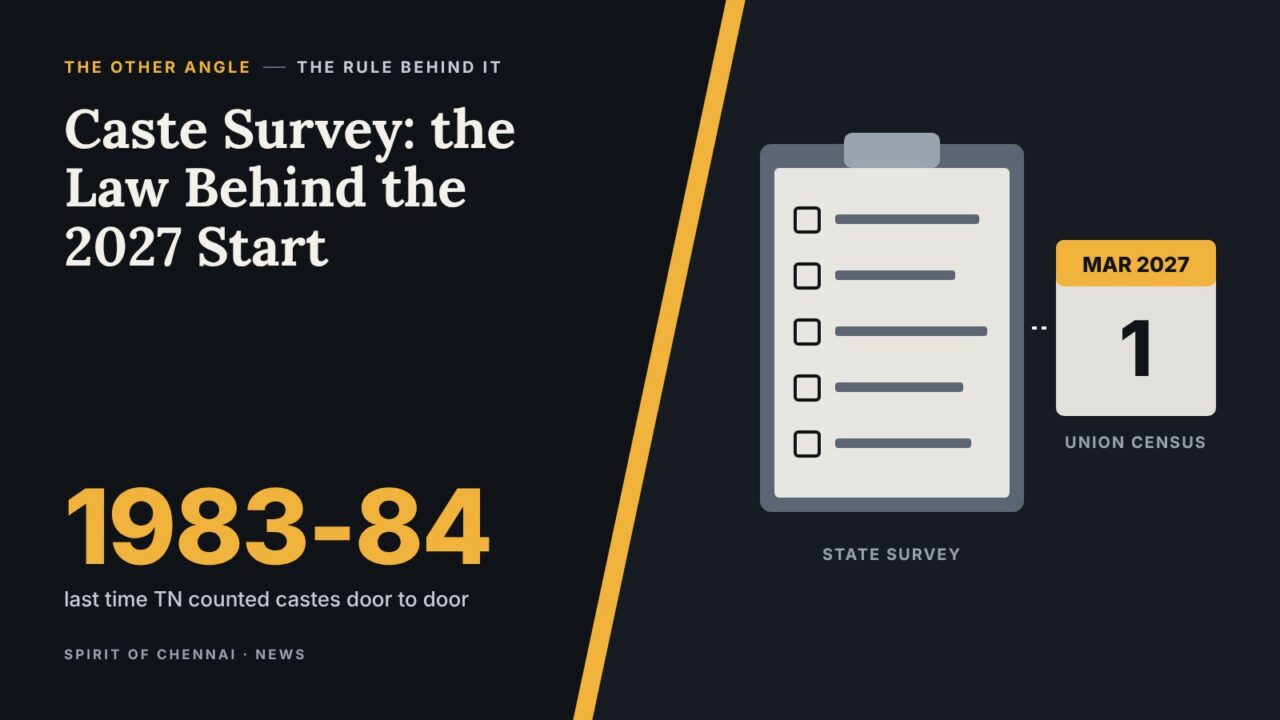
The Pioneer described the 1983-84 enumeration as the last door-to-door caste count in the State, which would make the new body the first since the Second Commission to go house to house.
What a notified survey can compel
If the survey is notified under the 2008 Act, the Act’s duties apply. Section 6 obliges a person asked for information to give it to the best of their knowledge. Section 15 sets a fine of up to ₹1,000 for refusing, or up to ₹5,000 for a company, with a further daily fine if the refusal continues after conviction. Section 16 covers false statements with up to six months’ simple imprisonment or a fine.
The same Act also limits the State. Section 9 says information furnished can be used only for statistical purposes, only staff involved in the survey may see the schedules, and results must be published so that no household can be identified. A survey run as an administrative exercise, outside the Act, would carry neither the compulsion nor these statutory protections. Which route the commission takes is one of the first details to look for.
One related decision the same day
The Cabinet also decided to seek a review in the Supreme Court of its 15 October ruling that a person from a Hindu backward class cannot claim the same benefits after converting to Islam, The Pioneer and DT Next reported. That case concerns who belongs to a listed group; the survey concerns how many people each group has and how they live. Both feed the same reservation system.
What this means for you
- Nothing changes in admissions or recruitment now. The 69% split and community certificates continue as before.
- When enumerators come, ask whether the survey has been notified under the Collection of Statistics Act. That decides both your duty to answer and the confidentiality rules.
- Data collected under the Act can be used only for statistics, not to check or cancel an individual certificate.
- Watch for the commission’s terms of reference: they will show whether it can recommend changes to any group’s share.
What to watch
1 March 2027
Main phase of the Union census, with caste enumeration, is scheduled to begin across most of India, as announced in June 2025.
February or March 2027
The State commission is to be constituted, headed by a retired High Court judge, according to the Law Minister.
Pending
The State’s review petition in the Supreme Court on the conversion ruling, which the Cabinet approved on 29 October.
Checked against official sources on 4 November 2026. Details may change; confirm on the linked official pages.
Sources
- The Collection of Statistics Act, 2008 (Act 7 of 2009), text via PRS Legislative Research
- Previous Commissions, Tamil Nadu Backward Classes Commission
- Commission constitution G.O.s (1969 to 2022), Tamil Nadu Backward Classes Commission
- Govt to conduct Population Census 2027 in two phases with caste enumeration, All India Radio News, 4 June 2025
- Pronouncement of Judgment: SC strikes down Tamil Nadu’s 10.5% reservation for Vanniyars, Supreme Court Observer, 31 March 2022
- TN Cabinet approves formation of Social Justice Commission to conduct survey, DT Next, 29 October 2026
- Tamil Nadu Cabinet clears statewide caste survey after four decades, The Pioneer, 30 October 2026
- Tamil Nadu Cabinet approves Social Justice Survey Commission to protect 69% reservation, ETV Bharat, 29 October 2026