Tamil Nadu’s grant for tourism, museums and the arts has grown fast, but most of the new money is going into tourism building works. Here is how Demand 29 is split, and what reaches artistes.
The numbers
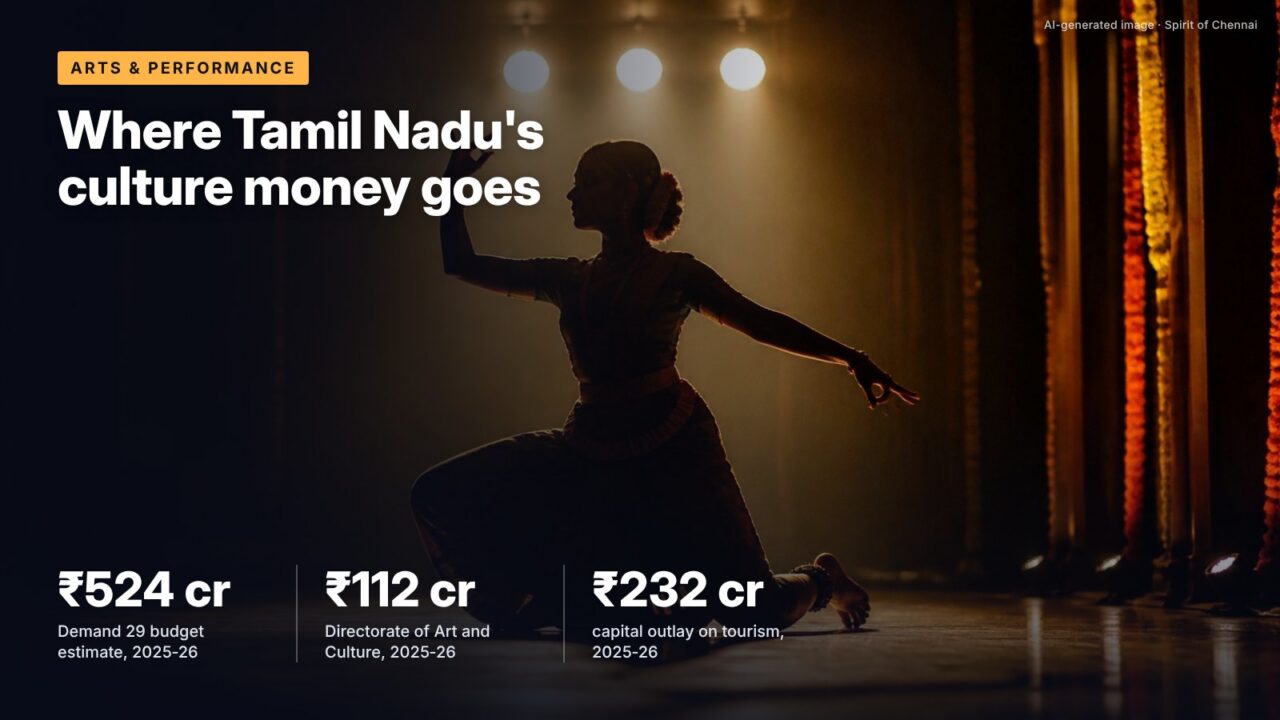
Tamil Nadu budgeted ₹524.16 crore for 2025-26 under Demand No. 29, the grant that pays for tourism, archaeology, museums and the arts. The surprise in the demand book is how little of it is about artistes: the Directorate of Tourism alone takes ₹272.47 crore, about 52 per cent, and most of that is capital spending on tourism projects. The Directorate of Art and Culture, which runs the music and fine arts colleges, the folk art schemes and the grants that reach individual performers, gets ₹112.31 crore.
The demand has also grown quickly. Actual spending in 2023-24 was ₹308.42 crore. The budget estimate for 2024-25 was ₹368.63 crore, revised upward during the year to ₹464.46 crore, and the 2025-26 estimate is higher again. Almost all of that growth is capital outlay on tourism, which rose from ₹81.39 crore in 2023-24 accounts to ₹232.46 crore in the 2025-26 estimate. The revenue side that pays salaries, stipends and grants moved far more slowly.
How Demand 29 is put together
Every state department reaches the Assembly through a “demand for grants”, a vote on money arranged by budget heads. Demand 29, titled Tourism – Art and Culture, sits under the Tourism, Culture and Religious Endowments Department. It is split into five accounting units: the Secretariat, and the Directorates of Tourism, Archaeology, Government Museum, and Art and Culture. Figures in the book are printed in thousands of rupees; the crore figures here are converted from them.
| Unit (BE 2025-26) | Revenue | Capital | Total |
|---|---|---|---|
| Directorate of Tourism | ₹40.01 cr | ₹232.46 cr | ₹272.47 cr |
| Directorate of Art and Culture | ₹104.81 cr | ₹7.50 cr | ₹112.31 cr |
| Directorate of Archaeology | ₹31.83 cr | ₹64.06 cr | ₹95.89 cr |
| Directorate of Government Museum | ₹24.71 cr | ₹6.15 cr | ₹30.86 cr |
| Secretariat (incl. ₹2 cr staff loans) | ₹10.63 cr | – | ₹12.63 cr |
| Demand 29 total | ₹211.99 cr | ₹310.17 cr | ₹524.16 cr |
Source: Government of Tamil Nadu, Finance Department, Demand for Grant No. 29, Budget Estimate 2025-26 (summary by directorate)
Where the arts money sits
Inside the demand, the arts proper appear under major head 2205, Art and Culture. Its net provision rose from ₹139.18 crore in 2023-24 accounts to ₹153.45 crore in the 2024-25 estimate, ₹160.40 crore in the revised estimate and ₹158.80 crore for 2025-26, a rise of about 14 per cent over two years. Two sub-heads carry most of the arts spending. Fine Arts Education, which pays for the four government music colleges, the 17 district music schools and the colleges of fine arts at Chennai and Kumbakonam, is ₹43.93 crore for 2025-26. Promotion of Arts and Culture, which includes festivals, awards and grants, is ₹47.38 crore, down from ₹52.40 crore actually spent in 2023-24.
That second line matters to performers. The 2024-25 policy note shows what flows through it: ₹3,000 a month to aged indigent artistes, ₹10,000 instrument and costume grants to 500 folk artistes, the Kalaimamani gold medal of five sovereigns, and the Chennai Sangamam festival. The note also records a series of grant increases: the Tamil Nadu Dr. J. Jayalalithaa Music and Fine Arts University grant from ₹2.03 crore to ₹3 crore, the Folk Artistes Welfare Board grant from ₹35 lakh to ₹90 lakh, and ₹2 crore for 25 part-time folk art training centres.
Share of Demand 29 for 2025-26 that goes to the Directorate of Tourism, mostly as capital outlay, according to the Finance Department demand book.
Why capital spending dominates
Capital outlay pays for buildings, restorations and new facilities rather than people. In Demand 29 it comes under two heads: 5452, capital outlay on tourism, and 4202, capital outlay on education, sports, art and culture. The second rose from ₹42.03 crore in 2023-24 accounts to ₹77.71 crore for 2025-26, and most of it sits with the Directorate of Archaeology, whose capital budget is ₹64.06 crore. That fits the department’s recent pattern of site museums and excavation work. The museum and arts directorates have small capital budgets, ₹6.15 crore and ₹7.50 crore.
One reading caution: the revised estimate for 2024-25 jumped well above the budget estimate, from ₹368.63 crore to ₹464.46 crore, mainly on the capital side. Capital estimates in this demand tend to move with project approvals, so the 2025-26 figure is a ceiling for the year rather than a spending record. The accounts, published two years later, are the number to test it against.
It’s often said the state’s culture budget is mostly money for artistes and temples.
The record shows Temple administration is not part of this demand, and less than a quarter of Demand 29 sits with the Directorate of Art and Culture. The largest single block is tourism capital works, ₹232.46 crore in the 2025-26 estimate.
A useful comparison
The scale of the state’s arts directorate is easier to judge against one central institution in the same city. The Union Ministry of Culture told the Lok Sabha in a written answer of 10 February 2025 that Kalakshetra Foundation in Thiruvanmiyur had a revised allocation of ₹26.62 crore for 2023-24. The Directorate of Art and Culture, with its colleges, schools, children’s centres and statewide schemes, has about four times that for 2025-26.
The museum figures tell a similar story about reliance on project money. The 2021-22 policy note put the museums budget for 2020-21 at ₹30.28 crore, of which ₹5.41 crore came for projects funded jointly with the Centre. Five years on, the Directorate of Government Museum’s 2025-26 total of ₹30.86 crore is almost the same in cash terms. Larger museum works have depended on the Union Museum Grant Scheme, which, a PIB release of 9 March 2026 shows, sanctioned ₹10.83 crore for the Egmore museum.
What the policy notes do not tell you
Policy notes describe schemes and announce increases, but they rarely print how much each scheme spent. The 2024-25 note does not give a total budget for the art and culture directorate at all; that has to be read from the demand book. Several cumulative figures, such as the 1,924 Kalaimamani awardees, appear unchanged across the 2021-22, 2023-24 and 2024-25 notes, which suggests they are not updated every year. Anyone tracking whether a scheme grew should compare the demand book lines year to year, not the narrative text.
What this means for you
- If you are an artiste seeking a grant or pension, the money comes from the Directorate of Art and Culture and the Eyal Isai Nataka Manram, not the tourism side of the demand.
- Budget estimates are ceilings. Check the accounts column, printed two years later, before concluding that a scheme was funded.
- Policy notes often repeat cumulative figures; the demand book is the better record of year-to-year change.
- Questions on specific scheme spending can be put to the Directorate of Art and Culture under the RTI Act.
What to watch
Pending
The 2026-27 demand book and policy note under the new government will show whether the tourism capital push continues and whether the arts heads grow.
Pending
Accounts for 2024-25 will show how much of the revised ₹464.46 crore was actually spent.
Checked against official sources on 23 October 2026. Figures and rules change; confirm on the linked official pages before relying on them.
Sources
- Demand for Grant No. 29, Tourism – Art and Culture, BE 2025-26 (Finance Department, Govt of Tamil Nadu)
- Art and Culture and Museums Policy Note 2024-25 (Govt of Tamil Nadu)
- Art and Culture Policy Note 2023-24 (Govt of Tamil Nadu)
- Art and Culture Policy Note 2021-22 (Govt of Tamil Nadu)
- Lok Sabha Unstarred Question 1126, Allocation of Grants to Autonomous Bodies, 10 Feb 2025 (Ministry of Culture)
- Financial assistance under Museum Grant Scheme, 9 Mar 2026 (PIB)