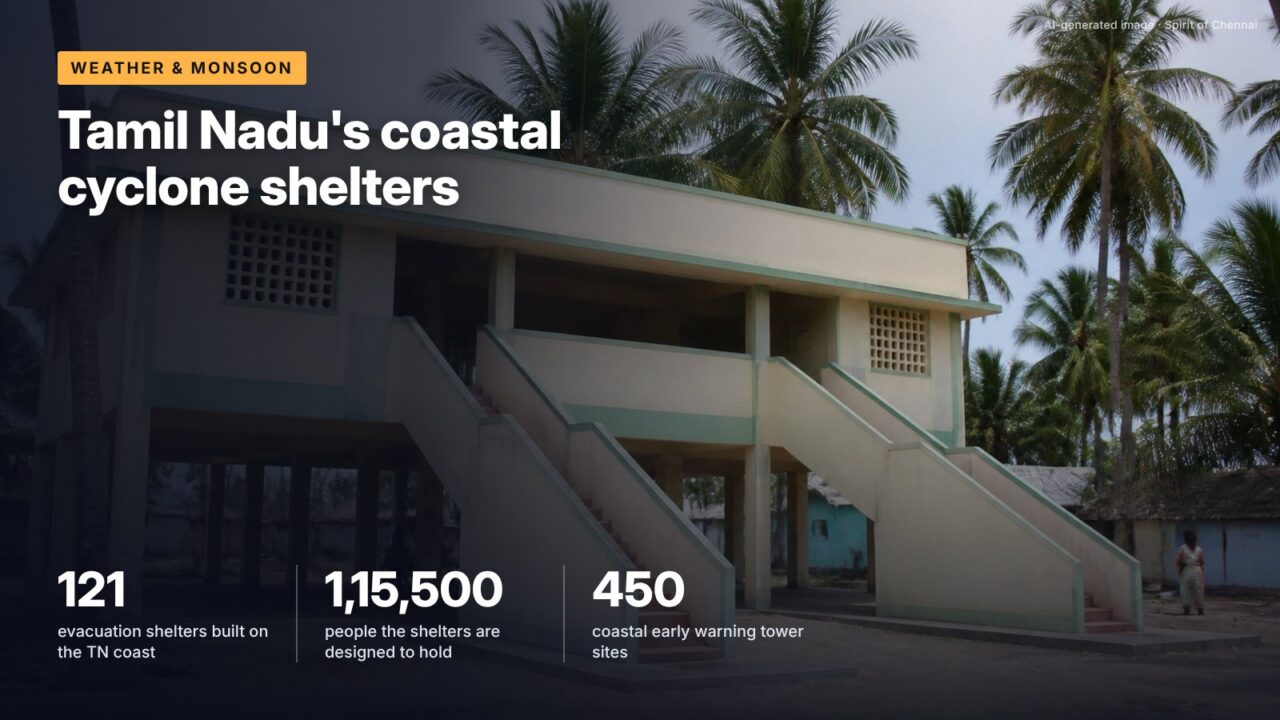
Tamil Nadu’s purpose-built cyclone shelters did not come from India’s national cyclone programme. They came from a World Bank project after the tsunami, and the completion report on it reads like an audit. What was built, who runs the shelters, and what went slower than planned.
The numbers
The 121 multipurpose evacuation shelters along Tamil Nadu’s coast were built under the Tamil Nadu and Puducherry Coastal Disaster Risk Reduction Project, financed by the World Bank, not under the National Cyclone Risk Mitigation Project. In a 2020 reply to the Lok Sabha, the Union Home Ministry stated plainly that “The State of Tamil Nadu is not covered under this Project” (Unstarred Question 1580). Phase I of the national project covered Andhra Pradesh and Odisha; phase II covered Goa, Gujarat, Karnataka, Kerala, Maharashtra and West Bengal.
The Tamil Nadu project’s Implementation Completion and Results Report of November 2021 records 121 shelters completed, 100 per cent of target, with a design capacity of about 1,15,500 people across 357 habitations. It also records slower progress on underground power lines, a cost lower than planned, and an overall rating of “moderately satisfactory”.
Why Tamil Nadu took a separate route
The shelters are part of a sequence that began after the 2004 tsunami. An Emergency Tsunami Reconstruction Project started about 14,400 multi-hazard resilient houses, and when the World Bank approved a US$236 million credit on 20 June 2013 for the follow-on project, it set out to finish those houses and add about 120 evacuation shelters, about 440 early warning systems, about 1,000 km of underground cabling and evacuation roads, benefiting over 17,000 families in about 150 coastal villages in 11 districts.
The national project still lists Tamil Nadu among its Category I high-vulnerability coastal states. The World Bank’s safeguards sheet for phase II provides only a contingent emergency component under which Tamil Nadu or Puducherry could request reallocation of funds after a major disaster.
What was built
| Item | Built in Tamil Nadu | Note |
|---|---|---|
| Community hall-cum-shelters | 53 | Used as halls between emergencies |
| School-cum-shelters | 64 | Run as school buildings |
| Primary health centre-cum-shelters | 4 | Health use between emergencies |
| Total shelters | 121 | 100% of target |
| Evacuation routes | 41 km | Target 44 km; plus 73 culverts and 1 bridge |
| Signage | 20 | |
| Design capacity | about 1,15,500 people | Across 357 habitations |
Source: World Bank, Implementation Completion and Results Report, Tamil Nadu and Puducherry Coastal Disaster Risk Reduction Project (P143382), November 2021
The dual-use design is the key choice. A building that is a school or community hall 360 days a year gets swept, painted and repaired; a stand-alone shelter tends to decay between storms. The report records coastal communities moving into completed shelters during the December 2015 floods, Cyclone Ockhi in 2017 and Cyclone Gaja in 2018.
Who runs the shelters
Each of the 121 shelters has a Cyclone Shelter Maintenance and Management Committee with a corpus fund for upkeep, the completion report says. The state issued operating guidelines for shelter management and maintenance by G.O. No. 279 on 1 August 2018. Village maintenance committees and fisheries co-management bodies were designed to keep paying for operation and maintenance after the World Bank money ended.
Fishers given VHF radio sets under the project, against a target of 5,000, per the World Bank completion report.
Warnings that reach the shore
A shelter is useful only if people know when to go. The project built an early warning network on the Tamil Nadu State Wide Area Network with towers at 450 sites along the coast, a central server at the Disaster Management Cell in Chepauk, Chennai, a backup in Tirunelveli and 13 district servers. Towers were designed for winds of 250 km/h and carry solar panels with 48 hours of battery backup. The report is internally inconsistent on completion, citing 100 per cent coverage in one place and 431 of 439 units in another. It also credits the state’s TN-SMART decision support app with more than 2,00,000 downloads.
What went slower than planned
Underground cabling, which keeps power on and removes falling-pole hazards in a cyclone, lagged. At project closing in June 2020, 418 km had been laid in Tamil Nadu, out of 936 km across both states against a target of 1,850 km. The state continued with its own funds, reaching 1,504 km by 31 July 2021, but only 15,252 of 26,407 service connections (58 per cent) were charged at that point, the report says.
The money also came in under plan. Total project cost was revised from US$337.2 million to US$247.5 million, and actual spending was US$233.5 million. Of the US$236 million IDA credit, US$163.4 million was disbursed. The closing date was extended by 23 months. Among its lessons, the report says cabling delays were underestimated, new implementing agencies lacked World Bank experience, and no baseline or impact evaluation was done.
It’s often said Tamil Nadu’s coastal cyclone shelters were built under the national cyclone mitigation programme.
The record shows The Union Home Ministry told Parliament that Tamil Nadu is not covered by that programme. Its 121 purpose-built shelters came from a World Bank-funded state project, per the Lok Sabha reply and the completion report.
What it means for Chennai
The completion report gives no Chennai-specific shelter figures; Chennai appears only as the site of the central warning server. In the city, people evacuated during cyclones and floods are housed mainly in relief centres such as schools and community halls arranged by the Corporation and district administration. The risk is real: during Severe Cyclonic Storm Michaung, Chennai and neighbouring districts received very heavy to extremely heavy rain on 4 to 6 December 2023, according to the IMD RMC Chennai report.
What this means for you
- If you live in a coastal village in one of the project districts, find out which school or hall is your designated shelter and who sits on its management committee.
- Coastal siren and tower warnings come through the state network; treat them as instructions to move, not just as information.
- Fishers should keep VHF sets charged and tuned during the October to December cyclone season.
- In Chennai, check your ward’s relief centres with the Corporation before the season peaks.
What to watch
Through December 2026
The northeast monsoon and Bay of Bengal cyclone season, when shelters and warning towers are tested.
Pending
Completion of charging for all underground cable service connections, which stood at 58 per cent in July 2021.
Pending
Any extension of national cyclone mitigation funding to Tamil Nadu, which is not covered at present.
Checked against official sources on 23 October 2026. Figures and rules change; confirm on the linked official pages before relying on them.
Sources
- Implementation Completion and Results Report, Tamil Nadu and Puducherry Coastal Disaster Risk Reduction Project (P143382), World Bank, November 2021
- World Bank approves $236 million for reducing disaster risks for coastal villages in Tamil Nadu and Puducherry, World Bank, 20 June 2013
- Lok Sabha Unstarred Question No. 1580, National Cyclone Risk Mitigation Project, Ministry of Home Affairs, 2020
- Integrated Safeguards Data Sheet, National Cyclone Risk Mitigation Project II (P144726), World Bank (copy)
- Report on northeast monsoon 2023, Regional Meteorological Centre Chennai, IMD