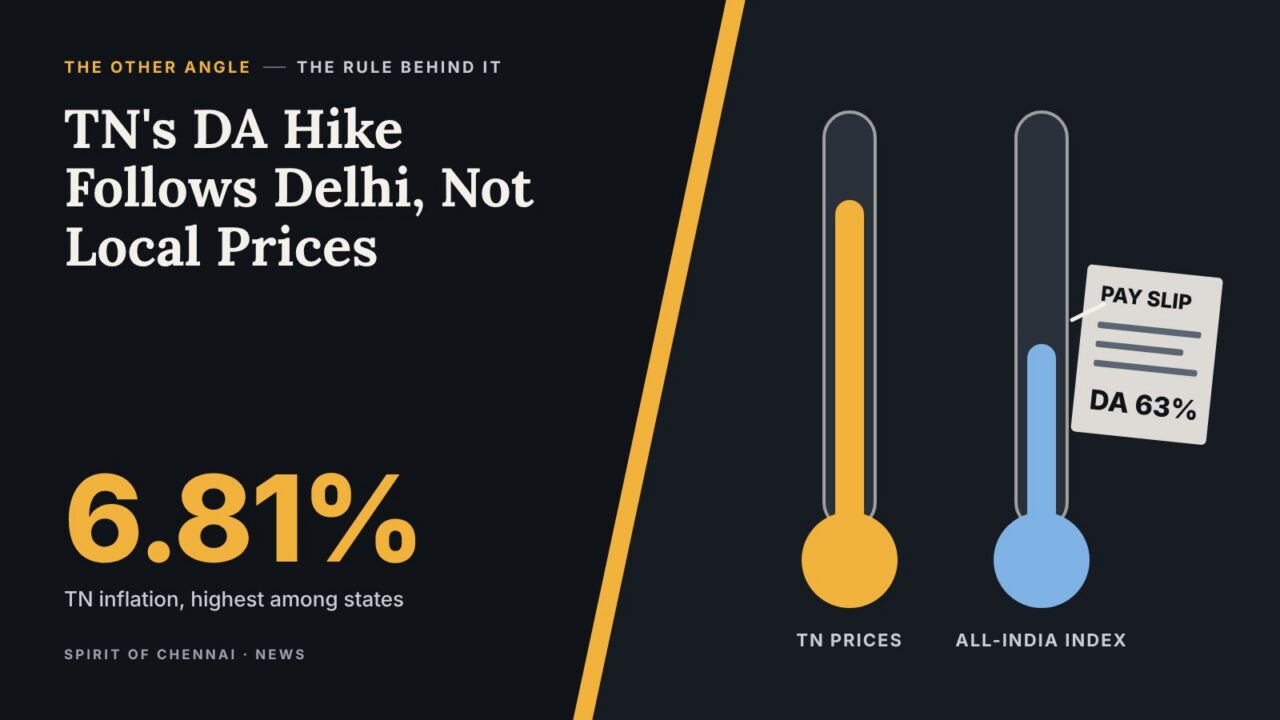
Tamil Nadu raised dearness allowance for about 16 lakh employees and pensioners from 60% to 63% on 31 October, a month after the state recorded India’s highest retail inflation. The two numbers have nothing to do with each other: the state’s DA follows a Union decision built on an all-India workers’ price index, not Tamil Nadu’s own.
The numbers
What was reported
IANS, in a report carried by Telangana Today on 31 October 2026, said Chief Minister C. Joseph Vijay had raised DA by three points to 63%, retrospective from 1 July 2026, at an extra cost of about ₹1,858 crore a year, following the Centre’s identical increase. A fortnight earlier, Business Standard reported that Tamil Nadu’s inflation had overtaken Telangana’s to become the highest among states. The coverage treated these as separate stories. Read together, they show who in Tamil Nadu is and is not protected from local prices.
The decision is made in Delhi
The Union Cabinet approved the increase on 28 October 2026: an additional 3% of basic pay or pension over the existing 60%, from 1 July 2026, costing ₹10,016.10 crore a year and covering about 48.54 lakh central employees and 68.71 lakh pensioners. The release says the increase follows an “accepted formula” based on the Seventh Central Pay Commission’s recommendations.
Tamil Nadu then matched it. The pattern repeated an earlier round: in May 2026 the state raised DA by two points to 60% from 1 January 2026, at about ₹1,230 crore a year, after the Union government did the same, DT Next reported.
The Consumer Price Index for Industrial Workers is compiled from 88 industrial centres, Chennai among them, according to a Labour Ministry release. The Labour Bureau says the index is used to regulate wages and dearness allowance for millions of workers and employees.
Two different price indices
The 6.81% figure that made headlines comes from the National Statistics Office’s Consumer Price Index on base 2024, which covers all households and is released state by state. The DA formula draws on a different family of indices, the Labour Bureau’s Consumer Price Index for Industrial Workers, calculated for industrial centres and averaged nationally. Chennai is one of those centres, but it is one of 88, so a sharp rise in Tamil Nadu’s prices barely moves the national average that pay decisions use.
| Month (2026) | Tamil Nadu CPI inflation | All-India CPI inflation |
|---|---|---|
| January | 3.35% | Not used here |
| July | 5.44% | 4.45% |
| August | 5.91% | 4.83% |
| September | 6.81% | 5.54% |
Source: NSO CPI (base 2024) press release for July 2026 via PIB; September figures via DD News; January and August Tamil Nadu figures as reported by Business Standard, 13 October 2026.
The gap has widened through the year. In July, Tamil Nadu was one point above the national rate; by September it was 1.27 points above, with food inflation in the state at 10.62%, the highest among states, according to Business Standard.
What three points of DA buys
DA is a percentage of basic pay, so the right comparison is pay plus DA. Between July 2025 and July 2026 the rate went from 58% to 63%. For an employee whose basic pay did not change, basic plus DA rose from 158 to 163 units, an increase of about 3.2%. Tamil Nadu’s consumer prices rose 5.44% over the year to July 2026 on the NSO measure. The two indices are not built the same way, so this is an illustration rather than a precise loss, but it shows the direction: a state employee in Chennai is compensated for India’s average price rise, not Tamil Nadu’s.
For the state’s budget the arithmetic runs the other way. Dividing ₹1,858 crore by about 16 lakh beneficiaries gives roughly ₹11,600 a year each on average, paid regardless of whether local prices rise faster or slower than the national index.
It’s often said a DA hike is the government’s response to high prices in the state.
The record shows both 2026 increases in Tamil Nadu followed Union decisions taken on a national formula, with the same rate and the same effective date. The state’s own inflation figure did not enter the calculation.
Who has no index at all
The 16 lakh employees, teachers and pensioners are, in one sense, the protected group. Most of Tamil Nadu’s working population has no automatic link to any price index: self-employed traders, gig workers, domestic workers and most private employees depend on whatever their employers or markets give. For them the 10.62% food inflation in September arrives with no adjustment at all. The state’s own levers for that group are mostly on the supply side, such as the public distribution system and subsidised sales, rather than on pay.
There is also a timing gap even for the protected. Each DA instalment is announced months after the period it covers. The July 2026 increase was approved by the Centre on 28 October and matched by the state on 31 October, with arrears for four months; the price rises it compensates for had already been paid at the shop.
What this means for you
- If you are a Tamil Nadu government employee or pensioner, the 63% DA applies from 1 July 2026; arrears follow the state’s order.
- Your DA tracks an all-India index; it will not rise faster because prices in Tamil Nadu are rising faster.
- For household budgeting, the state’s September food inflation of 10.62% is a better guide to what you are paying than the national 5.54%.
- Private-sector workers have no automatic adjustment; pay negotiations are the only route.
What to watch
12 November 2026
NSO releases October 2026 CPI, showing whether Tamil Nadu stays above the national rate, as stated by DD News.
Pending
The next DA instalment, for January 2027, which by the established pattern follows the Union decision.
Pending
The state’s own order setting out how and when the July to October 2026 arrears will be paid.
Checked against official sources on 4 November 2026. Details may change; confirm on the linked official pages.
Sources
- Cabinet approves Dearness Allowance to Central Government employees and Dearness Relief to Pensioners (PM India, 28 October 2026)
- Consumer Price Index for Industrial Workers, about the index (Labour Bureau, Ministry of Labour and Employment)
- CPI-IW for September 2021, 88 centres (Ministry of Labour and Employment, PIB, 29 October 2021)
- CPI press release for July 2026, base 2024 (NSO, MoSPI, via PIB, 12 August 2026)
- Retail inflation rises to 5.54% in September (DD News, Prasar Bharati, 12 October 2026)
- Tamil Nadu raises dearness allowance to 63 pc (IANS via Telangana Today, 31 October 2026)
- Tamil Nadu overtakes Telangana with highest retail inflation in September (Business Standard, 13 October 2026)
- Tamil Nadu govt hikes DA by 2% to 60% (DT Next, 14 May 2026)