Tamil Nadu’s folk artistes welfare board has added more than 22,000 members since 2017, but its payouts have barely moved. The policy notes show who gets paid, for what, and how little.
The numbers
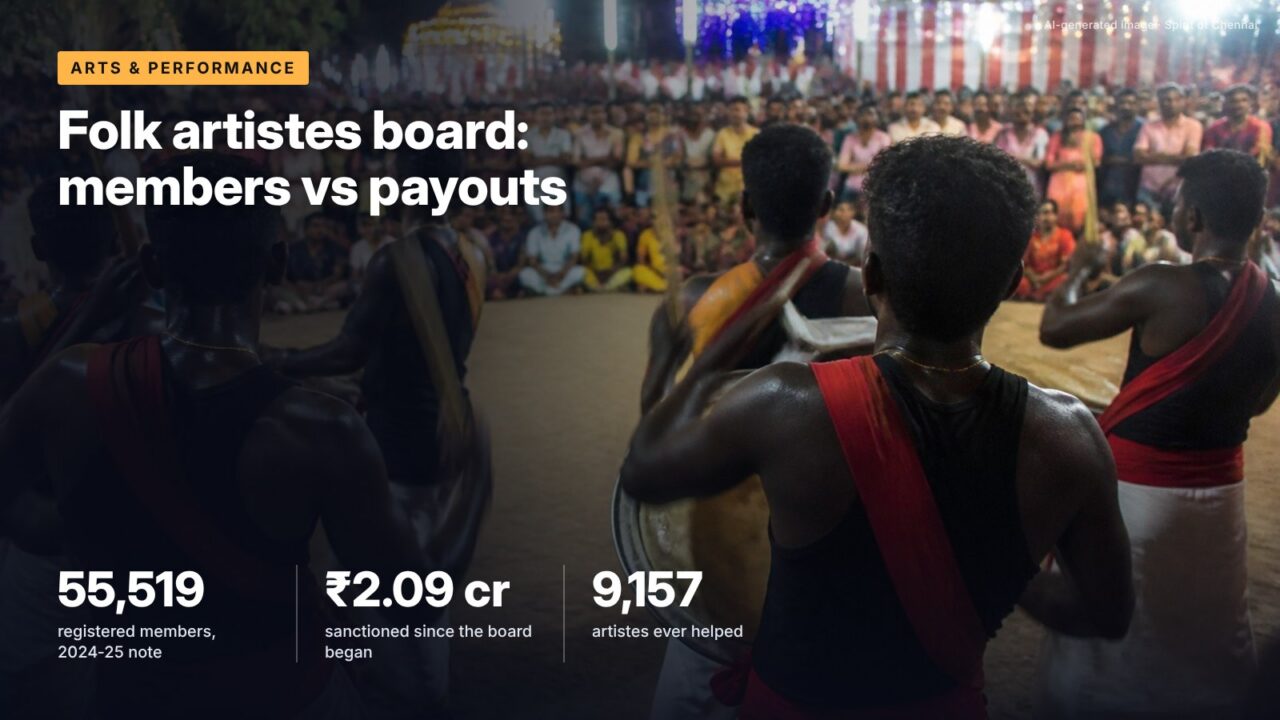
The Tamil Nadu Folk Artistes Welfare Board had 55,519 registered members when the state’s 2024-25 policy note was written. Since it began, it had sanctioned ₹209.11 lakh, a little over ₹2 crore, to 9,157 artistes. Divided across the membership, that is about ₹377 per member over the board’s whole life, which is the clearest measure of how thin this safety net is.
Membership has grown much faster than payouts. In March 2017 the board had 33,030 members; in seven years it added more than 22,000. Over the same period cumulative benefits rose by about ₹80 lakh. Between the 2023-24 and 2024-25 policy notes, the cumulative total moved by just ₹4.33 lakh and 60 beneficiaries, even as the board’s annual grant from the government was raised from ₹35 lakh to ₹90 lakh.
What the board is for
The board covers performers of the state’s traditional forms: the policy notes say 99 folk art forms have been identified, from karagattam and thappattam to therukoothu and oyilattam. Membership is the gateway to a fixed menu of one-time payments for life events, administered through the Directorate of Art and Culture. These are not wages or pensions. They are small grants paid when something specific happens.
| Benefit | Amount (2024-25 note) |
|---|---|
| Accidental death | ₹1,00,000 |
| Natural death | ₹20,000 |
| Funeral expenses | ₹5,000 |
| Marriage | ₹5,000 |
| Spectacles | ₹1,500, once in three years |
Source: Department of Art and Culture, Policy Note 2024-25, Tamil Nadu Folk Artistes Welfare Board
The notes also list education and child delivery assistance without printing the rates in the same table. Separate from the board, the Eyal Isai Nataka Manram pays ₹3,000 a month to selected aged indigent artistes, and the 2024-25 note records ₹10,000 grants to 500 folk artistes for instruments and costumes.
Membership against money, 2017 to 2024
| Policy note | Registered members | Cumulative sanctioned | Artistes helped |
|---|---|---|---|
| 2017-18 (as of 31.03.2017) | 33,030 | ₹129.23 lakh | 7,487 |
| 2021-22 | 43,175 | ₹157.53 lakh | 8,134 |
| 2022-23 | 47,976 | not stated | not stated |
| 2023-24 | 51,403 | ₹204.78 lakh | 9,097 |
| 2024-25 | 55,519 | ₹209.11 lakh | 9,157 |
Source: Govt of Tamil Nadu, Art and Culture policy notes 2017-18, 2021-22, 2022-23, 2023-24 and 2024-25
Read across the rows, the share of members who have ever received a benefit has fallen. In 2017 the 7,487 artistes helped were equal to about 23 per cent of the membership; by 2024-25 the 9,157 helped were about 16.5 per cent. Some artistes may have received more than one benefit, so the true share of individuals is lower still. The 2023-24 note gives one single-year figure: ₹31.19 lakh to 733 members in 2022-23.
Share of all money the board has sanctioned that went on natural death and funeral payments, ₹111.59 lakh of ₹209.11 lakh, per the 2024-25 policy note.
Where the money actually went
The 2024-25 note breaks the cumulative ₹209.11 lakh into five categories. Natural death and funeral claims for 776 artistes took ₹111.59 lakh. Education help for 3,826 members’ families took ₹54.42 lakh, spectacles for 3,878 took ₹24.57 lakh, marriage assistance for 657 took ₹17.33 lakh, and child delivery for 20 took ₹1.20 lakh. In other words, the board pays most often for glasses and schooling, but most of its money goes to families after a death.
The one large exception came during the pandemic. The 2021-22 policy note records COVID-19 relief of ₹7.48 crore sanctioned for folk artistes, of which ₹6.36 crore was spent. That single episode was nearly five times everything the board had paid in normal benefits up to then, ₹157.53 lakh.
It’s often said registering with the welfare board gets a folk artiste a monthly pension.
The record shows The board pays one-time amounts for death, marriage, education, childbirth and spectacles. The ₹3,000 monthly assistance for aged indigent artistes is a separate scheme with its own selection, and new beneficiaries have been added in batches of 1,000.
The pension track beside the board
The monthly assistance for aged indigent artistes has a longer paper trail than the board. The 2017-18 policy note put it at ₹1,500 a month, raised from ₹1,000 from 1 April 2013, with 13,563 artistes sanctioned up to then, 500 more added from 1 November 2016 at a cost of ₹37.50 lakh, and an annual income ceiling of ₹60,000. By 2021 the rate had been doubled to ₹3,000, and the 2021-22 and 2024-25 notes each record a batch of 1,000 new beneficiaries, in June 2021 and September 2023. The 2023-24 note adds that legal heirs of 123 indigent artistes received ₹91.11 lakh, and senior Kalaimamani awardees in hardship can get a one-time ₹1 lakh. Even this single scheme moves far more money each year than the board: 1,000 pensions at ₹3,000 a month cost ₹3.6 crore a year, more than the board has paid in its whole life.
Why the gap matters
A welfare board is only as strong as its claims process. Rising membership with flat payouts can mean several things: members who are young and have few claim events, artistes who do not know what they can claim, or applications that stall. The policy notes do not publish pending applications or rejection rates, so the cause cannot be pinned down from the official record. What is clear is that the government’s grant increase to ₹90 lakh a year is now well above what the board has been paying out annually in recent years.
Identity cards are part of the same system. District art societies have issued artist identity cards since 2002-03, and the count rose from 59,445 in the 2021-22 note to 82,748 in 2024-25. The 2017-18 note says the card is used to obtain state assistance, priority in government cultural programmes and travel concessions.
What this means for you
- If you perform a traditional form, register with the board through the district office of the Directorate of Art and Culture and keep your identity card current.
- Claims are event-based: file promptly after a death, marriage, birth or school admission in the family, with documents.
- Spectacles help can be claimed once every three years.
- The ₹3,000 monthly assistance is a separate application through the Eyal Isai Nataka Manram.
What to watch
Pending
The next policy note will show whether the higher ₹90 lakh grant has lifted payouts above the recent annual level.
Pending
Benefit rates have not been revised in the recent notes; any revision would come by government order.
Checked against official sources on 23 October 2026. Figures and rules change; confirm on the linked official pages before relying on them.
Sources
- Art and Culture and Museums Policy Note 2024-25 (Govt of Tamil Nadu)
- Art and Culture Policy Note 2023-24 (Govt of Tamil Nadu)
- Art and Culture Policy Note 2022-23 (Govt of Tamil Nadu)
- Art and Culture Policy Note 2021-22 (Govt of Tamil Nadu)
- Art and Culture Policy Note 2017-18 (Govt of Tamil Nadu)
- Demand for Grant No. 29, BE 2025-26 (Finance Department, Govt of Tamil Nadu)