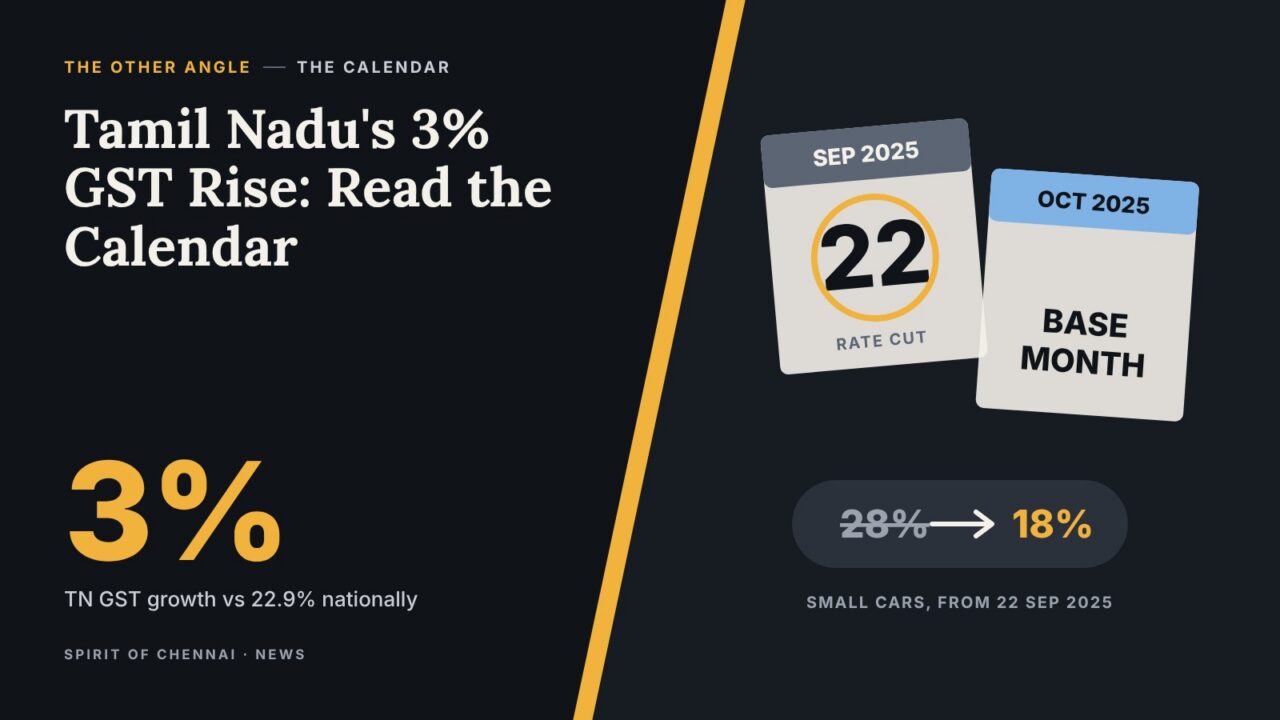
Tamil Nadu’s GST collections rose just 3% in October 2026 while India’s rose 22.9%, and the gap became a political row. The part nobody explained is the calendar: this October was measured against a month of sales made mostly at the old, higher tax rates, and the Deepavali shift means November’s figure will be distorted too.
The numbers
What was reported
ThePrint reported on 4 November that Tamil Nadu’s gross collections grew about 3%, to ₹11,661 crore, against double-digit growth in Karnataka, Kerala, Andhra Pradesh and Telangana. DMK leaders criticised the state government; Finance Minister Marie Wilson and Commercial Taxes Minister D. Logesh Tamilselvan replied that gross collection is not the state’s revenue and pointed to 8% growth in post-settlement SGST for the month. That pre- versus post-settlement debate has been aired before. This piece looks at something else: which months are actually being compared.
A tax collected one month after the sale
GST is paid on returns that businesses file for the previous month’s sales. So the figure the GST Network publishes at the start of November, labelled “October”, mostly reflects trade done in September. That matters this year because September 2025 was the month the tax rates changed.
The GST Council’s 56th meeting recommended on 3 September 2025 that new rates apply from 22 September 2025 for most goods and services. Among the largest cuts for Tamil Nadu’s economy was the move from 28% to 18% on small cars and motorcycles of 350 cc or less, products made in large numbers at plants around Chennai.
The October 2025 base therefore rests largely on supplies made before 22 September 2025, at the old rates. The October 2026 figure rests on supplies made a full year after the cut. Part of the slow growth is simply a lower tax rate on the same goods, not fewer sales.
Year-on-year change in the consumer price index for motor cars and jeeps in September 2026, one of the few items whose prices fell, according to the NSO data reported by DD News.
The base has moved as well
There is a second, quieter detail in the official tables. When the October 2025 numbers were first published, in a release dated 3 November 2025, Tamil Nadu’s collection for that month was ₹11,588 crore, up 4% on ₹11,188 crore in October 2024. In the October 2026 report, the same month is shown as ₹11,298 crore.
The reports state that the numbers are provisional and may change on finalisation; they do not explain this particular difference. The effect is not small. Measured against the October 2025 figure as first published, Tamil Nadu’s October 2026 collection would be only about 0.6% higher. The all-India base moved too: ₹1,95,936 crore for October 2025 in the 2025 release, ₹1,88,125 crore in the 2026 report.
| Tamil Nadu, gross GST (₹ crore) | Figure | Published in |
|---|---|---|
| October 2024 | 11,188 | 3 Nov 2025 release |
| October 2025, as first reported | 11,588 | 3 Nov 2025 release |
| October 2025, as restated | 11,298 | October 2026 report |
| October 2026 | 11,661 | October 2026 report |
| Pre-settlement SGST, Oct 2025 to Oct 2026 | 4,039 to 4,253 (+5%) | October 2026 report |
| Post-settlement SGST, Oct 2025 to Oct 2026 | 6,895 to 7,460 (+8%) | October 2026 report |
Source: GSTN monthly revenue reports, provisional; state figures exclude GST on imports. Percentage for the first-reported base calculated for this article.
Why the rest of India grew faster
The national headline of 22.9% includes GST on imports, which every state’s own figure excludes. The October 2026 report puts integrated GST on imports at ₹72,246 crore, and ThePrint reported import-related GST growth of 42.2% against 15.8% for domestic GST. Imports are cleared at ports and the tax is later settled to the consuming state, so a state’s gross column never shows that surge.
Neighbouring states also started from different bases. In the October 2026 table, Karnataka rose from ₹13,446 crore to ₹15,922 crore (18%), Kerala 23%, Andhra Pradesh 24% and Telangana 14%. Their mix of goods differs from Tamil Nadu’s, which leans heavily on manufacturing, including automobiles, so a cut concentrated on vehicles weighs on each state differently. Puducherry, next door, fell 7%.
It’s often said 3% GST growth means Tamil Nadu’s economy grew 3% in October.
The record shows gross GST is tax paid by businesses registered in the state, a month in arrears, at rates that were cut in September 2025, against a provisional base that has itself been restated. It is not a measure of output or sales volume.
The Deepavali shift that will hit November
The festival calendar is about to add a second distortion. Tamil Nadu’s 2025 holiday list, G.O. Ms. No. 792, put Deepavali on Monday 20 October 2025. The 2026 list, G.O. Ms. No. 708, puts it on Sunday 8 November 2026, 19 days later.
In 2025, the clothes, jewellery, sweets, electronics and vehicle buying before the festival fell almost entirely in October, and so showed up in November 2025 collections. In 2026, much of that spending runs into the first week of November, so it will be split between the November and December 2026 figures. When the November 2026 numbers are compared with November 2025, the base will carry a full festival season and the current month only part of one. Unless spending is much stronger, the year-on-year comparison is likely to look weak again, and December’s comparison correspondingly flattering.
The same caution applies to every state, but it matters most where the gross number has become a political scorecard. Comparing the October to December quarter as a whole, rather than single months, removes most of the festival timing.
What the state actually keeps
For the state budget, the relevant line remains post-settlement SGST: ₹7,460 crore in October 2026, and ₹51,726 crore for April to October, 15% higher than a year earlier, according to the October report. Pre-settlement SGST for April to October, the state’s share collected directly within Tamil Nadu, was ₹28,100 crore, 1% lower. Both are provisional. Neither is affected by the import surge in the national figure, and both carry the same rate-cut and festival-timing effects described above.
What this means for you
- Treat single-month GST growth figures with care until December: the rate cut and the Deepavali date both distort the comparison.
- For the state’s finances, look at post-settlement SGST, not the gross collection or the national headline that includes imports.
- Lower GST on small cars and two-wheelers since 22 September 2025 means buyers pay less tax per vehicle; that shows up as lower collections even when sales hold.
- Compare quarters, not months, when the festival falls in a different month from the year before.
What to watch
8 November 2026
Deepavali. Pre-festival spending in late October and early November will be split across the November and December GST figures.
Early December 2026 (date not fixed)
GSTN’s November 2026 report, the first month compared against a festival-heavy base from 2025.
Pending
Final, rather than provisional, figures for 2025-26, which may explain why the October 2025 base was restated.
Checked against official sources on 4 November 2026. Details may change; confirm on the linked official pages.
Sources
- GST revenue report, October 2026, state-wise and SGST tables (GST Network, November 2026)
- GST collections release for October 2025 (GST Network, via PIB, 3 November 2025)
- Recommendations of the 56th Meeting of the GST Council (PIB, Ministry of Finance, 3 September 2025)
- Public holidays 2026, G.O. Ms. No. 708 Public (Misc.), 11 November 2025 (Tamil Nadu Government Gazette)
- Public holidays 2025, G.O. Ms. No. 792 Public (Misc.), 22 November 2024 (Tamil Nadu Government Gazette)
- Retail inflation rises to 5.54% in September (DD News, Prasar Bharati, 12 October 2026)
- Tamil Nadu’s GST revenue grows just 3% in October (ThePrint, 4 November 2026)