Chennai rarely crosses 45°C, yet it can still be under a heatwave. Tamil Nadu has a statewide heat strategy, treats extreme heat as a state-level disaster, and counts very few heat deaths. Each of those facts needs reading carefully.
The numbers
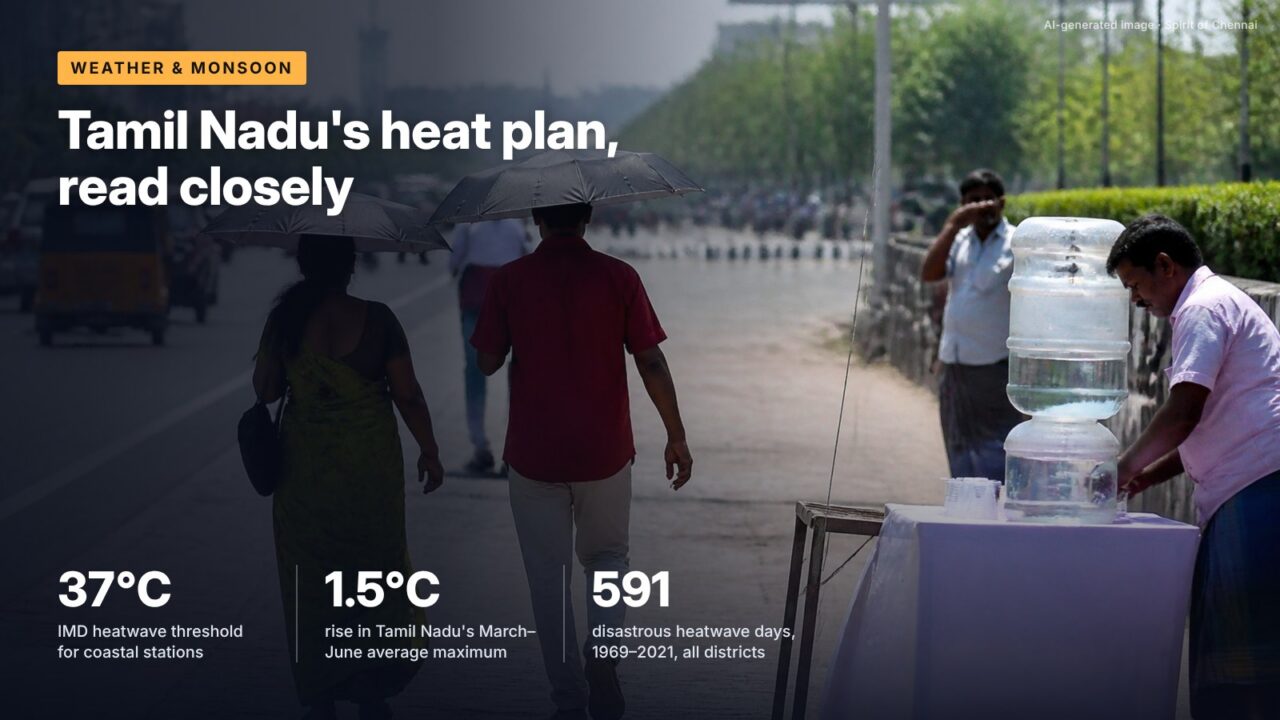
Heat in Tamil Nadu is rising faster than its official death toll suggests. The state’s heat mitigation strategy, prepared by the State Planning Commission, finds the average March to June maximum air temperature 1.5°C above the 1981 to 2011 baseline, and the average minimum 0.75°C higher. About 74 per cent of the population is exposed to air temperatures above 35°C. Yet NCRB data cited by the Union government record two heat deaths in Tamil Nadu in 2021 and two in 2022.
The gap between exposure and recorded deaths is the central fact for policy. The strategy itself estimates that only about 10 per cent of heat-related deaths are recorded, because of limited awareness and inconsistent reporting. A heat plan built on official deaths alone would aim far too low.
When IMD calls it a heatwave
IMD’s heatwave criteria are purely about temperature. In the plains, a station must reach at least 40°C, and a heatwave is declared when the maximum is 4.5°C to 6.4°C above normal (more than 6.4°C is a severe heatwave), or when it reaches 45°C regardless of normal (47°C for severe). Coastal stations such as Chennai follow a separate rule: a heatwave may be described when the maximum is at least 37°C and 4.5°C or more above normal.
The area rule matters too. The criteria must be met at two or more stations in a meteorological subdivision for at least two consecutive days, and the heatwave is declared on the second day. Warm nights, defined by how far the minimum is above normal, are counted only on days when the maximum is 40°C or more.
| Situation | Heatwave | Severe heatwave |
|---|---|---|
| Plains: departure from normal (max at least 40°C) | 4.5°C to 6.4°C above | More than 6.4°C above |
| Plains: actual maximum | 45°C or more | 47°C or more |
| Hills: threshold | Max at least 30°C, same departures | Same rule |
| Coastal stations | Max at least 37°C and 4.5°C above normal | Not separately defined |
| Warm night (max at least 40°C) | Min 4.5°C to 6.4°C above normal | Very warm: more than 6.4°C above |
Source: India Meteorological Department, FAQ on heat wave
The state strategy argues that these thresholds are not enough on their own. It recommends locally calibrated thresholds built on 10 to 15 years of mortality data, noting that only 10 of 37 heat action plans in India set local thresholds, the strategy says.
What the state’s heat strategy found
The Heat Mitigation Strategy draws on IMD and satellite data. Average annual heatwave days exceeded eight a year from 2011 to 2021, and more than 40 per cent of the state’s area had at least 15 heatwave days a year between 2011 and 2019. Seventeen of 38 districts face a continuous heatwave threat. “Thermal discomfort” days, a measure combining heat and humidity, are projected to rise from about 107 a year in 1985 to 2014 to 150 a year by 2050.
The document also uses an older measure. A “disastrous heatwave day” is a day with at least one human death attributed to heat; Tamil Nadu recorded 591 such days across all districts between 1969 and 2021. Up to the end of June 2023, 12 heatwave-related deaths were reported in the state.
Years since 1980 in which Meenambakkam’s temperature was above the long-term average, according to the state heat strategy.
Chennai’s problem is the night
For Chennai, the strategy’s most important finding concerns nights. The city’s built-up area more than doubled between 2000 and 2020. Night-time land surface temperature, measured by satellite, is about 2°C higher in Chennai’s urban core than in its peri-urban fringe. Across the state, major built-up areas averaged 26°C at night in March to May 2019 to 2023, against a statewide average of 24°C, and about 27 per cent of people live where night temperatures exceed the built-area average. Chennai, Madurai and Thoothukudi saw extreme-heat areas expand between 2003 and 2023.
Hot nights matter because the body recovers from daytime heat while sleeping. A coastal city with high humidity and warm nights can be dangerous without ever recording a headline maximum, which is exactly the case IMD’s 37°C coastal rule tries to capture.
Counting the dead
| Year | Tamil Nadu | All India |
|---|---|---|
| 2018 | 0 | 890 |
| 2019 | 0 | 1,274 |
| 2020 | 0 | 530 |
| 2021 | 2 | 374 |
| 2022 | 2 | 730 |
Source: NCRB data cited in Lok Sabha reply, Ministry of Earth Sciences, PIB, 20 August 2025
It’s often said Tamil Nadu barely has a heat problem, because almost no one dies of heatstroke here.
The record shows NCRB counts only two heat deaths a year in 2021 and 2022, but the State Planning Commission’s strategy estimates that about 10 per cent of heat deaths are recorded, and that 74 per cent of people are exposed to temperatures above 35°C.
The disaster tag and the money
Heat is not one of the 12 disasters notified for relief from the national and state disaster response funds. A state may use up to 10 per cent of its annual State Disaster Response Fund allocation for disasters it notifies locally, subject to conditions, the Union government told the Lok Sabha in August 2025. Tamil Nadu has classified extreme heat as a state-specific disaster, a step cited in the Lok Sabha by the Member for Chennai South, who described the state’s water kiosks, ORS distribution and ex-gratia relief for victims’ families as a precedent (Digital Sansad record).
Nationally, NDMA is working with 23 states on heat action plans covering early warning, awareness, health response and cooling centres, according to a Lok Sabha reply of April 2026. In Tamil Nadu, the State Planning Commission convened a Heat Action Network of departments, and actions are to be steered jointly by the commission and the Tamil Nadu State Disaster Management Agency. Its recommendations include scheduling outdoor work in cooler hours with shaded breaks, adjusting school timings, uninterrupted power for hospitals and more shade at schools and bus stops.
What this means for you
- In Chennai, a heatwave can be declared at 37°C if it is 4.5°C above normal at two stations for two days; do not wait for 40°C.
- Hot, humid nights are a health risk on their own; older people and those in tin-roofed homes need ventilation and water at night.
- Outdoor workers should plan heavy tasks for early morning and evening during April and May, the strategy’s peak stress months.
- Heat deaths are under-recorded; families seeking relief should report suspected heat deaths promptly to local health authorities.
What to watch
March to June 2027
The next summer season, when IMD issues daily heatwave bulletins and impact-based warnings.
Pending
Locally calibrated heat thresholds for Tamil Nadu cities, as recommended by the state strategy.
Pending
District heat action plans and death-investigation committees under national guidelines.
Checked against official sources on 23 October 2026. Figures and rules change; confirm on the linked official pages before relying on them.
Sources
- Beating the Heat: Tamil Nadu Heat Mitigation Strategy, State Planning Commission, Government of Tamil Nadu, 2024
- Beating the Heat: Tamil Nadu Heat Mitigation Strategy 2024, dataset copy of the State Planning Commission document (OpenCity)
- FAQ on heat wave, India Meteorological Department
- Parliament question: loss of lives and health crisis due to intense heat, PIB, 20 August 2025
- Parliament question: rise in temperature, PIB, 1 April 2026
- Lok Sabha: Need to declare heat waves a natural disaster, matter raised by the Member for Chennai South, Digital Sansad