Tamil Nadu raised its traffic spot fines in October 2022, three years after Parliament rewrote the penalties in the Motor Vehicles Act. The transport department’s own policy notes show how enforcement actually works: who checks, what gets suspended, and how much of each e-challan is ever paid.
The numbers
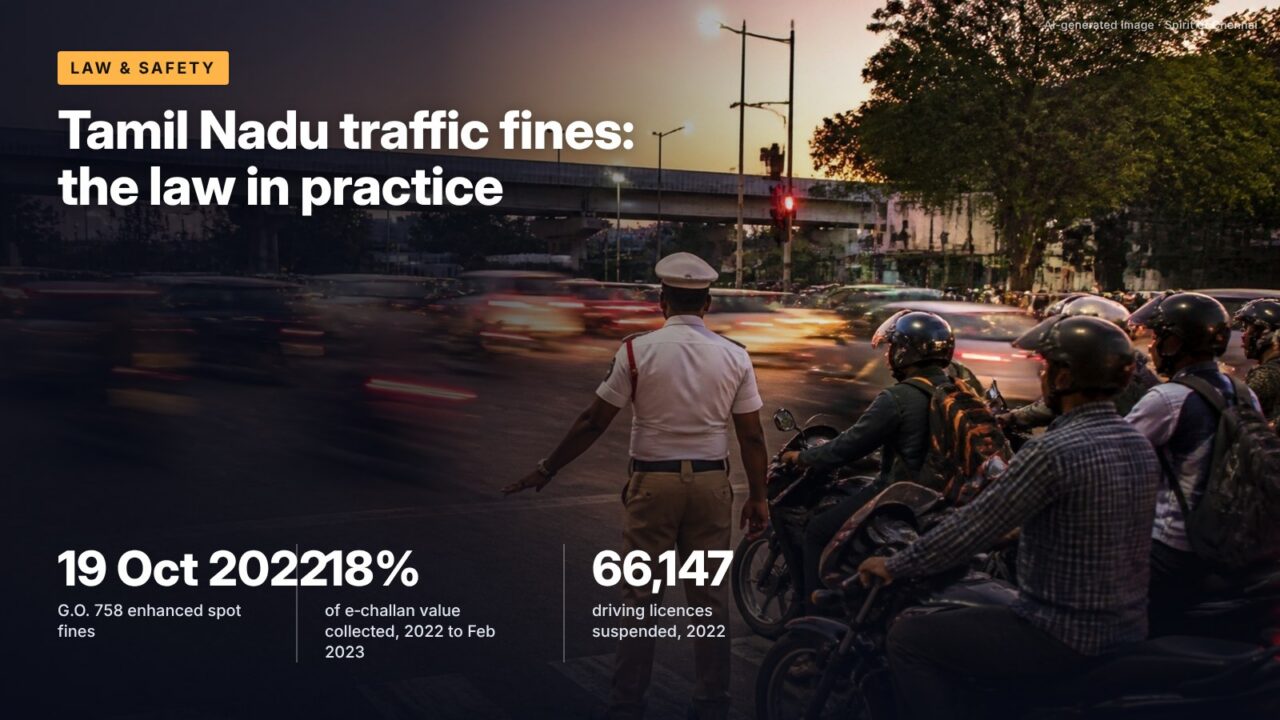
Of ₹22.32 crore in e-challans issued by Tamil Nadu’s transport enforcement officers between January 2022 and February 2023, only ₹4.11 crore, about 18 per cent, had been collected by the end of that period. Of 1,02,299 challans, 80,380 (79 per cent) were still pending, according to the department’s Policy Note 2023-24 for Motor Vehicles Acts Administration. The figures cover the transport department’s own checks, not traffic police challans.
The same note records the state’s key fines order: G.O.(Ms) No. 758, Home (Transport VII) Department, dated 19 October 2022, which enhanced spot fines; the revised amounts have been collected since November 2022. That order sits on top of the Motor Vehicles (Amendment) Act, 2019, which raised the statutory penalties nationally.
How the law sets a fine
There are three layers. Parliament fixes the penalty range in the Motor Vehicles Act, 1988: the 2019 amendment, passed by Parliament between July and August 2019, raised the fine for drunk driving from ₹2,000 to ₹10,000 and allows the Centre to raise fines by up to 10 per cent a year, PRS records. The Act then lets a state act within that range: section 200 allows specified offences to be compounded (settled by paying a fixed sum instead of going to court), and section 210A gives state governments power to increase penalties. Finally, the state notifies the actual amounts its officers collect on the spot, which is what G.O. 758 did.
The compounding amount is what most motorists actually pay. Contesting a challan sends it to a magistrate, who can impose anything within the statutory range.
Who enforces, and how much
Enforcement is split between the transport department’s motor vehicle inspectors and the police. In Chennai the Greater Chennai Police run 56 traffic police stations, according to the Police Policy Note 2023-24. The transport department has two zones in the city, Chennai North and Chennai South, each headed by a Joint Transport Commissioner who also acts as the Regional Transport Authority.
| Transport department enforcement | 2020-21 | 2022-23 (to Feb 2023) |
|---|---|---|
| Vehicles checked | 5.06 lakh | 10.53 lakh |
| Check reports issued | 0.93 lakh | 1.92 lakh |
| Tax collected at checks | ₹5.70 crore | ₹15.77 crore |
| Compounding fees | ₹9.70 crore collected | ₹28.65 crore proposed |
Source: Government of Tamil Nadu, Motor Vehicles Acts Administration Policy Notes 2021-22 and 2023-24
Checks doubled once pandemic restrictions eased. The most frequent offences booked in 2022-23 were driving without a licence (36,078), plying without valid insurance (31,791) and without a pollution certificate (15,012). Excess speed accounted for 8,297 cases and drunk driving for 607 in the transport department’s checks; police booking of drunk driving is separate.
The number of vehicles to police keeps growing. Tamil Nadu had 3,09,44,816 registered vehicles on 31 March 2021 and 3,38,21,790 on 28 February 2023, of which 2.85 crore were two-wheelers; the department says the state ranks third in vehicle population after Maharashtra and Uttar Pradesh. Registration certificates issued rose from 14.77 lakh in 2020-21 to 15.72 lakh in 2022-23 (to February). Transport e-challans also led to 503 vehicles being impounded, of which 128 had been released.
Licence suspensions tell a different story
Suspension, not the fine, is the sanction that keeps a driver off the road. The Policy Note 2021-22 gives a four-year series by offence.
| Licences suspended for | 2017 | 2018 | 2019 | 2020 |
|---|---|---|---|---|
| Mobile phone while driving | 57,158 | 1,26,181 | 35,834 | 32,067 |
| Drunk driving | 30,393 | 45,113 | 20,212 | 7,290 |
| Red light jumping | 19,145 | 51,363 | 18,297 | 23,893 |
| Overspeeding | 17,615 | 33,263 | 10,151 | 13,373 |
| Total (all six offences) | 1,56,694 | 3,35,152 | 1,13,533 | 1,08,257 |
Source: Government of Tamil Nadu, Motor Vehicles Acts Administration Policy Note 2021-22
The 2018 spike, more than double 2017, was followed by a fall of about two-thirds in 2019. The 2023-24 note puts 2022 suspensions at 66,147 for the same set of offences. The notes do not explain the swings, which suggests enforcement drives rather than a steady change in behaviour.
E-challans pending out of 1,02,299 issued by transport enforcement between January 2022 and February 2023, per the Policy Note 2023-24.
It’s often said traffic fines are mostly paid on the spot.
The record shows For transport department e-challans in 2022-23, about four in five were unpaid at the end of the period. The policy note shows ₹18.21 crore of ₹22.32 crore pending, which is why repeat offenders can accumulate challans without paying.
Two official death counts
A reader comparing the department’s notes will find two different series for road deaths in Tamil Nadu. The 2021-22 note reports 10,525 deaths in 2019 and 8,060 in 2020, a 53 per cent fall from 2016. The 2023-24 note reports 18,129 for 2019, 14,527 for 2020, 15,384 for 2021 and 17,884 for 2022. Neither note explains the difference, so any claim about whether higher fines have cut deaths needs to state which series it uses.
Where the fine money goes
Spot fines and compounding fees feed the Road Safety Fund, allocated ₹65 crore a year and made non-lapsable by G.O.(Ms) No. 198, Home Department, dated 13 March 2018. The 2023-24 note lists 3,668 accident hotspots with works estimated at ₹196.94 crore, of which 2,093 were being prioritised at ₹90 crore, and refers to a proposed Tamil Nadu Road Safety Authority. A Special Task Force on Road Safety was given ₹7.64 crore from the fund under G.O.(Ms) No. 146 of 15 March 2022. The note also describes Innuyir Kaappom Thittam, the state’s scheme for treating accident victims in the first hours after a crash.
What this means for you
- Check pending challans against your vehicle number on the Parivahan e-challan system before selling or renewing; unpaid ones follow the vehicle.
- Paying the compounding amount closes the case; contesting it sends it to a magistrate, who may impose a different fine within the Act’s range.
- Licence suspension for mobile phone use, drunk driving, red-light jumping and speeding is used heavily in drives; it costs more than the fine.
- Insurance and a pollution certificate are among the most-booked lapses and among the easiest to fix.
What to watch
Pending
Any notification under section 210A revising Tamil Nadu’s penalty amounts, or a central annual revision of fines under the 2019 amendment.
Pending
Status of the proposed Tamil Nadu Road Safety Authority mentioned in the 2023-24 policy note.
Checked against official sources on 23 October 2026. Figures and rules change; confirm on the linked official pages before relying on them.
Sources
- Policy Note 2023-24, Motor Vehicles Acts Administration (Demand No. 25), Home Department, Government of Tamil Nadu
- Policy Note 2021-22, Motor Vehicles Acts Administration, Government of Tamil Nadu
- The Motor Vehicles (Amendment) Bill, 2019, PRS Legislative Research
- The Motor Vehicles Act, 1988 (as amended), India Code, Ministry of Law and Justice
- Policy Note 2023-24, Police (Demand No. 22), Home, Prohibition and Excise Department, Government of Tamil Nadu