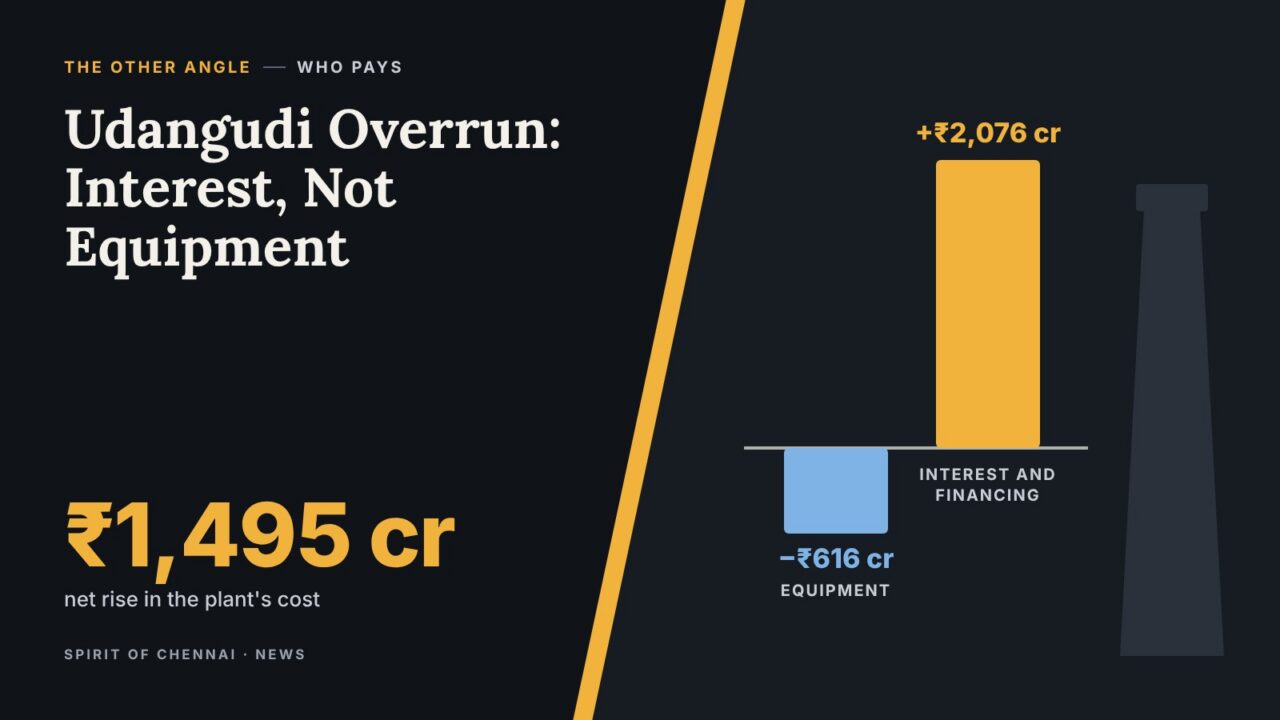
The cost of the Udangudi supercritical power project has been revised up by ₹1,495 crore, and Tamil Nadu’s power regulator is taking objections. The headline figure hides where the money went: the equipment contract actually got cheaper, while interest and financing costs during the long delay more than doubled. Who bears that depends on a regulatory test the coverage did not mention.
The numbers
What was reported
DT Next reported on 1 November 2026 that TNPGCL and TNPDCL had filed a joint petition, M.P. No. 48 of 2026, before the Tamil Nadu Electricity Regulatory Commission to approve a revised cost of ₹14,571.59 crore for the 1,320 MW project in Thoothukudi district, up from an approved ₹13,076.71 crore. The commission admitted it and, by a daily order of 27 October, invited objections until 13 November. Unit 1 began commercial operation on 5 September 2026; Unit 2 is expected soon.
Where the ₹1,495 crore went
The petition’s breakdown, as reported, shows the increase is not in the plant itself.
| Cost head (₹ crore) | Approved | Revised | Change |
|---|---|---|---|
| EPC contract (main plant) | 10,781.87 | 10,165.47 | -616.40 |
| Non-EPC works | 383.97 | 419.16 | +35.19 |
| Start-up fuel, interest during construction, financing | 1,910.87 | 3,986.97 | +2,076.10 |
| Total project cost | 13,076.71 | 14,571.59 | +1,494.88 |
Source: TNPGCL and TNPDCL petition M.P. No. 48 of 2026, as reported by DT Next, 1 November 2026. Rows do not sum to the total because other heads are not itemised in the report. Changes calculated for this article.
Interest during construction alone was ₹2,792.94 crore as of 31 March 2025. Financing and start-up costs have risen from about 15% of the approved cost to about 27% of the revised one. The equipment and construction contract, by contrast, came in ₹616 crore lower.
The rise from the ₹10,615 crore total cost, including interest during construction, recorded for Udangudi Stage I in the Energy Department’s 2018-19 policy note, to the revised ₹14,571.59 crore.
The schedule it was meant to keep
The project’s history is in the Energy Department’s own policy notes. In 2016-17, Stage I was costed at ₹10,615 crore and stuck in a High Court stay on the tender. By 2018-19, the court had ruled in the utility’s favour on 7 December 2017, a letter of intent had gone to BHEL the same day, the site was handed over on 15 December 2017, the Chief Minister had inaugurated the works on 29 January 2018, and the coal jetty had been awarded to ITD Cementation on 13 February 2018. Expected commissioning was 2021-22.
Unit 1 reached commercial operation in September 2026, roughly four to five years behind that target. Every year of delay is a year in which money is borrowed and spent but no electricity is sold, and interest piles onto the capital cost. In per-megawatt terms the project has gone from about ₹8 crore a MW in the 2018 figure, to ₹9.9 crore at the approved cost, to ₹11 crore now.
The test that decides who pays
A generator’s capital cost goes into the fixed charges that the distribution company pays every year for the plant’s life, and those charges flow into consumer tariffs or into state subsidy. So the question before TNERC is not only whether ₹14,571.59 crore was spent, but whether all of it may be passed on.
The national template is the Central Electricity Regulatory Commission’s 2024 tariff regulations, which govern central-sector stations. They treat delays caused by a generator’s own contractor or supplier as controllable, and allow extra interest during construction only in proportion to the part of the delay that is excused. Force majeure, change in law and land acquisition problems not caused by the generator are uncontrollable. In May 2026 the Appellate Tribunal for Electricity applied that distinction to a project in Tripura, holding that delays by BHEL as EPC contractor were controllable and disallowing the related interest, as reported by SCC Online. TNERC applies its own regulations to TNPGCL, but the same logic of a prudence check is at the heart of the petition.
The reasons the utilities give for the Udangudi delay mix both kinds: COVID-19, rainfall, changed emission norms and approval delays on one side; delays by the project management consultant, BHEL manpower shortfalls, a quarry accident and vendor changes on the other.
It’s often said the cost overrun means the boilers and turbines cost more than planned.
The record shows the EPC contract fell by ₹616 crore in the revised estimate. The increase is in interest, financing and start-up costs, which grow with time.
Why it matters beyond one plant
The state’s own white paper on the power sector, released by Electricity Minister CTR Nirmal Kumar in June 2026, put power sector debt at ₹2,47,130 crore and the 2021-26 gap between spending and revenue at ₹34,447 crore, The News Minute reported. Whatever part of the Udangudi increase is allowed adds to the fixed costs that this indebted system must recover; whatever is disallowed stays with the generating company and, ultimately, the state that owns it. Either way, the bill reaches Tamil Nadu residents, as electricity consumers or as taxpayers.
What this means for you
- Anyone can file objections to the petition before TNERC until 13 November 2026, according to the reported daily order.
- The issue for consumers is how much of the delay-related interest the commission allows into the tariff.
- The plant’s power is now flowing from Unit 1; the cost question affects future tariffs, not current supply.
- Similar questions are likely for other delayed state projects, so the commission’s reasoning here will be worth reading.
What to watch
13 November 2026
Last date for objections on M.P. No. 48 of 2026, as reported by DT Next; a public hearing date has not been reported.
Pending
Commercial operation of Unit 2; the reported expectation is that it will start generation soon.
Pending
TNERC’s order on the revised capital cost, including any part of the interest disallowed.
Checked against official sources on 4 November 2026. Details may change; confirm on the linked official pages.
Sources
- Energy Department Policy Note 2018-19 (Government of Tamil Nadu)
- Energy Department Policy Note 2016-17 (Government of Tamil Nadu)
- CERC (Terms and Conditions of Tariff) Regulations, 2024, Gazette No. 468 (Central Electricity Regulatory Commission, 1 July 2024)
- Udangudi power project cost rises by Rs 1,495 crore (DT Next, 1 November 2026)
- Tamil Nadu power sector debt touches Rs 2.47 lakh crore, says white paper (The News Minute, 25 June 2026)
- APTEL: delay by contractor and supplier are controllable factors under CERC tariff regulations (SCC Online, 21 May 2026)