Since 2 October 2026 women and transgender persons have ridden free on Express, LSS and Deluxe government buses in cities and on ordinary mofussil services, under the expanded Vettri Payanam scheme. The coverage counted buses and riders. This piece follows the money: what the State pays the transport corporations, the gap their own accounts show, and the private operators on the same roads who get nothing.
The numbers
What was reported
Chief Minister C. Joseph Vijay launched the scheme at the Koyambedu terminus on 2 October, bringing 12,695 of the 18,413 buses run by the seven State transport undertakings into fare-free travel, DT Next reported. Transport Minister Vijay Tamilan Parthiban said about 85 lakh women were expected to benefit daily, against an average of 71.70 lakh under the earlier ordinary-bus scheme in 2026-27.
How the money moves
Women do not get a pass. The conductor issues a zero-value ticket, which counts the trip, and the State later reimburses the corporation for the fare it did not collect. The 2021-22 Transport policy note records that zero-value tickets began on 12 July 2021 on 7,312 ordinary town buses, that women were about 60.70% of passengers on those buses in the first six weeks, and that the revised estimate for “Women Free Bus Passes” that year was ₹670 crore.
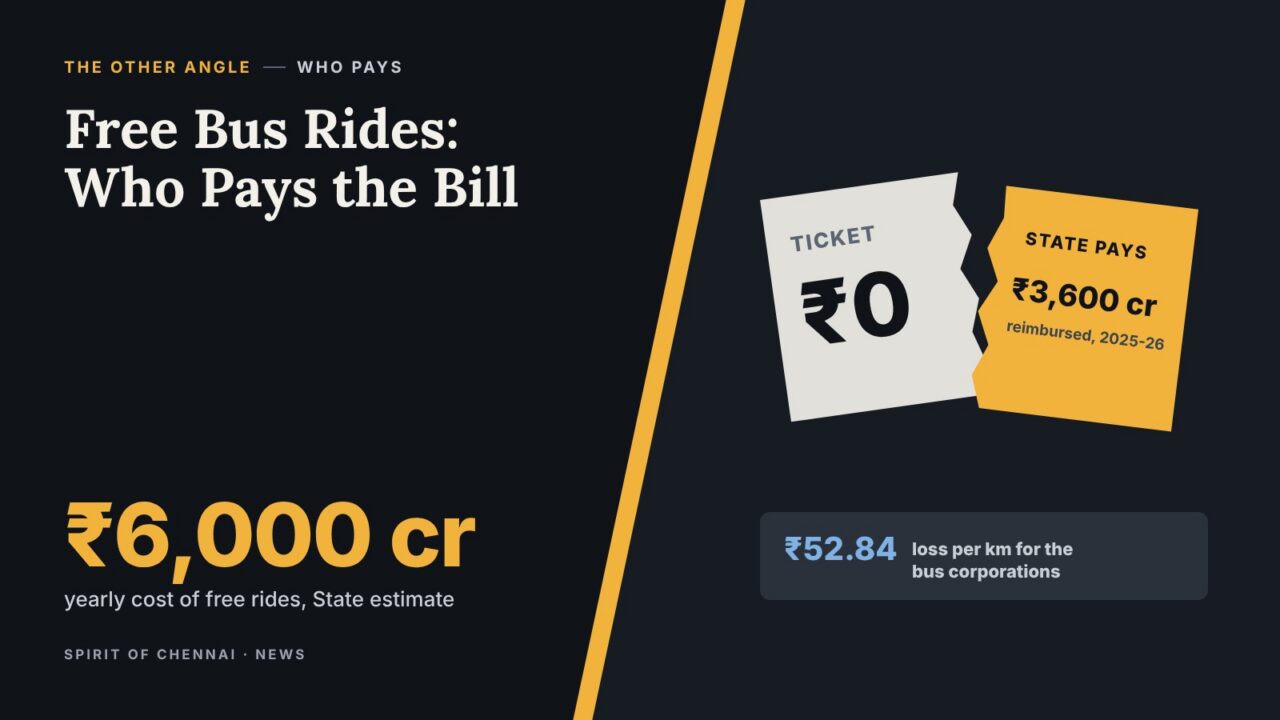
By 2025-26 the reimbursement had grown to ₹3,600 crore in the budget estimate, according to the 2025-26 policy note, which also lists ₹1,782 crore for student concessions and ₹1,857 crore for the diesel price difference. For the expanded scheme the government estimated about ₹6,000 crore a year, DT Next reported in August. That is about ₹16.4 crore a day, against about ₹9.9 crore a day at the 2025-26 allocation (each figure divided by 365).
| Stage | Buses covered | State money for free travel |
|---|---|---|
| 2021-22, launch | 7,312 ordinary town buses | ₹670 crore (revised estimate) |
| 2025-26 | 7,331 town and 169 mofussil ordinary buses (Feb 2025) | ₹3,600 crore (budget estimate) |
| From 2 Oct 2026, expanded | 12,695 of 18,413 buses | About ₹6,000 crore a year (State estimate, as reported) |
Source: Transport Department policy notes 2021-22 and 2025-26; DT Next, 26 August and 2 October 2026, for the 2026 row.
The gap the white paper measured
The reimbursement goes into corporations that were already short of money. The Finance Department’s June 2026 white paper put their cost at ₹78.81 per kilometre against revenue of ₹25.97, an operating loss of ₹52.84 a kilometre, partly covered by subsidies on diesel, student concessions and free travel. Their accumulated loss reached ₹72,667 crore in 2025-26 and total liabilities ₹61,642 crore.
| State transport undertakings | 2020-21 | 2025-26 |
|---|---|---|
| Net annual loss | ₹8,318 cr | ₹4,725 cr |
| Accumulated loss | ₹41,826 cr | ₹72,667 cr |
| Outstanding liabilities | ₹33,190 cr | ₹61,642 cr |
| Major costs (staff, diesel, pension, interest) | ₹13,590 cr | ₹23,659 cr |
Source: Finance Department, White Paper on the Fiscal Management of Tamil Nadu, June 2026, Tables 7.8 and 7.9.
The union federations’ point, as DT Next reported, is that a fixed allocation is not the same as paying for the fares actually forgone. The AITUC federation asked for compensation of the actual revenue loss, and the CITU federation for payments covering the full gap between revenue and expenditure. A union estimate of a ₹5,000 loss per bus per day across about 10,000 city buses put the cost near ₹18,000 crore a year, three times the State’s figure. The two estimates measure different things, and neither has been tested against a full year of Vettri Payanam tickets.
It’s often said that free travel for women is why the transport corporations lose money.
The record shows the white paper attributes the fall in operating revenue mainly to fares not being revised as costs rose. Diesel costs went up 185% and staff costs 43% between 2020-21 and 2025-26, while the free-travel subsidy is one of the items that partly fills the gap.
The operator nobody reimburses
Government buses do not run alone. The 2025-26 policy note counts 7,764 private stage carriages and 2,857 mini buses in the State, many on the same mofussil routes now free for women in government buses. A woman choosing between a private bus and a free government bus on the same stretch has an obvious incentive, and the private operator receives no zero-value ticket money for the fare that moves across.
That was the substance of a challenge by an Erode bus operator, N. Kalamani, which she withdrew in the first week of October after the High Court questioned her standing, according to LiveLaw’s weekly roundup. The court gave liberty to pursue remedies in the proper manner, so the question of what a private operator can claim is not settled.
Share of the State undertakings’ 18,413 buses now under Vettri Payanam (12,695 buses), calculated from figures reported by DT Next.
What Chennai riders should expect
MTC had 3,420 buses as of February 2025, of which 1,654 were ordinary Vidiyal Payanam buses, according to the policy note. The expansion brings MTC’s Express, LSS and Deluxe services into the scheme alongside the ordinary buses. The categories announced on 2 October do not include air-conditioned buses, and private buses are outside the scheme altogether.
What this means for you
- Women and transgender passengers should still collect the zero-value ticket. It is how the corporation claims reimbursement and how routes are planned.
- On mofussil routes, free travel applies only on government ordinary and listed services, not on private buses or mini buses.
- Any fare revision for other passengers would be a separate decision; the white paper’s comments on fares are analysis, not an order.
- Watch the revised estimates: the gap between the ₹3,600 crore allocation and the ₹6,000 crore estimate has to be met from the State budget.
What to watch
Pending
Revised estimates for 2026-27, which will show the actual reimbursement provided for the expanded scheme.
Pending
Any fresh petition by private operators after the High Court gave liberty to pursue remedies properly in October.
Checked against official sources on 4 November 2026. Details may change; confirm on the linked official pages.
Sources
- Transport Department Policy Note 2025-26, Government of Tamil Nadu
- Transport Department Policy Note 2021-22, Government of Tamil Nadu
- White Paper on the Fiscal Management of Tamil Nadu: An Examination of Public Finances, 2021-22 to 2025-26, Finance Department, Government of Tamil Nadu, June 2026 (copy of the official document)
- ‘Vettri Payanam Thittam’: Tamil Nadu expands free bus travel for women under rebranded scheme, DT Next, 2 October 2026
- Fare-free travel: transport unions welcome move, seek full reimbursement, DT Next, 26 August 2026
- Madras High Court Weekly Roundup, 5 to 11 October 2026 (N Kalamani v State of Tamil Nadu), LiveLaw