


Done. Here is the cleaned version with individual names removed and the narrative kept focused on institutions, policy, and the city’s transport transition.
Electric Buses in Chennai: How the City Moved from Pilot Experiments to a Larger Public Transport Shift
Chennai’s electric bus transition is no longer a symbolic pilot or a policy talking point. It has become a visible part of the city’s transport system and a serious component of Tamil Nadu’s wider effort to modernize public mobility. What makes Chennai’s journey especially significant is that electric buses here are not being introduced as a stand-alone technology change. They are part of a broader reform process involving depot upgrades, new operating contracts, low-floor accessible design, digital ticketing, stronger integration with the metro system, and an attempt to rebuild confidence in bus travel in one of India’s largest urban transport markets.
This matters because Chennai remains a deeply bus-dependent city. Official MTC data and tender records show a system with daily ridership in the range of 33 lakh passengers, a fleet of more than 3,400 buses, and hundreds of routes serving the metropolitan area. In a city of this scale, bus electrification is not a fringe experiment. It affects everyday mobility for workers, students, women commuters, and lower-income households who depend on buses as their primary mode of transport.
The story did not begin in 2025. Chennai had explored electric bus adoption much earlier. In 2019, the city saw trial runs of electric buses through early demonstrations linked to public transport operations. Those pilots did not immediately lead to large-scale deployment, but they mattered because they established that the idea had already entered the city’s transport planning imagination. Chennai was testing the technology long before the current phase of implementation took shape.
Even then, progress was uneven. When Tamil Nadu secured approval for 525 electric buses under the FAME II framework in 2019, Chennai was not part of the first wave of city allocations. Other urban centers in the state moved ahead earlier, while Chennai had to wait for a different financing and implementation path. That delay is an important part of the history. It shows that the city’s present momentum was not automatic. It had to be built later through policy shifts, institutional coordination, and a stronger funding structure.
The more durable shift began after the Tamil Nadu EV Policy 2023 and the strengthening of the Chennai City Partnership programme. The State’s EV policy set a target of converting 30 percent of public transport bus fleets to electric by 2030. At the same time, the Chennai City Partnership, backed by multilateral support, created a stronger framework for urban service reform in the metropolitan region. In transport, this helped move the conversation from isolated pilots to structured fleet procurement, institutional reform, and long-term service planning.
The governance side of this transition deserves more attention than it usually gets. Chennai’s electric bus journey has not been driven by one announcement or one office. It has been shaped by coordinated action across the State government, the Transport Department, MTC, and the financing institutions supporting the wider urban reform programme. Political leadership gave the transition visibility and momentum. Administrative leadership within MTC and the transport system provided the operational follow-through required to turn procurement into public service.
The first major public breakthrough came in June 2025, when 120 low-floor electric buses were launched from the upgraded Vyasarpadi depot. This marked the point at which Chennai’s electric bus programme became real to the public. It was not just a transport launch. It was a statement that public bus modernization had regained prominence in a city where infrastructure attention often gravitates toward rail and roads.
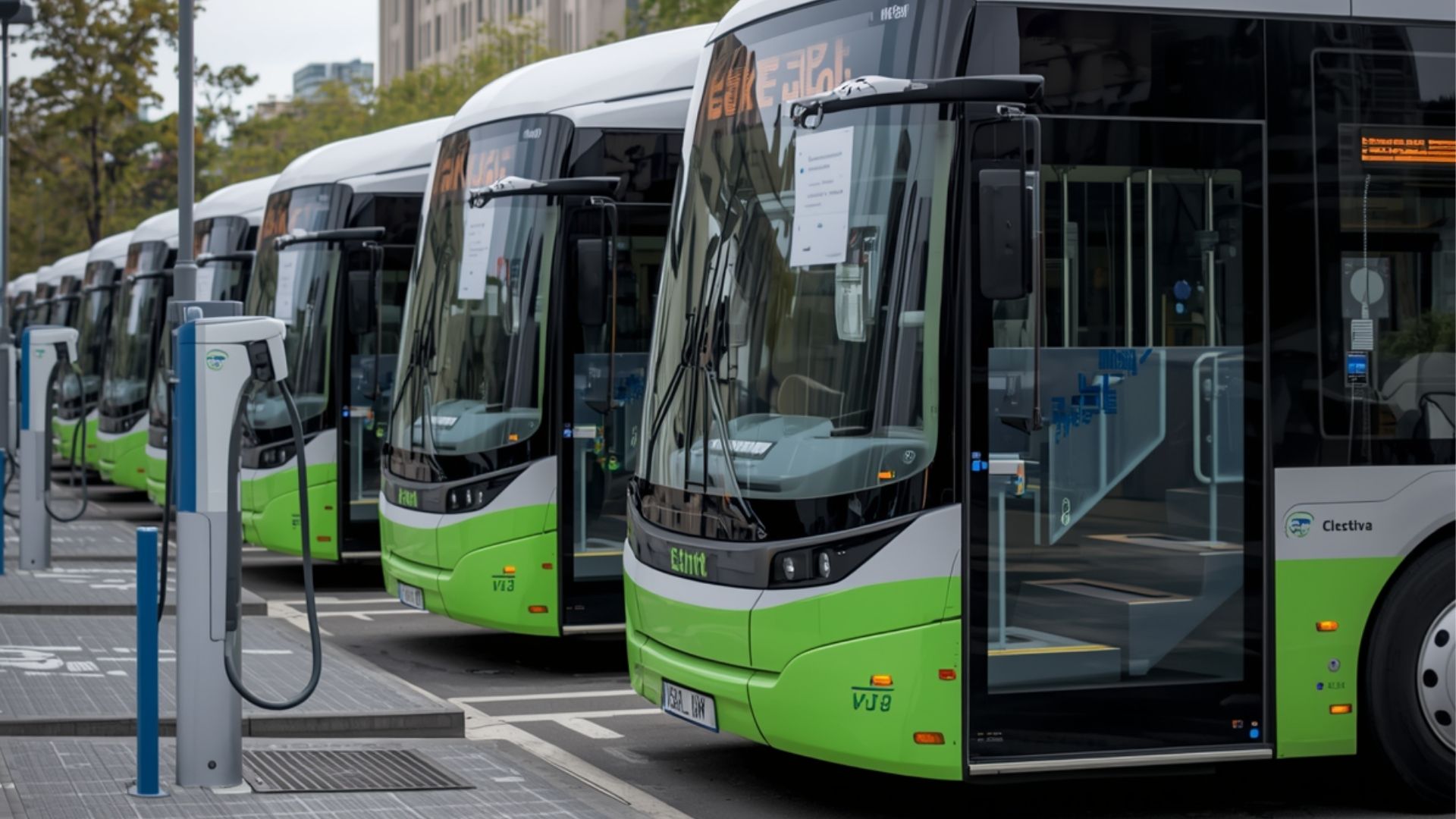
The June 2025 batch also revealed the kind of service Chennai was trying to build. The buses were low-floor and designed with features such as CCTV cameras, panic buttons, USB charging, and accessibility-oriented interiors. The significance of this phase was not only that the buses were electric. It was that Chennai was using electric bus procurement as a way to introduce a more modern passenger experience into the regular city bus system.
The next major stage followed in August 2025, when the upgraded Perumbakkam electric bus depot was opened and another 135 low-floor electric buses were added, including 55 air-conditioned units and 80 deluxe buses. This phase was especially important because it showed Chennai moving from a single headline launch to a more systematic, depot-based expansion model. It also signaled an effort to extend improved bus services toward growth corridors, including the city’s southern IT belt.
This phase also highlighted the importance of state-level support. Electric bus deployment in a city like Chennai cannot succeed through local operator initiative alone. It requires government backing for fleet reform, contract innovation, utility coordination, and infrastructure readiness. The shift toward electric buses in Chennai therefore reflects not only operator ambition, but also a wider willingness within the state transport system to support new service and financing models.
A third major public milestone came in December 2025, when the upgraded Poonamallee electric bus depot was opened and another 125 low-floor electric buses were added, including 45 air-conditioned units. By this stage, Chennai had established a phased pattern of electrification built around upgraded depots rather than isolated vehicle induction. That sequencing matters. Buses can be sanctioned or purchased on paper much faster than charging systems, maintenance facilities, and route deployment plans can be made operational. Chennai’s programme became more credible because it was visibly building the back-end systems alongside the fleet.
Within MTC, the operational side of this transition has been just as important as the public launches. Electric buses are ultimately judged not by flag-off events, but by how they are integrated into scheduling, route operations, ticketing, maintenance cycles, charging patterns, and commuter-facing service quality. Chennai’s recent progress suggests that the city has been treating electrification as part of a wider modernization effort rather than as a narrow vehicle replacement exercise.
The institutional framework behind these launches is equally important. Chennai’s first major electric bus phase has been tied to the Chennai City Partnership: Sustainable Urban Services Programme, supported by multilateral finance and technical assistance. Under this framework, a performance-based contract for 625 low-floor electric buses was awarded, representing a first for Tamil Nadu. This shifted Chennai toward a more structured model in which service delivery, contract enforcement, and performance monitoring matter as much as procurement.
That change in operating model is one of the most consequential parts of the Chennai story. Parts of the rollout have been structured through gross cost contracts, under which the operator supplies, maintains, and runs the buses while MTC pays on a per-kilometre basis and retains fare revenue. This is a major departure from the classic public operator ownership model. It spreads risk differently, reduces immediate capital pressure on the transport utility, and can accelerate deployment. But it also demands much stronger oversight from the public sector. In practical terms, Chennai’s electric bus journey is as much about institutional capability as it is about batteries and chargers.
By late 2025, the city’s electric bus programme had become visibly linked to depot modernization. Vyasarpadi, Perumbakkam, and Poonamallee emerged as key operational nodes in the first phase. Reports around the Poonamallee rollout noted upgraded infrastructure, multiple charging points, and rapid charging capability for the buses deployed there. This is where Chennai’s strategy begins to look more serious than tokenistic. Cities that focus only on bus purchases often run into operational bottlenecks. Chennai, by contrast, has had to build the supporting systems alongside the visible fleet expansion.
By early 2026, Chennai’s e-bus strategy was already moving into a second level of sophistication. MTC introduced a premium electric AC bus service on selected corridors, including routes connecting major terminals, business districts, and the southern technology corridor. This service offered reserved seating, app-based booking, and a no-standing format. It was clearly designed to target a different commuter segment, including riders who might otherwise choose private cars, cabs, or two-wheelers. In other words, Chennai was no longer using electric buses only as cleaner substitutes for diesel buses. It was beginning to use them as tools for mode shift and service differentiation.
This layer of service strategy matters. One of the hardest challenges in Indian urban mobility is not simply adding more buses. It is persuading a wider range of commuters to see buses as viable, safe, and comfortable. Chennai’s premium electric service appears to be an attempt to reclaim some of that lost middle-class ridership without abandoning the core social function of the public bus system. If managed well, that could become one of the most interesting aspects of the city’s transport reform.
The metro integration agenda also deserves attention. In 2026, MTC moved ahead with plans for smaller electric buses intended for first- and last-mile connectivity to metro stations. This showed the city beginning to think of electric buses not only as replacements on conventional routes but as connective tissue within a multimodal urban system. That is a major conceptual step. A bus network that works well with metro infrastructure is far more valuable than one that runs in parallel without coordination.
At the same time, MTC opened the door to a much larger future pipeline. Tender material in 2026 pointed to plans for 1,000 large air-conditioned electric buses, 300 smaller feeder electric buses, and even 20 electric double-decker buses. Whether all of these are delivered on the original timeline is a separate question. But the direction is unmistakable. Chennai is no longer planning in dozens. It is planning in hundreds and potentially thousands.
The environmental rationale for this transition is real, though it should not be overstated. Transport is a major contributor to Chennai’s urban emissions and roadside air pollution burden. Since buses in a large city fleet run long daily distances and carry far more passengers per vehicle than private cars or two-wheelers, electrifying them can produce both emissions and local air quality gains. Still, the deeper value lies in strengthening public transport itself. A clean bus network that loses riders to private vehicles will not transform urban mobility. A clean bus network that becomes more reliable, accessible, and attractive can.
This is why the design of Chennai’s electric buses matters so much. Low-floor entry, kneeling capability, wider aisles, accessible interiors, CCTV surveillance, panic buttons, passenger information systems, and mobile charging are not ornamental features. They address long-standing weaknesses in ordinary bus travel. For many riders, especially older persons, women, people with disabilities, and families, the quality of boarding and the sense of safety inside the vehicle matter as much as travel time. Chennai’s e-bus rollout has therefore become a vehicle for service quality reform as well as decarbonization.
There is still reason for caution. Electric bus transitions are often slowed by charging constraints, power supply bottlenecks, spare-part logistics, software issues, depot readiness, training needs, and contract disputes. Chennai is not exempt from any of these risks. The city’s progress so far is substantial, but it remains a phased implementation story rather than a completed transformation. The test will be whether the system delivers dependable route-level service at scale over time.
Even so, Chennai’s position in 2026 is much stronger than it was a few years ago. The city has moved from trial buses in 2019 to large depot-based launches in 2025, a structured 625-bus first phase, premium electric services, feeder integration plans with the metro, and large new tender pipelines. That is a meaningful shift in both ambition and execution. The story is still being written, but it is already clear that Chennai has entered a new phase in which the electric bus is becoming central to how the city thinks about public transport reform.
In the end, the most important thing about electric buses in Chennai is not simply that they are electric. It is that they have forced the city to confront bigger questions about what a modern urban bus system should be. Cleaner, yes. But also more accessible, more visible, more integrated, and more dependable. The institutions most closely tied to this shift include MTC, the Tamil Nadu Transport Department, and the broader urban reform and financing architecture supporting the Chennai City Partnership programme. That is the real story. Chennai’s electric buses are not a one-day launch. They are the visible edge of a larger change in how the city is trying to move.

