


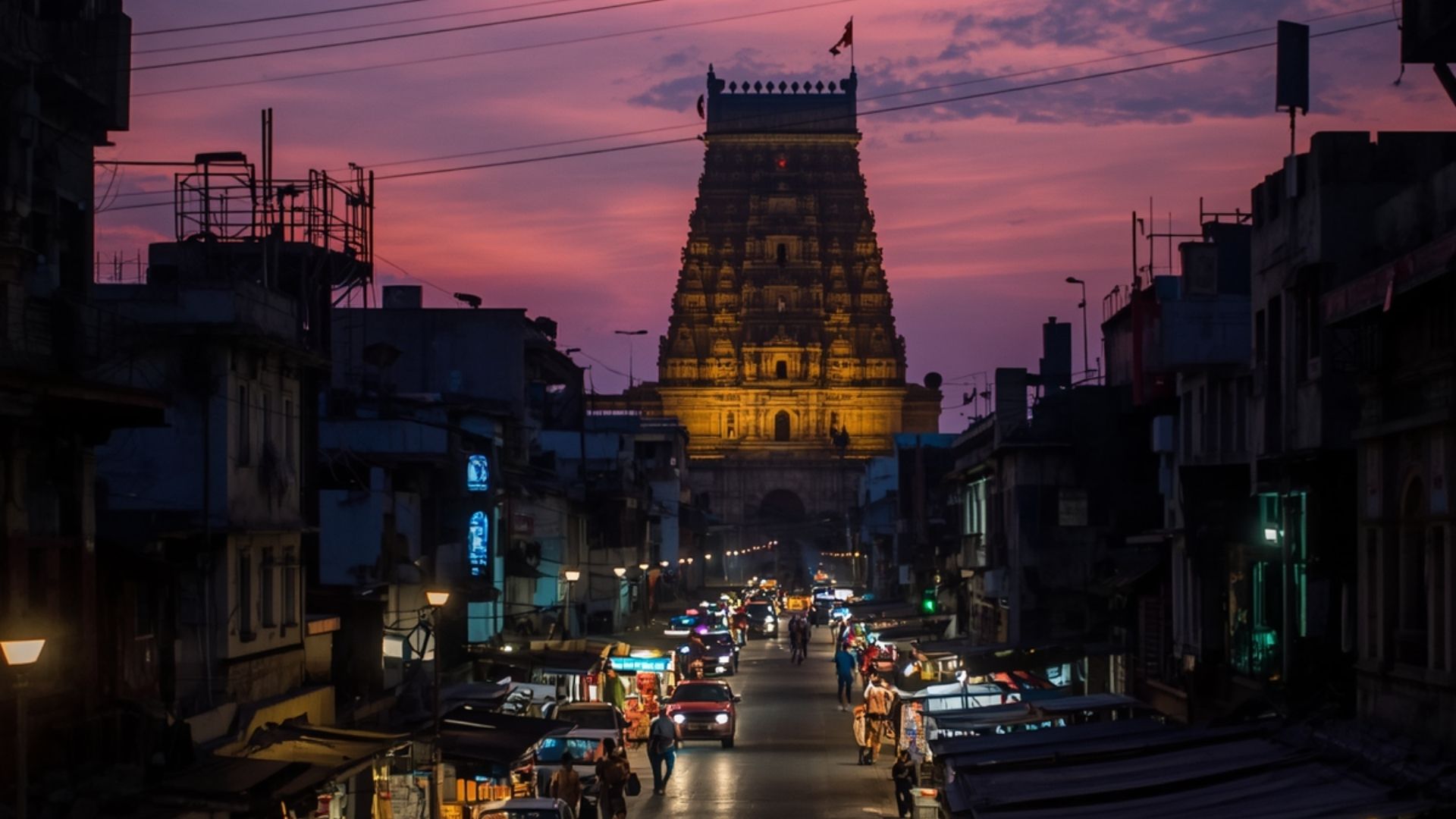
Chennai rewards the curious. Beyond the long sweep of Marina Beach and the tower gopurams of Kapaleeshwarar Temple lies a city of surprising depth — ancient apostolic caves, a living artists’ commune on the coast, a 450-year-old banyan tree that has outlasted empires, a fish harbour that wakes at 4am, and a church that preserves the memory of a people who have almost entirely vanished. Most visitors never find any of them. This guide is for those who want more than the highlights reel.
The places below are arranged roughly as a 24-hour itinerary, moving from north to south, with practical details at each stop. You don’t need all of them — pick what speaks to you. But each one offers something the city’s famous sites simply don’t.
Early Morning — George Town (North Chennai)
1. The Armenian Church of the Holy Resurrection (6:00–7:30 AM)
On Armenian Street in the heart of George Town, tucked behind a busy lane of wholesale traders, stands one of the most extraordinary hidden buildings in South India. The Armenian Church of the Holy Resurrection was built in 1712, making it one of the oldest churches in Chennai, and it holds within it the story of a community that no longer exists here.
Armenian merchants arrived in Madras during the seventeenth century, drawn by trade in cotton, silk, and precious stones. At their peak they were prosperous enough to construct this church and maintain a community cemetery that still contains more than 350 graves — many with inscriptions in the Armenian script, a language you are extremely unlikely to encounter anywhere else in Tamil Nadu. Walk slowly through the cemetery and you are reading an unlikely history: of traders from the Caucasus who found, for a time, a home on India’s Coromandel Coast.
The church itself is serene, with whitewashed walls, polished floors, and photographs lining the interior that trace the long arc of the Armenian presence in Madras. The caretaker, who speaks some English, is genuinely glad to have visitors and will share stories not found in any guidebook. Arrive before 9:30 AM and you often have the whole place to yourself.
Know before you go: Open daily 9:30 AM to 2:30 PM. Entry is free. The church is on Armenian Street near the High Court — a five-minute walk from Parry’s Corner. Sunday mornings at 9:30 AM are when the bells ring.
2. Royapuram Fishing Harbour (5:00–7:00 AM)
If you can wake early enough, the Royapuram Fishing Harbour, a few kilometres north of George Town, offers one of Chennai’s most visceral and unscripted experiences. This is the city’s oldest and busiest working harbour, and in the pre-dawn hours it becomes a world unto itself.
Boats that left the previous evening begin returning from around 4 AM, low in the water with the night’s catch. By 5:30 AM the wharf is in full roar — crates of tuna, kingfish, snapper and prawn are sorted and auctioned at extraordinary speed, buyers and sellers communicating in a rapid patois of Tamil and hand signals. The smell is bracing. The light, especially around sunrise, turns the harbour into something a painter would struggle to recreate.
Most visitors to Chennai see seafood only on a menu. Here you see where it actually comes from — the sweat, the ice, the chaos, the careful pride of a community that has worked this water for generations. Wander the surrounding lanes and you’ll find tea stalls, net-menders, and women sorting fish by hand at a pace that suggests they have been doing exactly this all their lives, because they have.
Know before you go: The harbour is at Royapuram, accessible by auto-rickshaw or app cab. There is no entry fee. Go before 7 AM for the full spectacle; it quietens significantly by mid-morning.
Mid-Morning — Central Chennai
3. Little Mount Caves, Saidapet (9:00–10:30 AM)
Few places in Chennai carry as much layered meaning as the caves at Little Mount in Saidapet, and few are as overlooked by visitors who assume the nearby St. Thomas Mount is the main event. The Little Mount caves are older in significance and far more intimate.
According to tradition stretching back to the earliest centuries of Christianity in India, the apostle Thomas — one of the twelve disciples of Jesus — came to the subcontinent in around 52 CE and spent time preaching along the Coromandel Coast. He is said to have sheltered in these low, dimly-lit caves during a period of persecution, and the rock inside still bears what pilgrims identify as his handprints and footprints, worn smooth by centuries of reverent touch.
But even if you come without any religious investment, the caves repay a visit. They are ancient, quiet, and strangely moving — you’re inside a rock formation in the middle of a modern city, and people have been coming here to pray for nearly two thousand years. A small spring near the cave is said never to have dried since Thomas created it, and the Portuguese built a chapel here in 1551 that still stands. The atmosphere is unlike anywhere else in the city.
Know before you go: Open from 4:30 AM daily. Free entry. Located at Lourd Doss Grotto Road, Saidapet — easily reached by metro to Saidapet station, then a short auto ride. Budget an hour, more if you want to sit.
4. Semmozhi Poonga — The Botanical Garden in the City Centre (10:30 AM–12:00 PM)
Most people walk past the entrance to Semmozhi Poonga without realising what’s inside. Sandwiched between the American Consulate and the traffic of Cathedral Road in Teynampet, this 20-acre botanical garden is one of the city’s most genuinely pleasant green spaces — and because it sits in a part of town associated with commerce and government rather than tourism, it rarely has the crowds of the more famous parks.
Established by the Tamil Nadu Horticulture Department in 2010, Semmozhi Poonga contains over 500 varieties of plants, including flowering trees, medicinal herbs, aromatic species, and a section dedicated to orchids and butterflies. The paths wind through gentle slopes past ponds of water lilies, shaded benches, and classical fountain sculptures. On weekday mornings you’ll share it mainly with retired residents doing slow circuits and groups of school children making notes.
The garden’s name, Semmozhi, refers to the classical Tamil language, honoring Tamil’s status as one of the world’s oldest living languages. There’s poetry in that — a garden named for language, full of living things.
Know before you go: Open Wednesday to Monday (closed Tuesdays), 10 AM to 7:30 PM. Entry is ₹75 for adults, ₹40 for children aged 5–10. Located opposite the American Consulate on Cathedral Road, Teynampet. An hour here is sufficient unless you want to linger.
Afternoon — South Chennai (Adyar)
5. The Theosophical Society and the Adyar Banyan Tree (2:00–4:30 PM)
This may be the single most underrated place in all of Chennai. On the south bank of the Adyar River, between the Besant Nagar coast and the city’s interior, lies a 260-acre campus that functions as a small forest — complete with resident deer, jackals, mongooses, parakeets, and seasonal migratory birds, all of it set within a city of millions.
The Theosophical Society established its international headquarters here in 1882. Founded in New York by Helena Blavatsky and Henry Steel Olcott, the Society has long pursued a philosophy of universal brotherhood, and the campus reflects that unusually literally: it houses a Hindu temple, a Buddhist shrine, a Zoroastrian fire temple, a Sikh shrine, and a Christian church, all within walking distance of each other, surrounded by trees.
At the heart of the campus — and worth coming for alone — is the Adyar Aala Maram, the Great Banyan Tree. Estimated to be over 450 years old, its aerial roots cover approximately 40,000 to 60,000 square feet. The original central trunk was destroyed in a cyclone in 1989, but the roots and branches survived and have continued to grow; today the tree resembles a grove more than a single organism, its columns descending from the canopy like the pillars of a cathedral. The 14th Dalai Lama sat beneath it during his first visit to India in the 1950s.
The campus roads are unpaved and vehicle-free. Birdsong is audible throughout. The Adyar Library and Research Centre, one of the world’s foremost collections of spiritual literature, houses Buddhist scrolls over a thousand years old, though it is not generally open to casual visitors. What you can access freely is the gardens, the tree, the multi-faith shrines, and an atmosphere of extraordinary calm rarely found anywhere in the city.
Know before you go: Open Monday to Saturday, with limited hours (roughly 8–10 AM and 2–5 PM for general visitors — check the Society’s website before you go, as hours can vary). Closed Sundays. Entry is free. Located in Adyar, about 12 km from Chennai Central Station. Wear comfortable shoes — it’s a large campus and the paths are uneven. Photography is permitted in the gardens.
6. The Broken Bridge, Adyar Estuary (5:00–6:30 PM)
Walk or drive from the Theosophical Society gates toward the coast and, after passing through a small fishing village and about a kilometre on foot along the estuary bank, you reach one of Chennai’s most quietly famous spots: the Broken Bridge.
In 1977 a cyclone brought down a bridge spanning the point where the Adyar River meets the Bay of Bengal. The two stumps of the broken structure were never demolished or rebuilt. They simply remained, slowly mellowing into the landscape, becoming in time something unexpected: one of the best viewpoints in the city.
Standing at the water’s edge near the bridge at dusk, you watch the river open into the sea on one side and the Indian Ocean horizon stretch away on the other. The estuarine light at golden hour is remarkable. Herons and egrets work the shallows. Fishing boats dot the bay. The city falls quiet here in a way it does almost nowhere else.
Do not attempt to climb onto the bridge itself — it is fenced and prohibited, and correctly so. But the area around it is accessible, the views are excellent, and the walk from the Theosophical Society campus makes for a satisfying late-afternoon loop.
Know before you go: Free entry, open at all hours, though the walk from the road is best done before dark. An auto-rickshaw can drop you to the Theosophical Society Green Gate exit facing Besant Nagar; from there it is roughly a 20-minute walk through the fishing settlement to the bridge.
Late Afternoon Detour — Guindy
7. Guindy National Park (3:00–5:30 PM, if not doing Adyar)
Guindy National Park is one of the most remarkable facts about Chennai: a functioning national park, covering 270 hectares, located entirely within city limits — one of only a handful in India. It is surrounded on all sides by urban development, yet within its boundaries roam blackbuck, spotted deer, jackals, porcupines, and over 130 species of birds.
The park is not dramatic in the way that forest reserves in wilder parts of India are dramatic. There are no tigers, no elephant corridors. What it offers instead is something rarer in a city of Chennai’s size: the experience of walking through old-growth scrub forest that smells of earth and bark rather than exhaust fumes, and genuinely encountering wildlife going about its business.
The attached Children’s Park is popular with families on weekends; for a quieter experience, go on a weekday morning when you can spend an hour on the trails and rarely see another person. The blackbuck, once nearly extinct in Tamil Nadu, are now a stable population here and often visible grazing in the open grass patches.
Know before you go: Open Wednesday to Monday, 9 AM to 5:30 PM (closed Tuesdays). Entry ₹60 for adults, ₹10 for children over 5. Located off Sardar Patel Road near the IIT Madras campus, accessible by metro (Guindy station) or auto.
Evening — The Coast South of the City
8. Cholamandal Artists’ Village, Injambakkam (4:00–6:30 PM)
About 20 kilometres south of the city centre on the East Coast Road, in the coastal neighbourhood of Injambakkam, sits what is perhaps Chennai’s single best-kept cultural secret: India’s largest and oldest self-sustaining artists’ commune, Cholamandal Artists’ Village.
Founded in 1966 by KCS Paniker — one of India’s most significant modernist painters and then-principal of the Government College of Fine Arts — Cholamandal began as an act of collective will. Thirty-eight artists pooled their resources, bought 10 acres of land by the sea, and built a community where they could live and work entirely on the proceeds of their art. No grants, no institutional support: just painting, sculpture, batik, ceramics, and handicrafts.
The artists who lived and worked here through the 1960s, 70s and 80s are now credited with founding the Madras Movement — a distinct school of South Indian modernism that broke from Western art influences and tried to forge a visual language rooted in the region’s own heritage. Their work has been shown at the Venice Biennale, the Paris Biennale, and in galleries across Europe and the Americas.
Today, around 21 resident artists still live in the village. You can walk freely around the campus — past studio buildings in exposed red brick, an outdoor sculpture garden with works by visiting international artists, the open-air theatre named Bharathi, and two commercial galleries, Indigo and Laburnum, where paintings and sculptures are displayed and sold. The Museum of the Madras Movement, which opened in 2009, documents the movement’s history with a permanent collection. On lucky visits you’ll find artists still at work in their studios, happy to chat.
It is simultaneously a working community, a museum, and one of the most peaceful places within striking distance of the city. Entry costs ₹30 for adults.
Know before you go: Open daily 9:30 AM to 6:30 PM. Entry ₹30 for adults, ₹10 for children. Located on the ECR near Injambakkam, roughly a 45-minute drive from the city centre. The nearest bus stop is Injambakkam, about 1 km away; an auto from there is the easiest option. Allow at least two hours.
Practical Notes for the 24-Hour Visitor
Getting around: Chennai’s metro covers key stops including Saidapet and Guindy. For the Theosophical Society, Adyar, and the ECR south, app-based cabs (Ola, Uber) are the most practical option. Auto-rickshaws are readily available in all areas and are preferable for short hops.
When to go: November to February, when the weather is cool and dry, is the most comfortable time to explore. Avoid weekends at Guindy and Semmozhi Poonga if you prefer quiet. The Royapuram harbour and the Broken Bridge are best in the early morning and evening respectively.
What to bring: Comfortable walking shoes are essential — several of these sites involve significant walking on uneven ground. Carry water at all times; Chennai gets hot even in winter. A light scarf is useful for temple and church visits.
24-hour route summary: Royapuram harbour at dawn → Armenian Church at 9 AM → Little Mount Caves by mid-morning → Semmozhi Poonga at noon → Theosophical Society in the early afternoon → Broken Bridge at dusk → Cholamandal Artists’ Village (if combining with an ECR evening drive). Guindy National Park substitutes well for Semmozhi Poonga if you prefer wildlife to gardens.
None of these places will be on the standard itinerary handed to you by any tour operator. That is precisely the point.

