


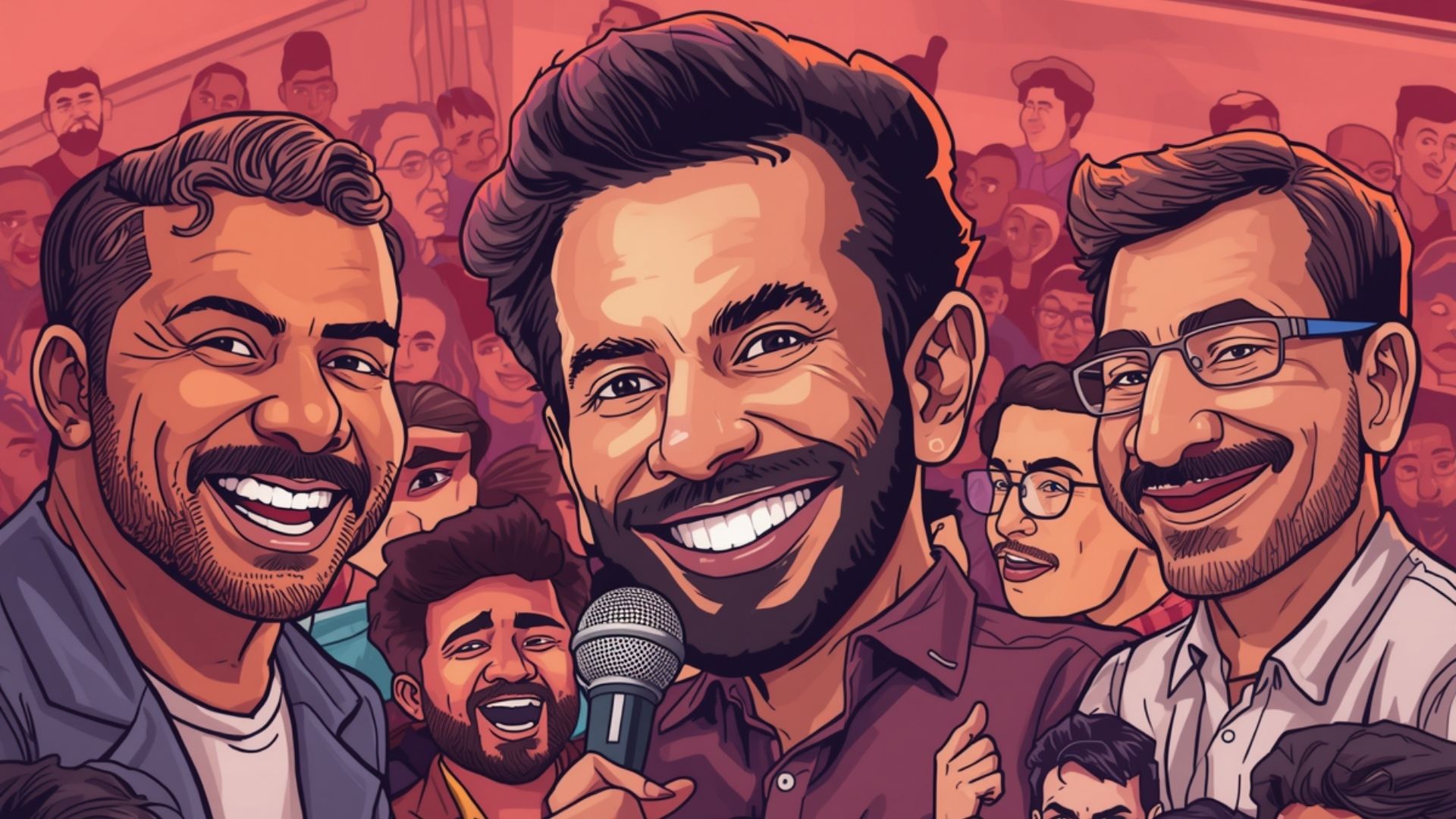
Chennai’s Stand-Up Comedy Scene: How a Conservative City Built One of India’s Most Distinct Comedy Cultures
Chennai did not stumble into stand-up comedy by accident. The city had comedy long before anyone called it a “circuit.” It had film comedians, mimicry stars, stage banter, sabha humour, pattimandram wit, political satire and a very local talent for kalaai. That sharp, needling style of teasing that lands harder than generic one-liners. What stand-up did was not invent humour in Chennai. It reorganised it. It took comedy out of side tracks, skits and supporting roles, put a single person under a spotlight and asked the audience to listen to one voice at a time. That shift sounds simple. In Chennai, it was not. The city had to build the form, the audience, the rooms and the confidence to sustain it.
That is what makes Chennai’s comedy scene so interesting. It did not grow in the same way as Mumbai or Delhi. It was not fuelled first by nightlife districts, big club culture, or a giant Hindi-speaking market. Early stand-up in Chennai had to work around a multilingual city, a corporate audience that often preferred English, a wider Tamil audience that was used to cinema and television formats and a cultural setting where jokes about sex, religion and politics could still make organisers nervous. The result was a comedy culture that grew more slowly, but also more distinctly. It became bilingual, then Tanglish, then unapologetically Tamil. It produced pioneers, musical comics, family-friendly storytellers, satirists, corporate crowd-pleasers, digital-native performers and a new generation that treats stand-up not as an experiment but as a career.
Before the mic stand, there was already a comedy city
Any serious account of Chennai stand-up has to begin with the city’s older comedy DNA. A 2025 account of the scene’s evolution in Indulge Express traced a line from N. S. Krishnan, Chandrababu, Goundamani and Senthil, to Vivekh, Kovai Sarala, Vadivelu and Santhanam, arguing that Tamil cinema had long treated comedy as central, not ornamental. In the same piece, comics such as Badava Gopi and Bosskey linked modern stand-up to older South Indian performance traditions, mimicry, festival joke sessions and audience-facing humour that existed before Western-style stand-up became visible in the city. Chennai, in other words, was never humourless. What it lacked was a stable, modern live-stand-up ecosystem.
That gap matters. In a national history of Indian stand-up, DeadAnt notes that while Mumbai was consolidating open mics around Vir Das and The Comedy Store, Karthik Kumar was already trying to adapt Chennai theatre economics into a one-person comic format around 2008. He described the move as partly practical. Theatre was expensive. So Evam began making smaller, solo comedy-led performances that could survive outside formal auditoriums. That is one reason Chennai stand-up did not begin as pure club comedy. It came out of theatre, improvisation and stage survival. It was built by people who knew performance before they knew stand-up grammar.
The Karthik Kumar moment
If one person has to be named as the key architect of Chennai’s stand-up scene, it is Karthik Kumar. By his own account, the first public gigs of what Chennai would later call stand-up happened in late 2009, even before the format had a settled name in the city. He has said that from 2009 to 2011 these were urban, story-driven monologues performed at places such as Alliance Française and only later, in 2012, did the label “Evam Stand-up Tamasha” solidify. He also recalled that the first solo experiment could swing wildly, one early show drawing almost nobody, another with the same material suddenly packing the room. That is usually how scenes begin. Not with a grand launch, but with trial, embarrassment and a few people who keep going.
Karthik’s importance was not just that he performed. It was that he institutionalised. Evam became one of the first organised stand-up platforms in the South. By 2017, Madras Musings was already describing Evam as the group that had “led the pack” in Chennai and named Karthik Kumar, Aravind SA and Aswin Rao among the faces associated with that early moment. The same article observed that Chennai had five weekly open mic nights by then, a surprisingly healthy number for a city still seen by outsiders as conservative and slower-moving than the big northern comedy hubs.
Karthik also helped Chennai think beyond Chennai. DeadAnt’s reporting on Indian comedians overseas notes that Evam artists including Karthik Kumar, Aravind SA, Ashwin Rao and Bhargav Ramakrishnan were among the first Indian comedians to try a US tour in 2013. Karthik later described those tours as entrepreneurial bets aimed at South Indian diaspora audiences hungry for nostalgia. That turned out to be one of Chennai comedy’s biggest business lessons. Tamil stand-up did not have to stop at the city border. It could travel anywhere Tamils had gone.
Open mics, rooms and the making of a real scene
A comedy scene is not built only by stars. It needs rooms. It needs weekly failure. It needs badly lit stages, awkward silences, friends who clap too early and organisers who keep booking the next night anyway. Chennai crossed that threshold in the late 2010s.
By 2017, as noted, the city had five weekly open mics. Then in 2019 a more formal milestone arrived. CounterCulture Comedy Club opened to the public on 1 February 2019 as a venue focused specifically on comedy, with an emphasis on local and regional talent. CounterCulture describes itself as Chennai’s first 150-seat comedy room and says it has programmed over 250 live stand-up shows since its inception. That matters because dedicated venues change the behaviour of both comics and audiences. Once a city has a room built for comedy, rather than borrowing pubs and cafés, the art form stops feeling temporary.
The next layer came with newer performance spaces. Medai’s Chennai venue started in 2021, according to its organiser profile and the space openly positions stand-up as part of its regular programming rather than a side booking. This is a different kind of progress. CounterCulture represented the dedicated comedy-room model. Medai represents something else, a black-box arts space where stand-up sits next to theatre, music and dance, which helps comedy be seen not just as nightlife but as part of Chennai’s broader live-culture calendar.
That physical build-out is one reason Chennai’s stand-up now feels more stable than it did a decade ago. In 2025, Indulge Express described the city’s journey as one that had moved “from empty chairs to packed houses.” That line is dramatic, but the underlying change is real. The city now has enough performers, enough rooms and enough audience familiarity that comedy is no longer treated as an occasional novelty act.
Why language changed everything
One of the biggest shifts in Chennai stand-up has been linguistic. Early English stand-up had an economic advantage because corporate gigs paid and corporate audiences were usually mixed, multilingual and more comfortable with English. The News Minute’s 2019 report on Tamil stand-up captured this clearly. At a Chennai panel on the growth of Tamil comedy, Annamalai Lakshmanan, founder of Tanglish Comedy, said English comics found it easier to make money because corporate organisers preferred English for practical reasons. Tamil comics had passion and audience, but not always the same monetisation path.
That began to change as local comics stopped treating Tamil as a translation problem and started treating it as a primary comic language. The same report quoted comics explaining that humour cannot simply be shifted line by line from English to Tamil because references, rhythm and cultural memory change with the language. In 2016, Annamalai founded Tanglish Comedy, a collective that met regularly, invited new performers and gave Tamil-plus-English stand-up a structure in Chennai. By 2023, he was still describing Tanglish Comedy as a deliberate platform-building effort, saying Tamil’s flexibility made it especially effective for stand-up.
Praveen Kumar’s career captures this shift beautifully. In a 2025 profile, Indulge Express noted that Praveen spent nearly eight years doing English stand-up across India before realising that Tamil let him connect more deeply. He put it plainly: regional comedy hits harder in the mother tongue. That move did not shrink his world. It expanded it. His Tamil material has taken him from Chennai to Australia, the United States and Hyderabad and his touring model now leans heavily into a family-friendly Tamil audience.
Even outsiders noticed the change. When Delhi comic Rajat Chauhan returned to Chennai in 2024, he told DT Next that the city’s stand-up scene was growing and that regional comedy here was flourishing. That is a useful external marker. By then, Chennai’s comedy identity was no longer just “English sets in a conservative city.” It had become a place where Tamil-language live comedy was visibly gaining strength.
The key people who shaped the circuit
Any list will be incomplete, but some names are impossible to leave out.
Karthik Kumar remains the scene-builder and early pioneer, the comic who helped give Chennai stand-up its first organised structure through Evam and who pushed the form from theatre improvisation into a recognisable live-comedy movement. His later work also shows how Chennai comics matured with the form. By 2020 he was part of Amazon’s Amazon Funnies and his Prime special Blood Chutney had already established him as one of the South’s most visible stand-up names.
Alexander Babu is the scene’s most distinctive hybrid performer, a comic who fused stand-up with music, nostalgia, Carnatic references and Tamil cultural memory. In the 2025 Indulge Express oral history, he traced his start to 2013, when Evam was doing pub-based stand-up nights that were mostly English because of the corporate crowd. He later began inserting music into his sets, which eventually led to Alex in Wonderland, his Prime Video special that blends Tamil cinema, music, philosophy and humour. Karthik Kumar, in the same history, pointed to Alexander Babu’s sold-out auditoriums in Europe as proof that Chennai comedy now has international pull.
Praveen Kumar is one of the major bridges between early English stand-up and the present Tamil mainstream. Prime Video’s Mr. Family Man positioned him squarely as a comic of middle-class domestic life, while later interviews show him evolving that persona into newer specials such as Family Man Returns and 8. He is especially important because he proved that Tamil stand-up could be clean, family-friendly, narrative-heavy and still commercially strong across India and abroad.
Annamalai Lakshmanan, often known as Mala, matters less as a single-star phenomenon and more as a language entrepreneur. Tanglish Comedy, which he founded in 2016, helped create recurring opportunities for Tamil and Tanglish performers in Chennai. His interviews show a comic deeply interested in audience interaction, wordplay and the long-term growth of Tamil stand-up as an ecosystem rather than just as his own career.
Rajmohan Arumugam deserves mention as one of the key bridges between Tamil digital media and live comedy. He was one of the three mentors and judges on Comicstaan Semma Comedy Pa, alongside Karthik Kumar and Praveen Kumar. That role matters because Comicstaan Tamil did more than showcase talent. It signalled that Tamil stand-up had enough depth to sustain a televised competition around genres, mentoring and performance craft.
Syama Harini is one of the important contemporary voices in the city, especially because Chennai, like most Indian comedy scenes, has had fewer prominent female stand-ups than male comics. She was part of Comicstaan Semma Comedy Pa, later appeared in LOL: Enga Siri Paappom and DeadAnt identified her as the runner-up of Comicstaan Tamil. In a 2025 interview, she described comedy not simply as entertainment but as catharsis, which gives a good sense of how newer Chennai comics are writing from personal frustration and lived experience rather than simply performing generic “funny content.”
Mervyn Rozz is another important second-wave figure. He was credited as one of the writers on Comicstaan Semma Comedy Pa and a 2025 profile in The New Indian Express described him as a comic who left an unfulfilling corporate job and had by then spent nine years in comedy. That trajectory, salaried life to full-time stand-up, is now familiar across Indian cities. In Chennai, Mervyn is part of the generation that helped normalise comedy as a full-time pursuit rather than a clever side hustle.
Around them sits a wider ecology. Abhishek Kumar moved between digital character comedy and live formats and was part of both Comicstaan Tamil and LOL. Bhargav Ramakrishnan appeared both in the Evam orbit and in Amazon’s Tamil comedy world. Badava Gopi and Bosskey represent the older Chennai tradition of mimicry, punning and stage humour that has not vanished but instead overlaps with stand-up. Vidyullekha Raman, though better known from cinema, offered an important 2025 observation that today’s audiences increasingly want sharper, more socially aware humour and that women in live comedy are often doing better than women in film comedy.
OTT changed the scale
The single biggest accelerator in recent years has been platform visibility. By 2020, Amazon already had a portfolio of five Tamil comedy specials, according to a behind-the-scenes account of Comicstaan Tamil. That base mattered. It meant the platform had already tested audience appetite before launching Comicstaan Semma Comedy Pa in September 2020. The show, produced by OML, brought Praveen Kumar, Karthik Kumar and Rajmohan Arumugam in as mentors and judges and put contestants such as Syama Harini, Abhishek Kumar, Mayandi Karunanithi, Yogesh Jagannathan and Annamalai Lakshmanan into living rooms across India and the diaspora.
That was a turning point. Social Samosa’s account of the show’s rollout said the goal was not just to promote contestants but to educate viewers about comedy genres themselves, from anecdotal and topical humour to sketch and improv. That matters more than it sounds. A city scene grows much faster when audiences understand that comedy is not one thing. Once people start recognising different styles, they become repeat customers rather than one-time viewers.
Amazon doubled down in 2021 with LOL: Enga Siri Paappom, which mixed stand-up comics with film, television and sketch personalities. The show was hosted by Vivek and Mirchi Shiva and included Syama Harini, Abhishek Kumar and Bhargav Ramakrishnan among its contestants. It was not a pure stand-up format, but that is partly the point. By then, Chennai comedy was no longer living inside a strict genre box. Stage stand-up, digital sketch comedy, television humour and film comic performance were all starting to overlap.
What has really changed in recent years
Three things have changed at once.
First, Tamil and Tanglish are no longer side languages in the scene. They are central to it. What began as a largely English, corporate-friendly format has widened into a much more local comic culture. That does not mean English comedy disappeared. It means it no longer has a monopoly on prestige or money.
Second, the city now has infrastructure. Open mics became regular. Dedicated rooms appeared. Comedy nights are no longer an improvised side product of pubs alone. Chennai may still not have the sheer scale of Mumbai, but it now has enough repetition, enough venues and enough audience conditioning for comics to build material consistently.
Third, the scene has diversified in style. Karthik Kumar has said the current ecosystem contains clean comics, edgy comics, political comics and micro-genres that each find their own tribe. That tracks with what the city now offers. Alexander Babu’s music-heavy nostalgia comedy is not Praveen Kumar’s middle-class family storytelling. Syama Harini’s cathartic ranting energy is not Annamalai’s Tanglish audience play. Badava Gopi’s sound effects and mimicry are not the same thing as younger open-mic confessional humour. This variety is usually the clearest sign that a scene has moved past infancy.
The unresolved problems
None of this means Chennai comedy is frictionless. The old constraints have not vanished. Tamil stand-up still has to deal with audience sensitivity, organiser caution and the risks around taboo or political topics. The 2019 Chennai panel on Tamil stand-up made that clear, with comics discussing how sex, religion and politics remained the touchiest zones. Karthik Kumar echoed a version of the same tension in 2020 when he described comedy as a place that lives on the edge, trying to be funny without dodging reality.
There is also the question of gender. Vidyullekha Raman argued in 2025 that while women are thriving in stand-up across Tamil, Hindi and Telugu scenes, film and television still lag badly in giving female comedians strong comic parts. Chennai’s stand-up scene has produced important women comics, but it is still not a balanced field. That imbalance remains one of the clearest signs that the scene has grown, but not fully opened.
Why Chennai matters now
What Chennai has built is not just a smaller version of Mumbai. It has built a comedy culture with its own grammar. It carries theatre in its bones, cinema in its memory, mimicry in its reflexes and language politics in its writing. It is a city where English comics had to survive first, Tamil comics had to claim space next and now both share a stage with musical acts, sketch hybrids, OTT alumni, digital creators and open-mic regulars.
That is real progress. Not because the city suddenly became cool, but because it made a form fit its own temperament. Chennai’s stand-up scene is sharper today because it stopped imitating someone else’s map. It found its own route, one mic, one room, one language shift at a time. And at this point, it is no longer an emerging curiosity. It is one of the most distinctive regional comedy cultures in India.

