If you, a parent or a grandparent left money in a bank account and forgot it, it is not lost. Balances untouched for 10 years or more are moved by the bank to the Reserve Bank of India’s Depositor Education and Awareness (DEA) Fund, and the depositor or legal heirs can claim them back at any time, with interest where the account earned it, according to the RBI’s DEA Fund FAQs. The RBI’s UDGAM portal lets you search for such deposits across many banks in one place.
UDGAM, at udgam.rbi.org.in, only finds the money. The RBI does not pay claims: you take the search result to the bank, which repays you and then recovers the amount from the DEA Fund. Searching is free and needs only a name, a mobile number and one identifier such as PAN or date of birth.
What counts as unclaimed
The DEA Fund scheme covers credit balances in savings, current, fixed and recurring deposits, among other account types, at commercial and co-operative banks that have stayed inoperative or unclaimed for a decade. Banks transfer them on the last working day of the month after the 10-year mark. The scheme sets no time limit for claiming, though the RBI encourages people to claim as soon as they know.
When UDGAM was launched, 30 banks were on it, covering about 90% of the DEA Fund by value as of 4 March 2024, the RBI’s UDGAM FAQ says, with the rest being added. If your bank is not listed, ask it directly.
Before you start
| Document | Who needs it | Notes |
|---|---|---|
| Your name and mobile number | Everyone searching | To register on UDGAM |
| Account holder’s name as in the bank | Everyone searching | Try spelling variants and initials |
| One identifier of the holder | Everyone searching | PAN, driving licence, voter ID, passport or date of birth; address if none |
| Your KYC documents | Depositor claiming | Officially valid ID and address proof for the bank |
| Death certificate and heir papers | Heirs claiming | As set out in RBI’s deceased-claims rules |
Source: RBI UDGAM FAQs; RBI directions on deceased customers’ claims.
The steps
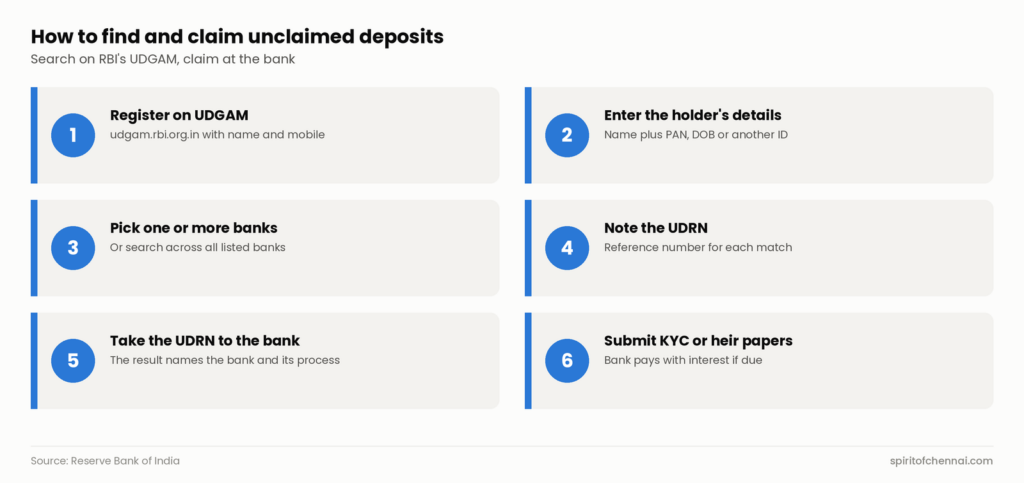
- Register on UDGAM. Go to udgam.rbi.org.in and sign up with your name and mobile number.
- Enter the account holder’s details. For an individual, give the name and at least one of PAN, driving licence, voter ID, passport number or date of birth. If you have none of these for an elderly relative, the address can be used instead.
- Choose the banks. Select one bank or several. If you are unsure where a relative banked, select every bank you think is possible, including ones that have since merged.
- Read the results. Each match shows the bank and a Unique Deposit Reference Number (UDRN). The UDRN hides the account number and branch from third parties, and the branch uses it to settle your claim.
- Take the UDRN to the bank. The result names the bank and its claim process. Visit with the UDRN, your ID and any papers it asks for.
- Claim as depositor or heir. A living depositor completes KYC and asks for the account to be reactivated or closed. Heirs follow the bank’s deceased-claim route; under the RBI’s 2025 directions, commercial banks use a simplified procedure up to ₹15 lakh where there is no nominee.
- Check the payout. The bank repays the balance, and interest if the account was interest-bearing, then seeks reimbursement from the DEA Fund.
Who does what
| Body | Role |
|---|---|
| Your bank | Transfers the balance after 10 years; settles your claim; recovers from the fund |
| RBI’s DEA Fund | Holds the money; reimburses the bank after it pays you |
| UDGAM portal | Search only; shows the bank and UDRN |
| Liquidator | Handles claims if the bank is under liquidation |
Source: RBI DEA Fund FAQs; RBI UDGAM FAQs.
The DEA Fund scheme sets no deadline for a depositor or heir to claim money transferred to it, according to the RBI’s FAQs.
Common mistakes
- Expecting UDGAM or the RBI to pay you. Only the bank settles the claim.
- Searching with a single spelling. Old records may use initials first, as many Tamil names were written.
- Paying an agent to search. The portal is open to anyone, and registration needs only a mobile number.
- Assuming no result means no money. Banks not yet on UDGAM, and accounts not yet 10 years dormant, will not show.
If it goes wrong
If the bank delays or refuses a valid claim, write to its grievance cell with the UDRN and keep the acknowledgement. If it does not reply within 30 days, or you are unhappy with the answer, complain to the RBI Ombudsman at cms.rbi.org.in under the Integrated Ombudsman Scheme, 2026. For disputes among heirs over an old account, a lawyer can advise.
Quick answers
Is my money lost if it went to the DEA Fund?
No. You or your legal heirs can claim it from the bank at any time, with interest if the account was interest-bearing.
What do I need to search on UDGAM?
The account holder’s name, the bank or banks, and one of PAN, driving licence, voter ID, passport or date of birth.
Can I claim online on UDGAM?
No. UDGAM only searches. You claim at the bank named in the result, quoting the UDRN.
Information checked against official sources on 19 October 2026. Fees, dates and rules can change; confirm on the linked official pages before acting.