IIT Madras ocean engineers have built SEANAV, a simulated sea in which software captains can practise path-following and collision avoidance before going near a real ship.
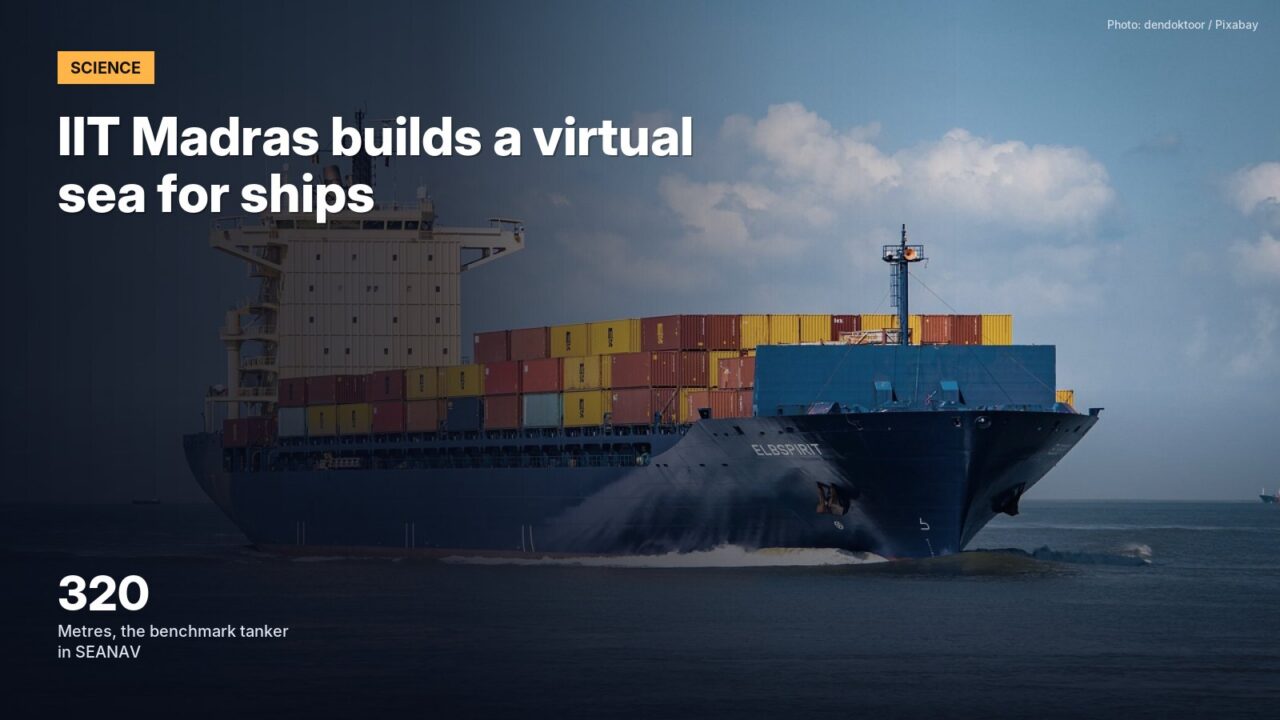
The test ship is a tanker about 320 metres long. It exists only in software.
Researchers in the Department of Ocean Engineering at IIT Madras, known in Tamil as சென்னை ஐஐடி (Chennai IIT), have built a real-time digital twin of the sea called SEANAV, short for Sea Navigation, the institute said in a press release on 12 November. It recreates waves and vessel motion on the Unity3D game engine, and the team calibrated it against that benchmark tanker so that a manoeuvre in the simulator behaves like one in commercial shipping. Inside it, autonomous navigation systems can be tested, broken and retrained without the cost and risk of sea trials. The team has already shown AI-driven path-following and collision avoidance in simulated waves and with simulated sensors.
The sensors are deliberately imperfect. SEANAV fuses LiDAR and marine radar with stereo cameras, then adds the noise and delay real instruments produce, so the software has to cope with fog or poor visibility. Several AI-controlled vessels can run at once and learn to share crowded water under COLREGs, the international collision rules at sea. A virtual ship’s bridge, viewed through Meta Quest headsets, lets human officers rehearse port approaches and emergencies.
SEANAV provides a realistic and scalable platform for developing and validating autonomous maritime navigation technologies.Dr. Suresh Rajendran, Associate Professor, Department of Ocean Engineering, IIT Madras, press release of 12 November 2026
Rajendran led the work with co-lead Dr. Athira M. Nambiar of SRM Institute of Science and Technology. The IIT Madras team named in the release are Aniket Malviya, Jothish S, Mukesh S K, Thirunavukarasu P and Vaidesh. The research is published in the ASME Journal of Offshore Mechanics and Arctic Engineering, with related work presented at the OMAE conferences in Vancouver in 2025 and Tokyo in 2026.
Chennai port is on the list of uses
The release names Chennai among four major ports, with Mumbai, Visakhapatnam and Kochi, as places where AI-assisted navigation could cut the risk of collisions and groundings. It also links the project to the Ports Ministry’s Sagarmala Programme and Maritime India Vision 2030, though it does not name a funding source or any trial on a real vessel.
Next, the team plans digital twins of major Indian ports, certified VR training for pilots, and checks against physical scale models.
Checked against official sources on 13 November 2026.