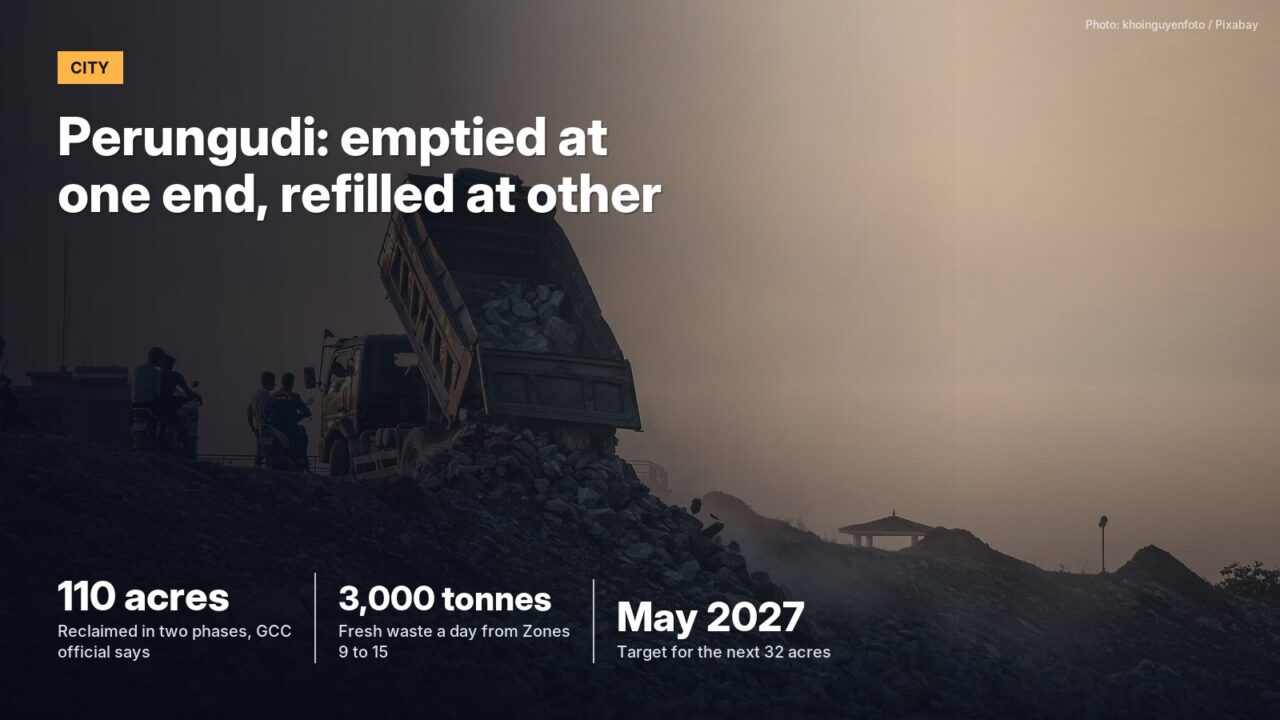
The Corporation says 110 acres of the Perungudi dump yard have been reclaimed, but about 3,000 tonnes of fresh garbage still arrive there every day from seven southern zones.
One hundred and ten acres. That is the figure a senior Greater Chennai Corporation official put on the land reclaimed at the Perungudi (பெருங்குடி) dump yard in two phases of biomining, speaking on Wednesday after residents’ welfare associations along the OMR side asked the civic body to hurry.
The associations want the whole 225 acres cleared and dumping stopped. The official said work on another 32 acres should be finished by May 2027. A government order has been issued for the rest of the legacy waste, with work expected to begin by March 2027, and a 100 tonne-a-day windrow composting plant is under way at the site. Fresh waste, the official said, will be processed once the old heaps are gone.
The associations count differently. Their federation’s president put the reclaimed area at 100 acres.
What the Corporation told the green tribunal
The Corporation’s own sworn figures, filed in July before the southern bench of the National Green Tribunal in a suo motu case on Chennai’s cleanliness ranking, are lower again. That status report records about 29.28 lakh cubic metres of legacy waste biomined in Phase I and 94 acres reclaimed. The next phase, 5.50 lakh tonnes, has a letter of acceptance and is due by March 2027.
The same report says Perungudi takes about 3,000 tonnes a day of fresh waste from Zones 9 to 15, the southern half of the city from Teynampet to Sholinganallur, and that the small windrow plant was expected to start operating from August 2026. A much larger compost plant was put out to tender, along with a regional waste-to-energy plant at Keerapakkam. Neither is running.
So the dump yard is being emptied at one end and refilled at the other.
The citywide numbers in the affidavit explain why. Chennai generates about 6,500 tonnes of garbage a day. About 750 tonnes is processed. The remaining 5,750 tonnes goes to the two dump yards at Kodungaiyur and Perungudi, roughly half each.
Residents point to the marsh
The dump yard sits on the edge of the Pallikaranai (பள்ளிக்கரணை) marsh, and the associations say dumping is hurting it. They list mosquitoes, groundwater contamination and stench in the rainy season in Thoraipakkam, Perungudi and Pallikaranai, and say the fresh waste has climbed above 50 feet.
G. Shanthakumari, who chairs the Corporation’s Standing Committee on Health, said she had asked officials for a report on groundwater contamination and had asked the Commissioner to install CCTV cameras to watch lorries entering and leaving the yard.
What the water tests show
The residents’ complaint about groundwater has years of evidence behind it. Researchers drilled multilevel boreholes around the dump yard’s edge for a geochemical study published in 2013 to trace how leachate seeps into the groundwater, and a 2016 study of wells in and around the site examined the same problem. In 2024 the Tamil Nadu Pollution Control Board tested two borewells near the dump yard against drinking water standards. One had total dissolved solids of 18,762 mg per litre, about 37 times the 500 mg per litre allowed under the Indian drinking water standard, IS 10500:2012. The same sample had 6,248 mg per litre of chloride against a limit of 250, and copper and lead at 0.81 and 0.58 mg per litre against 0.05 for each. The second borewell had 996 mg per litre of dissolved solids, with its other readings within limits. Leachate from the yard also drains into the Pallikaranai marsh. IIT Madras built a pilot system with the Corporation in 2021 to treat it before it reaches the marsh, but the project stalled for want of money: “We are awaiting funds to run the plant,” Professor Indumathi Nambi told Citizen Matters.
Civic officials have been leaning on the source of the waste as well. On 5 November its officers checked 260 bulk waste generators across all 15 zones and fined 126 of them a total of ₹6,30,000 for not segregating waste or keeping proper bins, according to its press release that day. Hotels, malls, marriage halls, schools and hospitals were told to segregate at source and process on site where they can. The Corporation has collected bulk generators’ waste free of charge since 1 April 2026.
For Context
Biomining at Perungudi began in October 2021 and was meant to finish by 2024. At Kodungaiyur, the city’s other dump yard, the Corporation told the tribunal that biomining under the Swachh Bharat Mission would cost about ₹650 crore and be completed by May 2027, with about 225 acres reclaimed there. The Pallikaranai site has had about 40,853 cubic metres biomined and about 5 acres reclaimed, now used for a cow shed, an animal birth control centre and a baling centre.
Checked against official sources on 13 November 2026.
Sources
- O.A. No. 144 of 2025 (SZ), Additional Status Report filed by Greater Chennai Corporation, National Green Tribunal, July 2026
- Greater Chennai Corporation press release No. 652: bulk waste generators fined, 5 November 2026
- Greater Chennai Corporation: What’s New
- Tamil Nadu Pollution Control Board groundwater analysis near Perungudi dumpsite, September 2024
- Geochemical investigation of groundwater contamination in Perungudi dumpsite, South India, Arabian Journal of Geosciences (2013)
- Study on ground water quality in and around Perungudi solid waste dumping site in Chennai, Rasayan Journal of Chemistry (2016)
- Reclaiming Perungudi dump yard is going to take more than biomining, Citizen Matters