The Madurai Bench has given Tamil Nadu Police until 24 November to show, district by district, what happened to five years of SC/ST Act cases, down to the appeals filed.
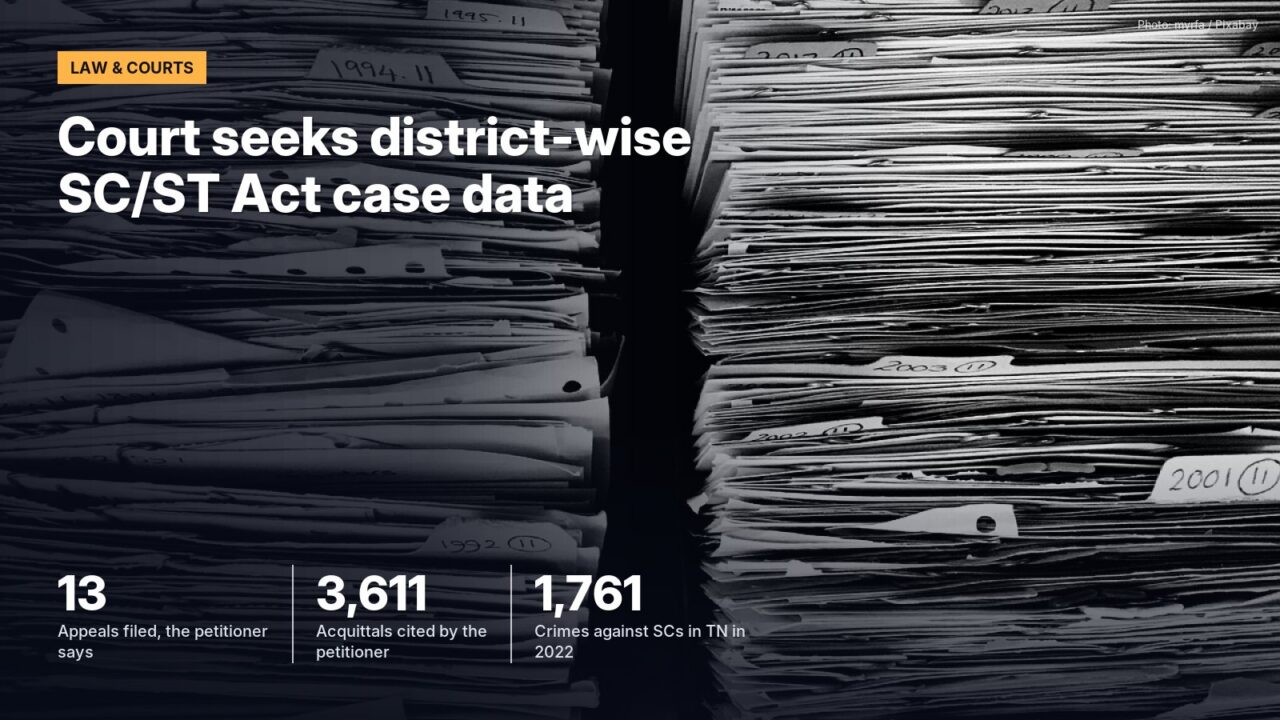
Thirteen appeals. That is the number at the centre of a public interest petition now before the Madurai Bench of the Madras High Court, or சென்னை உயர் நீதிமன்ற மதுரைக் கிளை. A Madurai-based human rights activist told the court, using answers obtained under the Right to Information Act, that 3,611 cases under the Scheduled Castes and the Scheduled Tribes (Prevention of Atrocities) Act ended in acquittal between 2015 and 2025, and that the State filed only 13 appeals against them in the High Court.
The petition counts 11,117 cases registered across 31 districts in that decade, and puts the conviction rate at about 3%.
The court has not accepted or tested those numbers. It has asked the police for their own.
The data the Bench wants
A Division Bench of Justices P. Velmurugan and K.K. Ramakrishnan directed the Director General of Police and the Additional Director General of Police (Social Justice and Human Rights) to file a report on or before 24 November 2026. It must cover the last five years, district-wise. The court listed what it wants to see:
- cases registered under the Act
- investigations completed, charge sheets filed and charge sheets still pending
- cases pending trial and cases disposed of, with acquittals and convictions
- cases where the Director of Prosecution’s opinion was sought on an appeal or on seeking a higher sentence
- appeals filed in the High Court and the Supreme Court
The matter returns on 25 November.
The petitioner’s case is about who appeals
The petition turns on a gap between the trial court and the appeal court. A victim of a caste atrocity who sees the accused acquitted often cannot pursue an appeal alone, the petitioner argued, so the State should review every acquittal and appeal wherever the law supports it. “The responsibility for considering an appeal cannot be placed entirely upon the affected victim,” the petition said. The Bench’s request for the Director of Prosecution’s opinions goes straight to that point: it will show how often the prosecution even considered an appeal, and in which districts it did. The district split matters because the State’s own figures are usually published as a single statewide total, which hides whether a few districts carry most of the acquittals or the problem is spread evenly from Chennai to Kanniyakumari.
What the Act provides
The SC/ST (Prevention of Atrocities) Act is Act No. 33 of 1989. Parliament passed it on 11 September 1989 and it came into force on 30 January 1990. Its long title sets out three jobs: to prevent atrocities against members of the Scheduled Castes and Scheduled Tribes, to provide Special Courts and Exclusive Special Courts to try those offences, and to provide relief and rehabilitation for victims. The Ministry of Social Justice and Empowerment administers it at the Union level. Investigation and prosecution, including any decision to appeal, sit with the State.
National crime figures are compiled by the National Crime Records Bureau in its annual Crime in India report. Those tables report conviction rates and pendency by state, and the Union government has placed state-wise SC/ST Act figures before Parliament, including in a Rajya Sabha answer of 24 July 2024. None of the published tables break Tamil Nadu down by district or count appeals, which is the gap the court’s order would fill.
For Context
Tamil Nadu’s registered caste crime has moved up and down for over a decade. In a Lok Sabha answer on 19 December 2023, the Ministry of Home Affairs gave NCRB figures for crimes against Scheduled Castes in the State. They fell to 1,144 in 2019, the lowest in that series, and then climbed each year to 1,761 in 2022.
Crimes against Scheduled Tribes are far fewer in Tamil Nadu but rose faster, from 15 cases in 2018 to 67 in 2022.
Across India, the same answer counted 57,582 crimes against Scheduled Castes in 2022. Tamil Nadu’s 2022 total was its highest since 2013, when 1,845 cases were recorded.
Checked against official sources on 12 November 2026.
Sources
- Order of the Madras High Court, Madurai Bench (Justices P. Velmurugan and K.K. Ramakrishnan), in a public interest litigation on SC/ST Act cases, November 2026
- The Scheduled Castes and the Scheduled Tribes (Prevention of Atrocities) Act, 1989 (India Code, Ministry of Law and Justice)
- Lok Sabha Unstarred Question No. 2625, Atrocities against SCs/STs, Ministry of Home Affairs, 19 December 2023
- State/UT-wise cases, charge-sheets and convictions under the SC/ST (Prevention of Atrocities) Act, from Rajya Sabha Unstarred Question No. 301, 24 July 2024 (Open Government Data Platform India)