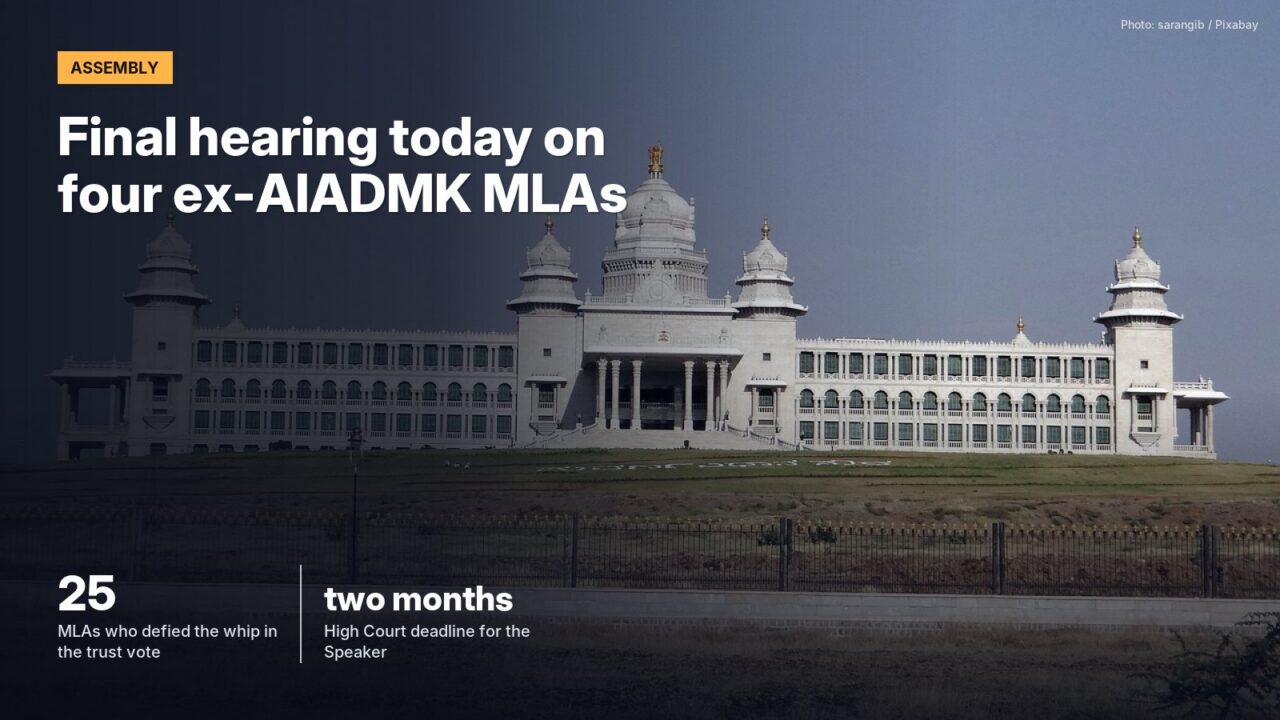
Speaker J.C.D. Prabhakar holds the final hearing on 12 November in the AIADMK’s disqualification plea against four legislators who quit the party and the House in May.
Two of them came to the Speaker’s chamber on Tuesday. Former Ambasamudram MLA Esakki Subaya and former Perundurai MLA S. Jayakumar gave oral and written explanations in reply to the AIADMK’s complaint. The party’s MLAs Agri S.S. Krishnamurthy and Thalavai N. Sundaram attended with senior advocate S.R. Rajagopal. Afterwards both former members said the inquiry was “proceeding in the right direction”.
Thursday’s sitting is the last before a decision.
Who is the plea against, and how did it start?
AIADMK general secretary Edappadi K. Palaniswami filed the disqualification petition after 25 AIADMK MLAs backed the TVK government led by Chief Minister C. Joseph Vijay in the trust vote, against the party whip. He later accepted the explanations of 21 of them. The plea now concerns four people: S. Jayakumar (Perundurai), Maragatham Kumaravel (Madurantakam) and P. Sathyabama (Dharapuram), who resigned on 25 May 2026, and Esakki Subaya (Ambasamudram), who resigned the next day. Maragatham Kumaravel and P. Sathyabama returned to the Assembly after winning the 6 October bypolls as TVK candidates. Assembly Secretary R. Shanthi had summoned all four, and Mr Palaniswami, for personal hearings on 30 July.
Why is there still a case when they have already resigned?
Because the High Court said the two questions are separate. The First Bench of Chief Justice Sushrut Arvind Dharmadhikari and Justice G. Arul Murugan upheld the Speaker’s acceptance of the resignations of six former AIADMK legislators, finding them voluntary and genuine. It also held that a pending disqualification plea did not stop the Speaker from accepting a resignation, and that accepting it does not make the disqualification proceedings infructuous. The Speaker still has to decide them. The Constitution’s Article 190(3)(b) lets a Speaker accept a resignation only after being satisfied it is voluntary and genuine, which is what the July hearings examined.
What does the anti-defection law say?
The Tenth Schedule of the Constitution sets two main grounds. Under paragraph 2(1)(a), a member is disqualified “if he has voluntarily given up his membership of such political party”. Under paragraph 2(1)(b), a member is disqualified for voting or abstaining “contrary to any direction issued by the political party” without its prior permission, unless the party condones it within fifteen days. The AIADMK’s petition rests on the trust-vote whip.
Tamil Nadu’s own procedure sits in the Tamil Nadu Legislative Assembly (Disqualification on Ground of Defection) Rules, 1986, framed under paragraph 8 of the Schedule, which lets the Speaker “make rules for giving effect to the provisions of this Schedule”. The July hearings on the resignations were held under Rule 7(7) of those rules.
What exactly is the Speaker’s role here?
Paragraph 6(1) says any question on disqualification “shall be referred for the decision of the Chairman or, as the case may be, the Speaker of such House”, and that the decision shall be final. Paragraph 7, which barred courts altogether, was struck down by the Supreme Court in Kihoto Hollohan in 1992. In Keisham Meghachandra Singh v. Speaker, Manipur Legislative Assembly (21 January 2020), a Bench led by Justice R.F. Nariman repeated that the Speaker deciding such a petition “is a Tribunal”, whose orders courts can review on limited grounds such as mala fides, a breach of natural justice or perversity. In the Assembly’s own Tamil name, the office is பேரவைத் தலைவர் (Speaker of the House).
Is there a deadline?
Yes. The High Court issued what it called a time-bound mandamus, directing the Speaker to conclude the proceedings within two months, and said it could step in under Article 226 if he did not. The Supreme Court’s 2020 judgment had separately said three months from the filing of a petition “is the outer limit”, barring exceptional circumstances.
What happens after 12 November?
The Speaker will pass an order on the four. If any of them is found disqualified, the order can be challenged only on the narrow grounds the Supreme Court has allowed. Both sides have had their hearings: the AIADMK through its MLAs and counsel, the four through their written and oral replies.
- 25-26 May 2026Four AIADMK MLAs resign from the Assembly
- 30 July 2026Speaker holds fresh personal hearings on the resignations
- 6 October 2026Two of the four win bypolls as TVK candidates
- 10 November 2026Two former MLAs appear in the disqualification inquiry
- 12 November 2026Final hearing before the Speaker
Checked against official sources on 12 November 2026.
Sources
- The Constitution of India, Tenth Schedule and Article 190 (Legislative Department, Ministry of Law and Justice, as on 1 May 2026)
- Keisham Meghachandra Singh v. Speaker, Manipur Legislative Assembly, Civil Appeal No. 547 of 2020 (Supreme Court of India, 21 January 2020)
- Judgment of the First Bench, Madras High Court, on the acceptance of resignations of six AIADMK MLAs (October 2026)
- Notice of the Tamil Nadu Legislative Assembly Secretariat summoning four former MLAs, 24 July 2026