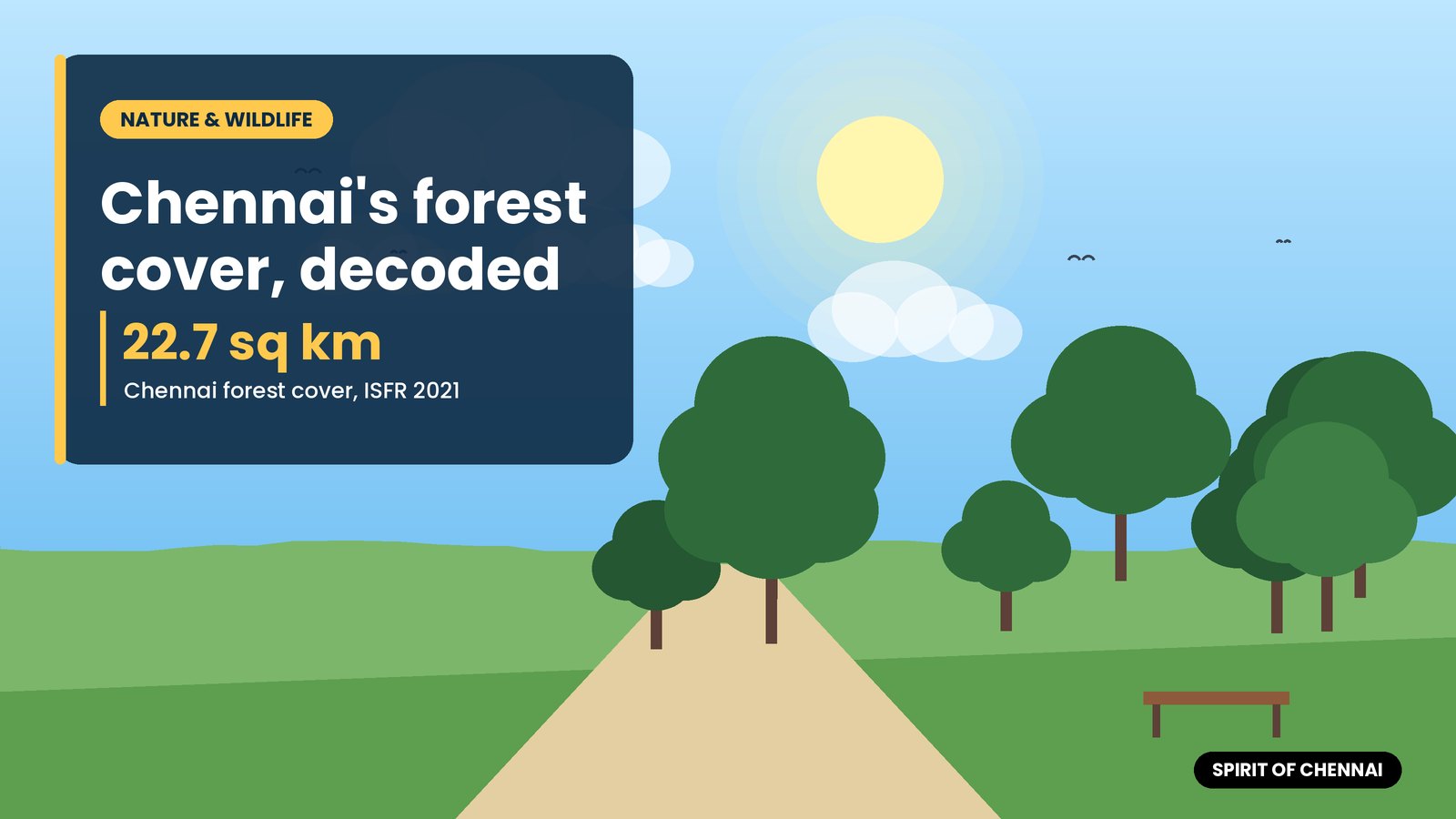
Chennai had 22.70 sq km of forest cover in 2021, up from 18.02 sq km in 2011, according to Forest Survey of India figures that the Union environment ministry gave in a Lok Sabha reply on 20 March 2023. That is a gain of 4.68 sq km over ten years. The Economic Survey 2021-22 counted it as roughly a 26 per cent rise, one of the better performances among the seven mega cities the survey compared.
The most recent edition, the India State of Forest Report (ISFR) 2023, was released in December 2024. It puts Chennai district’s forest cover at 21.12 sq km. This page sets out what each report says, what the numbers mean, and where they come from.
Chennai’s figures, edition by edition
| Report | Area measured | Forest cover | Source |
|---|---|---|---|
| ISFR 2011 | Chennai (mega city) | 18.02 sq km | Lok Sabha reply, March 2023 |
| ISFR 2021 | Chennai (mega city) | 22.70 sq km | Lok Sabha reply, March 2023 |
| Change 2011 to 2021 | Chennai (mega city) | +4.68 sq km (about 26%) | Lok Sabha reply; Economic Survey 2021-22 |
| ISFR 2023 | Chennai district (175 sq km) | 21.12 sq km, 12.07% of area | DT Next report on ISFR 2023 |
Take care when comparing the last row with the first two. The 2011 and 2021 figures come from the city tables used for the mega-city comparison. The 2023 figure is from the district table, as DT Next reported it, and the boundaries may not match. The same report noted that cover for the Greater Chennai Corporation area fell to 4.66 per cent in ISFR 2023, from 5.28 per cent in ISFR 2021. A reader can safely say Chennai’s cover rose through the 2010s. It is less safe to read the 2023 district figure as a precise drop of about 1.6 sq km.
Where Chennai’s forest cover actually is
Forest cover in these reports is a satellite measure of tree canopy. It is not the same as land legally recorded as forest. In Chennai, the biggest single block is the Guindy National Park, 270.57 hectares, formed in 1978 according to the state’s statistical handbook. Next to it are the wooded grounds of IIT Madras and Raj Bhavan. Large institutional campuses, old residential areas with mature avenue trees, and riverbank greenery along the Adyar make up much of the rest.
This is also why the city’s figure can rise even as open land disappears. Trees planted along roads and in parks in the 2000s have grown canopies big enough to register. A single large project that clears a wooded campus, though, can show up as a loss in the next edition.
Tamil Nadu in the same reports
For the state as a whole, the Tamil Nadu Forest Department quotes these ISFR 2023 figures:
| Measure (ISFR 2023) | Area | Share of state |
|---|---|---|
| Forest cover | 26,450 sq km | 20.34% |
| Tree cover outside forests | 5,371 sq km | 4.13% |
| Forest and tree cover combined | 31,821 sq km | 24.47% |
The combined share was 24.48 per cent in 2021, so it was almost unchanged. Underneath, the state lost about 61 sq km of forest cover and gained about 47 sq km of tree cover, for a net loss of about 14 sq km, DT Next reported. Over the longer run the trend is upward. A Lok Sabha reply of 11 August 2025 gives Tamil Nadu’s forest cover as 24,245.21 sq km in 2013 and 26,450.22 sq km in 2023, a rise of 2,205.01 sq km.
The state’s legally recorded forest area is a separate number. The statistical handbook puts it at 22,418.21 sq km in 2022-23, or 17.24 per cent of land area, made up mostly of reserved forests.
Among districts, ISFR 2023 gave the Nilgiris the highest forest cover at 66.55 per cent and Mayiladuthurai the lowest at 2.77 per cent. Kancheepuram, next door to Chennai, was at 4.35 per cent.
How to read these numbers
- Forest cover is not forest land. A private campus with dense trees counts. A reserve forest that has lost its canopy may not.
- Editions come every two years. The 2019, 2021 and 2023 reports are the recent ones. Small changes between editions can reflect better satellite imagery as much as real change.
- Check the boundary. City, district and corporation figures use different maps, so compare like with like.
- Go to the report. District tables sit in Volume II of each ISFR, in the Tamil Nadu chapter.
Quick answers
How much forest cover does Chennai have?
ISFR 2023 puts Chennai district’s forest cover at 21.12 sq km, about 12 per cent of its 175 sq km. ISFR 2021 recorded 22.70 sq km for the city.
Has Chennai’s green cover increased?
Between 2011 and 2021 it rose by 4.68 sq km, about 26 per cent, according to FSI figures given to Parliament.
What is Tamil Nadu’s total forest and tree cover?
31,821 sq km, or 24.47 per cent of the state, in ISFR 2023.
Information checked against official sources on 18 October 2026. Fees, dates and rules can change; confirm on the linked official pages before acting.
Sources
- Lok Sabha Unstarred Question 3212: Decrease in forest area in metropolitan cities, 20 March 2023 (Parliament Digital Library)
- Economic Survey 2021-22, Volume 2, page on forest cover in major cities (Ministry of Finance)
- Tamil Nadu State Forest Profile: Status of Forest (Tamil Nadu Forest Department)
- Lok Sabha Unstarred Question 3461: Tiger reserve in Tamil Nadu, 11 August 2025 (Parliament Digital Library)
- Statistical Handbook: Forests chapter (Department of Economics and Statistics, Tamil Nadu)
- Tamil Nadu loses 14 sq km of green cover in 3 years: report (DT Next)