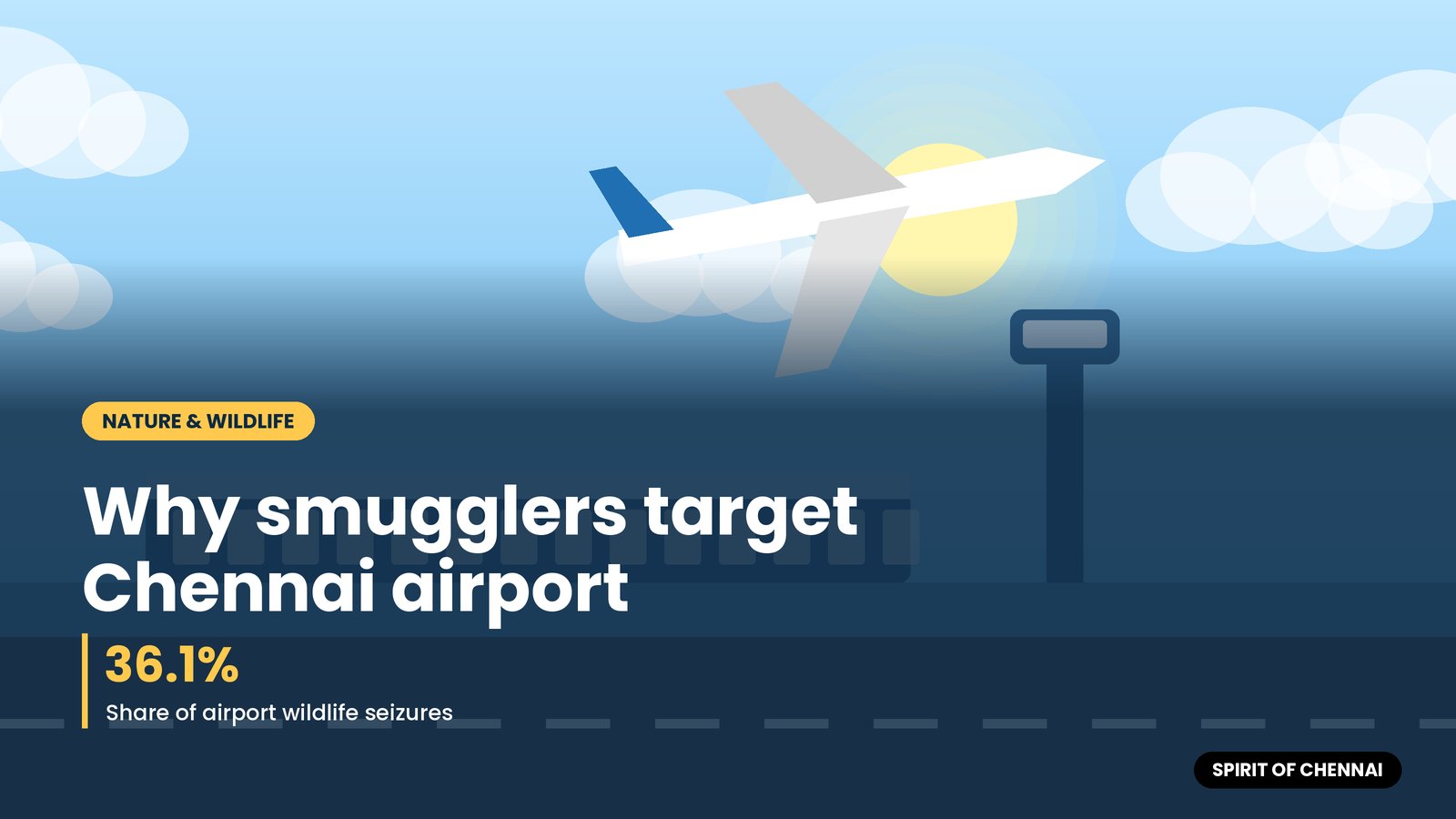
Chennai airport accounted for 36.1 per cent of all wildlife seizure incidents at Indian airports between 2011 and 2020, more than any other airport in the country. That is the finding of a March 2022 study by the wildlife trade monitoring network TRAFFIC. Mumbai came second with 14.8 per cent and Delhi third with 11.3 per cent. The traffic moves in both directions. Exotic pets come in, mostly from Bangkok, and Indian star tortoises go out, mostly towards Malaysia.
Here is what gets caught, what happens to the animals, how the law has changed, and what a Chennai resident who keeps or wants an exotic pet needs to know.
What the national study found
TRAFFIC counted 141 seizure incidents across 18 airports in the ten years to 2020. Together they involved over 70,000 animals, body parts or derivatives, plus more than 4,000 kg of wildlife products. Reptiles made up 46 per cent of the seized species, mammals 18 per cent, timber 13 per cent and marine species 10 per cent. Among native animals, the Indian star tortoise was the one seized in the largest numbers. It turned up in about one in five native-species incidents.
Recent Chennai cases
| When | What was found | Route | Outcome reported |
|---|---|---|---|
| October 2018 | Macaws, cockatoos, conures, squirrel monkeys and iguanas at two Chennai premises | International syndicate | DRI searches; one alleged mastermind arrested in Chennai |
| December 2019 | 12 kangaroo rats, 3 prairie dogs, 1 red squirrel, 5 blue iguanas | Bangkok to Chennai | Checked by Vandalur zoo vets; deportation planned |
| August 2023 | 16 pythons, 30 blue iguanas, 4 Persian squirrels | Bangkok to Chennai | Passenger arrested; animals sent back to Thailand |
| August 2024 | 780 live star tortoises | Chennai to Kuala Lumpur | Three passengers handed over by customs |
The cases come from the Directorate of Revenue Intelligence’s file of a 2018 report and from DT Next reports in 2019, 2023 and 2024. In the 2024 case, airport security grew suspicious when lightly shaken cardboard boxes did not feel right. DT Next valued the tortoises at about Rs 15 lakh. At least ten major smuggling attempts were stopped at Chennai airport in 2023 alone, The News Minute reported, citing official records.
Why live animals are usually sent back
Seized exotic animals are generally put on the next available flight back to the country they came from. Officials do this on the advice of quarantine and wildlife staff, because animals from abroad can carry diseases and India has few places to keep them. Indian species are different. Star tortoises caught leaving the country are handed to the State Forest Department for rehabilitation.
A 2022 investigation by The News Minute reported that seized animals often arrive dehydrated, and that a pair of marmosets could sell for about Rs 10 lakh in India.
How the law has tightened
Until recently, smugglers of exotic animals faced a gap in the law. Many foreign species were not listed under the Wild Life (Protection) Act, 1972, so charges tended to fall under customs and foreign trade rules instead. The 2018 DRI case, for example, cited the Customs Act, 1962, the Foreign Trade (Development and Regulation) Act, 1992, and the international CITES convention, alongside the wildlife law.
The India Code index of the Act shows how that changed:
- 22 March 2023: the Wild Life (Protection) Amendment Act, 2022 was brought into force.
- May and August 2023: notifications named India’s CITES management and scientific authorities, delegated powers under the new trade chapter, and fixed ports of entry and exit for wildlife.
- 28 February 2024: a notification under Section 49M set out how people must report living animals of species in Schedule IV, the list covering exotic species.
Under those reporting rules, people who already had such animals were given six months, until 28 August 2024, to register them with the state’s Chief Wildlife Warden on the PARIVESH 2.0 portal, Greater Kashmir reported. Anyone acquiring one now must report it within 30 days.
What residents should do
- Do not buy undocumented exotic pets. If a seller cannot show legal import papers and registration, walk away.
- Register what you own. If you keep a Schedule IV species, make sure it is reported on PARIVESH. If you are unsure, ask the Chennai Wildlife Warden’s office.
- Never keep a star tortoise. It is a protected Indian species. If you find one, leave it in cover, away from roads.
- Report tip-offs. The Chennai Customs website has a Report Smuggling section.
This is general information, not legal advice. Anyone facing a notice should consult a lawyer.
Quick answers
Why is Chennai airport a wildlife smuggling hotspot?
It has direct flights to Bangkok and Kuala Lumpur, the main source and destination markets. It recorded 36.1 per cent of airport seizure incidents nationally from 2011 to 2020.
What happens to seized exotic animals?
They are usually deported to the country they came from. Seized Indian species go to the Forest Department.
Do I need to register an exotic pet?
If it belongs to a Schedule IV species, yes. Report it on PARIVESH 2.0 within 30 days of getting it.
Information checked against official sources on 18 October 2026. Fees, dates and rules can change; confirm on the linked official pages before acting.
Sources
- High Flying: insight into wildlife trafficking through India’s airports, briefing paper, March 2022 (TRAFFIC)
- Wild Life (Protection) Act, 1972: notifications and amendments index (India Code, Government of India)
- International gang of wildlife smugglers busted in Chennai (New Indian Express, hosted by Directorate of Revenue Intelligence)
- Chennai Customs official website
- Iguanas, macaws, marmosets: exotic animal craze turns Chennai into trafficking hub (The News Minute)
- Trafficking of exotic animals: ED to investigate money laundering (The News Minute)
- Customs seize blue iguanas, pythons, Persian squirrels from city man (DT Next)
- 780 live star tortoises, e-cigarettes worth Rs 52 lakhs seized at Chennai airport (DT Next)
- Exotic species seized at airport (DT Next)
- August 28 last date for declaring exotic animals under Schedule IV of Wild Life Protection Act (Greater Kashmir)