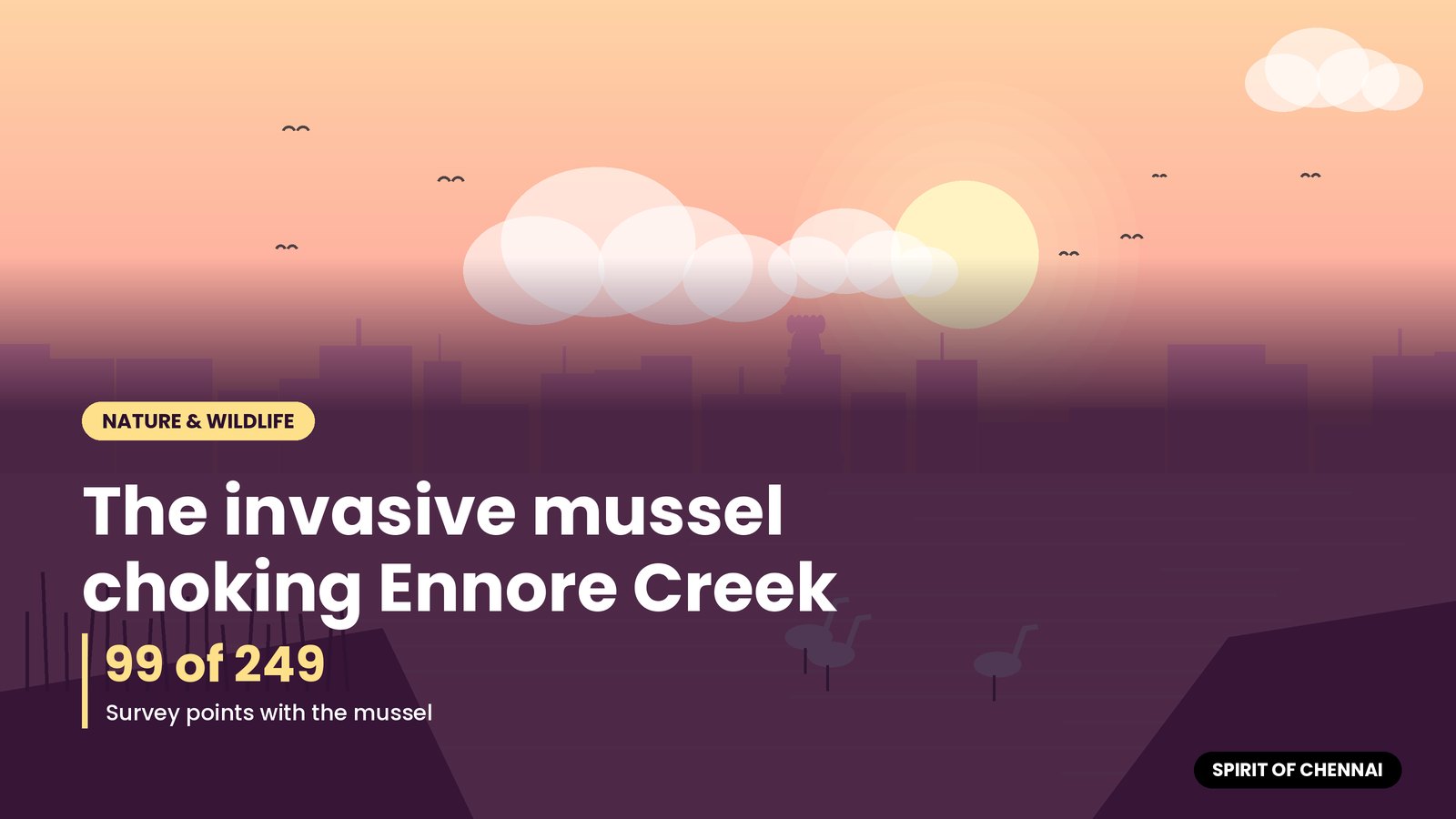
A South American mussel, Mytella strigata, known on the Ennore coast as kaaka aazhi or charru mussel, has spread through Ennore Creek and the Kosasthalaiyar estuary, cutting into the catch of local fishers. A November 2025 mapping survey by the National Centre for Sustainable Coastal Management (NCSCM) found the mussel at 99 of 249 sampling points, about 40 percent, DT Next reported.
The same survey found that about 380 families depend on the estuary. Some 150 households have already moved to other work, and fishers who stayed reported monthly incomes of Rs 5,000 to 10,000, down from Rs 30,000 to 50,000. The case has been before the National Green Tribunal since 2023. Here is how the mussel got here, what it does, and why removing it has proved so hard.
What the mussel is and how it arrived
The charru mussel is native to the Pacific and Atlantic coasts of South America. It was first documented in Indian waters in 2019, growing on floating plastic bottles, wooden pilings, boat hulls and fish-cage walls. A study led by researchers at Sathyabama Institute of Science and Technology later found it among 17 species fouling 367 litter items on beaches between Puducherry and Parangipettai, DT Next reported in October 2023. The study suggested marine litter may help it move along the coast.
How it reached Ennore is disputed. The Water Resources Department has blamed ballast water from ships and sought Rs 160 crore from Kamarajar Port. The port says the risk of spread through ballast water is minimal, according to DT Next. Fishers and the Save Ennore Creek Campaign first raised the alarm in December 2022.
What it does to the creek
The mussel settles in dense mats that spread like a carpet across the creek bed. Petitioners told the tribunal that it:
- stops prawns from grazing and burrowing into the sediment, hitting the creek’s most valuable catch;
- strips phytoplankton from the water, leaving too little food for shrimp;
- crowds out two native shellfish that fishers sell, yellow clams (manja matti) and green mussels (pachai aazhi).
The NCSCM survey found the heaviest clusters near bridges, the estuary mouth, mangroves, fishing zones, towers and small landing points. Those are the same spots where fishers set nets and land their boats, so the mats sit right where the catch used to be. An earlier NCSCM study looked at hotspots and density along a 20 km stretch of the Kosasthalaiyar, the Wetland Authority told the tribunal in 2025.
The case and the official response
| When | What happened |
|---|---|
| 2023 | The Fisheries Department studied the mussel in March and recommended dredging the worst-hit stretch. The NGT southern bench, hearing a petition by fisherman Kumaresan Sooluran, asked for a detailed report in October. |
| August 2024 | The Chief Secretary asked the State Wetland Authority to commission a removal study, with CMFRI, NIOT and CIBA to submit a joint proposal. |
| February 2025 | The tribunal found the reports unsatisfactory and warned it could summon officials. Dredging had covered 500 metres. NCSCM was given mapping and Dr MGR Fisheries College, Ponneri, control work. |
| August 2025 | The Wetland Authority told the tribunal the Fisheries Department was not cooperating. The WRD drew up a Rs 90 crore dredging proposal for Kattupalli, Puzhuthivakkam and Athipattu. |
| November 2025 | NCSCM’s survey warned that dredging should not be a permanent fix. |
Sources: DT Next, October 2023; DT Next, February 2025; DT Next, August 2025.
Why removal is so hard
Studies by NCSCM and CMFRI cited before the tribunal found biological eradication not very successful. Dredging removes the mats but, NCSCM warned, it also scoops out eggs, larvae and native animals, changes the seabed, alters underwater sound and stirs up heavy metals and nutrients. That matters in a creek already loaded with fly ash and industrial waste. The WRD separately began dredging fly ash along a 1.7 km stretch at Rs 28 crore. The Chief Secretary has asked the Fisheries Department to quantify fishers’ losses and look at long-term management.
Why Pulicat is watching
Ennore Creek connects north to Pulicat lake, one of India’s largest brackish lagoons. Pulicat supports over 60 fish species and abundant prawns, according to the Andhra Pradesh Forest Department, and both the Pulicat sanctuary and Ennore lie in the State Wetland Authority’s list of priority wetlands. Early reports described heavy infestation in both Ennore and Pulicat. A spread through the whole lagoon would hit thousands more fishing families.
Quick answers
What is kaaka aazhi?
The local name for Mytella strigata, an invasive South American mussel now spreading in Ennore Creek and the Kosasthalaiyar.
Is the mussel safe to eat?
No official advisory on eating it from Ennore has been issued. Given the creek’s industrial pollution, avoid shellfish collected there.
Who is responsible for removing it?
The tribunal has involved the Water Resources Department, the State Wetland Authority and the Fisheries Department, which disagree over who should lead.
Information checked against official sources on 18 October 2026. Fees, dates and rules can change; confirm on the linked official pages before acting.
Sources
- Invasive mussel: CS instructs scientific institutions to help remove Kakka Aazhi from Ennore (DT Next, August 2024)
- NGT seeks action to remove invasive mussel from Ennore-Pulicat (DT Next, October 2023)
- Will summon officials for inaction in removing Kakka Aazhi: NGT warns (DT Next, February 2025)
- Wetland Authority reports lack of support from TN depts (DT Next, August 2025)
- Dredging to remove Charru mussels may disrupt Kosasthalaiyar aquatic system, warns study (DT Next, November 2025)
- Litter ferries invaders from afar to Tamil Nadu coast (DT Next, October 2023)
- List of 100 wetlands and Ramsar sites (Tamil Nadu State Wetland Authority)
- Pulicat Bird Sanctuary (Andhra Pradesh Forest Department)