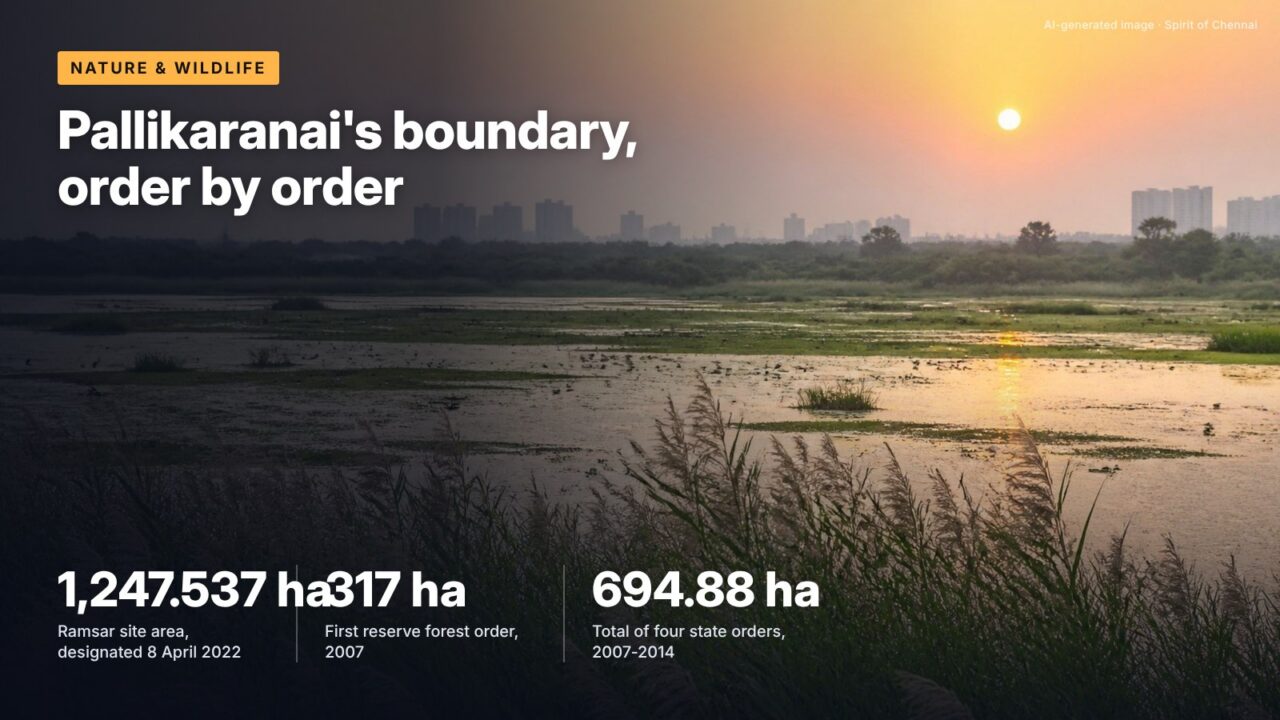
Pallikaranai’s protected area was built up order by order, from a 317-hectare reserve forest in 2007 to a 1,247.5-hectare Ramsar site in 2022. Reading the orders in sequence shows what is legally protected, by whom, and where the line is still unsettled.
The numbers
The Pallikaranai Marsh Reserve Forest that India listed under the Ramsar Convention on 8 April 2022 covers 1,247.537 hectares, according to its Ramsar Information Sheet. The four Tamil Nadu orders that sheet cites as the site’s legal protection add up to 694.88 hectares. The gap of about 553 hectares is the most important fact about the marsh’s boundary, and the published sheet does not explain it.
Both numbers are a fraction of what was once there. The same sheet describes much of south Chennai as a former floodplain of over 50 square kilometres, about 5,000 hectares. How the protected core was carved out of that, and what rules now apply to it, is a story of separate departments acting at different times.
The marsh before the orders
The earliest numbers come from surveys by the Chennai research group Care Earth, cited in a 2010 bird checklist in the Journal of Threatened Taxa: an original extent of 4,000 to 5,000 hectares, about 600 hectares remaining by 2002 and 420 hectares by 2005, a loss of roughly 30 per cent in three years. The authors named the city’s waste dump, which occupied more than 250 acres of marshland, along with real estate and IT parks on the edges, and the absence of any law protecting urban wetlands as such.
Those figures and the later legal ones are not the same measure. Care Earth counted surviving marsh habitat. The government orders define land with a legal status. Some notified land had already been degraded, and some wet land lay outside every order.
Four orders that drew the line
| Order | Department | Area (ha) |
|---|---|---|
| G.O.Ms. No. 52, 9 April 2007 | Environment and Forests | 317.00 |
| G.O.Ms. No. 127, 24 December 2012 | Municipal Administration and Water Supply | 170.40 |
| Section 26, Tamil Nadu Forest Act, 1882; Kancheepuram District Gazette No. 6, 1 July 2013 | Revenue land declared reserve forest | 131.55 |
| G.O.Ms. No. 147, 12 May 2014 | Revenue | 75.93 |
| Total of the four | 694.88 |
Source: Ramsar Information Sheet, Pallikaranai Marsh Reserve Forest (site 2481), 2022; total is the sum of the listed orders
The sequence shows how the core was assembled. The forest department took the first 317 hectares in 2007. In 2012 the municipal administration department transferred land held for urban purposes, in 2013 revenue land was declared reserve forest under the 1882 Act, and in 2014 the revenue department handed over a further parcel. Each transfer moved land from a department that could have built on it to one charged with keeping it wild.
The difference between the 1,247.537 ha Ramsar site and the 694.88 ha covered by the four state orders listed in its information sheet.
What the Ramsar listing added
The Ramsar designation is an international listing, and the sheet states its official and GIS-calculated areas as identical, at 1,247.537 hectares. Its boundary description field is blank; it points instead to an uploaded digital map. The managing bodies named are the Tamil Nadu State Wetlands Authority and the Conservation Authority of Pallikaranai Marshland under the forest department.
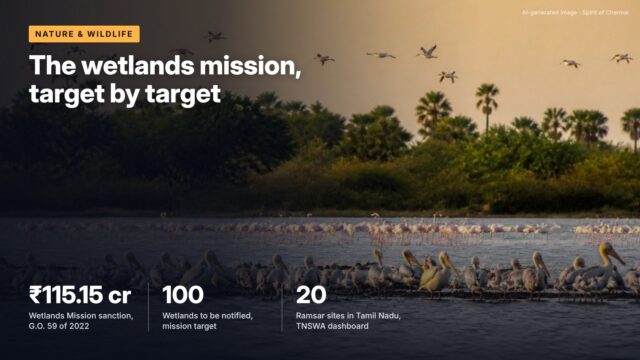
The state’s own list of 100 wetlands identified under the Tamil Nadu Wetlands Mission lists the site’s owners as the forest department, the Water Resources Department and the Greater Chennai Corporation. That three-way ownership helps explain the area gap: land held by WRD and the Corporation sits inside the Ramsar map without being reserve forest.
The rules that now apply
For land inside a wetland, the Wetlands (Conservation and Management) Rules, 2017, notified as G.S.R. 1203(E) on 26 September 2017, list prohibited activities under Rule 4: converting a wetland to other uses or encroaching on it, setting up or expanding industries, dumping solid waste, storing or disposing of construction debris, hazardous substances or e-waste, discharging untreated sewage or effluent, permanent construction other than boat jetties, and poaching. A state can ask the Centre to relax any item only on its wetland authority’s recommendation.
Formal notification under the Rules needs a brief document setting out the boundary, the zone of influence and the activities to be permitted. A Union environment ministry memorandum of 8 March 2022 adds a safeguard: relying on a Supreme Court order of 4 October 2017, it says the 2,01,503 wetlands above 2.25 hectares mapped in the 2011 national wetland inventory must be protected on Rule 4 principles whether or not they have been notified.
What the surveys count
The Ramsar sheet estimates 381 species in the site, including about 141 plants (29 of them grasses), 10 mammals, 21 reptiles, 10 amphibians, nine molluscs and five crustaceans. It gives two different bird totals, 115 and 165, and two fish totals, 46 and 50, in different sections. The 2007 survey behind the 2010 checklist recorded 101 bird species, 76 breeding residents and 25 winter visitors, in work done between February and August.
The sheet’s land-cover figures for the surrounding area are the starkest. Between 2010 and 2020 natural vegetation fell from 91.04 to 35.08 square kilometres while built-up area rose from 97.17 to 145.41 square kilometres. Mapped wetland area rose from 16.11 to 31.64 square kilometres, a rise the sheet does not explain. The sheet rates flood control and storage as the site’s most important service and names the Perungudi dumpsite, sewage and transport corridors among high-impact threats.
It’s often said the whole Pallikaranai Ramsar site is protected reserve forest.
The record shows The orders cited in the Ramsar sheet cover 694.88 hectares. The rest of the 1,247.537-hectare site is held by the Water Resources Department and the Greater Chennai Corporation, and its protection rests on the wetland rules and on how those departments manage their land.
What this means for you
- Anyone buying land near Pallikaranai, Perungudi, Thoraipakkam or Medavakkam should check the survey number against the forest department’s notified area and the Ramsar map before paying an advance.
- Dumping debris or letting untreated sewage into the marsh breaks Rule 4 of the 2017 Rules even where land is not reserve forest; complaints go to the Tamil Nadu State Wetlands Authority.
- Construction near the site edge has been disputed before the courts and the green tribunal; check the current position of any order before relying on a builder’s assurance.
- Bird counts are uneven across surveys, so treat any single headline number of species with care.
What to watch
Pending
Formal notification of Pallikaranai under the 2017 Wetlands Rules, which would publish an agreed boundary and list of regulated activities; the site is on the state’s list of 100 wetlands.
2025-26 to 2026-27
The last years of funding under the Tamil Nadu Wetlands Mission, which pays for brief documents and management plans for listed wetlands.
Checked against official sources on 23 October 2026. Figures and rules change; confirm on the linked official pages before relying on them.
Sources
- Ramsar Information Sheet: Pallikaranai Marsh Reserve Forest, India (site 2481), 2022
- Pallikaranai Marsh Reserve Forest, Ramsar Sites Information Service
- Tamil Nadu State Wetlands Authority
- List of 100 wetlands identified under Tamil Nadu Wetlands Mission, TNSWA
- Wetlands (Conservation and Management) Rules 2017 and guidelines, compendium hosted by TNSWA
- MoEFCC office memorandum on protection of wetlands under Rule 4, 8 March 2022 (TNSWA copy)
- Consolidated checklist of birds in the Pallikaranai Wetlands, Journal of Threatened Taxa 2(8), 2010