The PMK wants the Madras High Court to make the State send two Assembly resolutions on Tamil as the court’s language to the Union government.
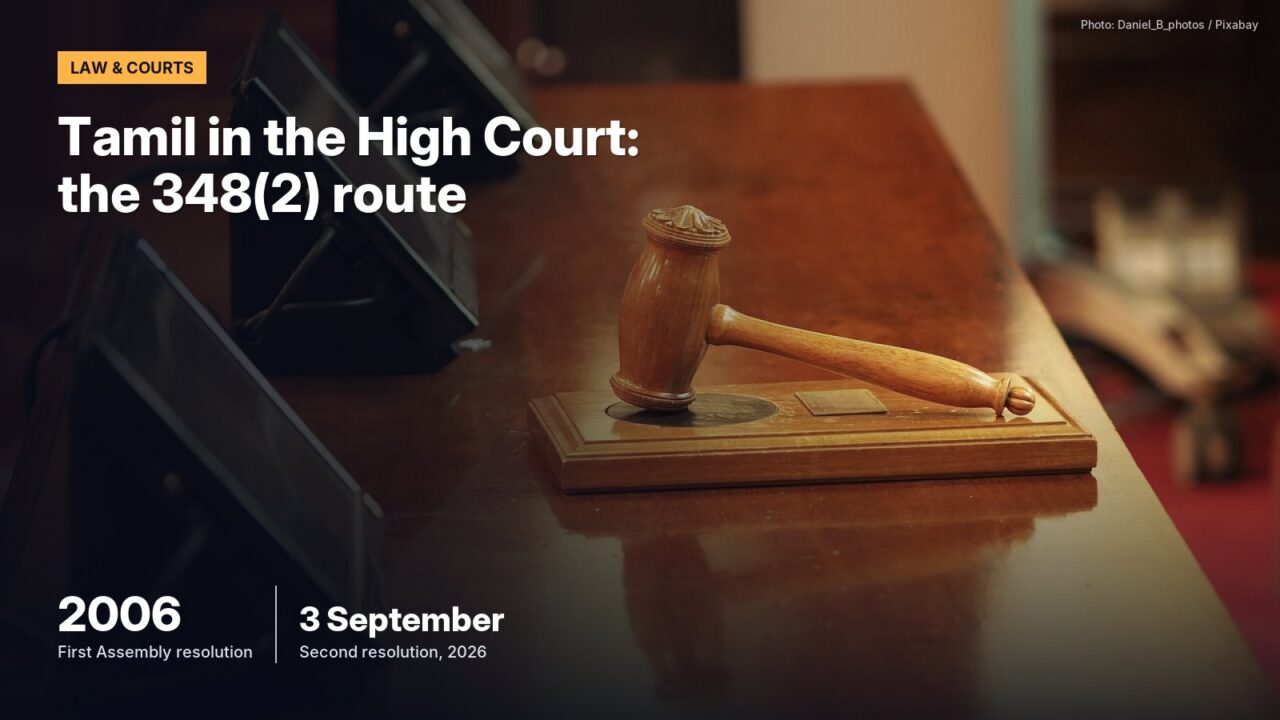
The petition is a public interest litigation filed by PMK general secretary Vadivel Ravanan, and it asks for one specific thing. The State government should forward the two resolutions to the Union government under Article 348(2) of the Constitution, so that the President’s consent can be sought for Tamil to become the principal language of the High Court.
The first resolution dates from 2006. The second was adopted unanimously on 3 September 2026, urging the Union government to recognise Tamil as the principal language of the court and to make arrangements for petitions and documents to be filed, arguments presented and judgments delivered in Tamil. The petition is expected to be listed for hearing shortly.
What Article 348 allows
Article 348(1) says proceedings in the Supreme Court and every High Court shall be in English. Clause (2) opens a door, but only partly: the Governor of a State may, with the previous consent of the President, authorise the use of Hindi or any other language used for the State’s official purposes in the proceedings of the High Court that has its principal seat in that State. The same clause keeps judgments, decrees and orders out of it, so those stay in English.
Judgments are dealt with separately. Section 7 of the Official Languages Act, 1963 lets the Governor, again with the President’s previous consent, authorise the State’s official language for a High Court’s judgments, decrees and orders, provided an English translation goes with them.
The Madras High Court itself dates from 1862 and is one of the country’s three chartered High Courts, along with Calcutta and Bombay. English has been its language since then.
Tamil already runs the State’s own business. The Tamil Nadu Official Language Act, 1956 made Tamil the official language of the State under Article 345, so it qualifies as “the official language of the State” in both provisions. What it lacks is the President’s consent.
The Governor’s part is not a free hand either. Under the Constitution the Governor acts on the advice of the State’s Council of Ministers, which is why the resolutions have to travel through the State government first.
In both cases the decision sits with the President, acting on the Union government’s advice. That is why the PMK’s petition is aimed at getting the resolutions to New Delhi rather than at the High Court itself.
In Tamil, the demand is for தமிழ் (Tamil) in the சென்னை உயர் நீதிமன்றம் (Madras High Court). It does not ask the court to switch languages on its own, and it could not; Article 348 leaves that to the Governor and the President.
Next
The petition is to be listed for hearing. No date has been fixed.
After that
If the resolutions reach New Delhi, the Union government decides whether to advise the President to consent.
For Context
This has been tried before. After the 2006 resolution, the State government sent a proposal to the Union government on the Governor’s recommendation, and in February 2007 the High Court’s Registrar-General forwarded details of the infrastructure that would be needed to run the court in Tamil. The consent never came, and English remains the only language of the court’s proceedings nearly two decades later.
The September 2026 resolution went further than the first, asking for filings, arguments and judgments in Tamil, and it is the second of the two documents the petition now wants sent to the Union government.
Checked against official sources on 16 November 2026.
Sources
- Public interest litigation filed by the PMK in the Madras High Court seeking forwarding of Assembly resolutions under Article 348(2), November 2026
- Constitution of India, Article 348 (Legislative Department, Ministry of Law and Justice)
- Official Languages Act, 1963 (India Code)
- Tamil Nadu Legislative Assembly
- Madras High Court