


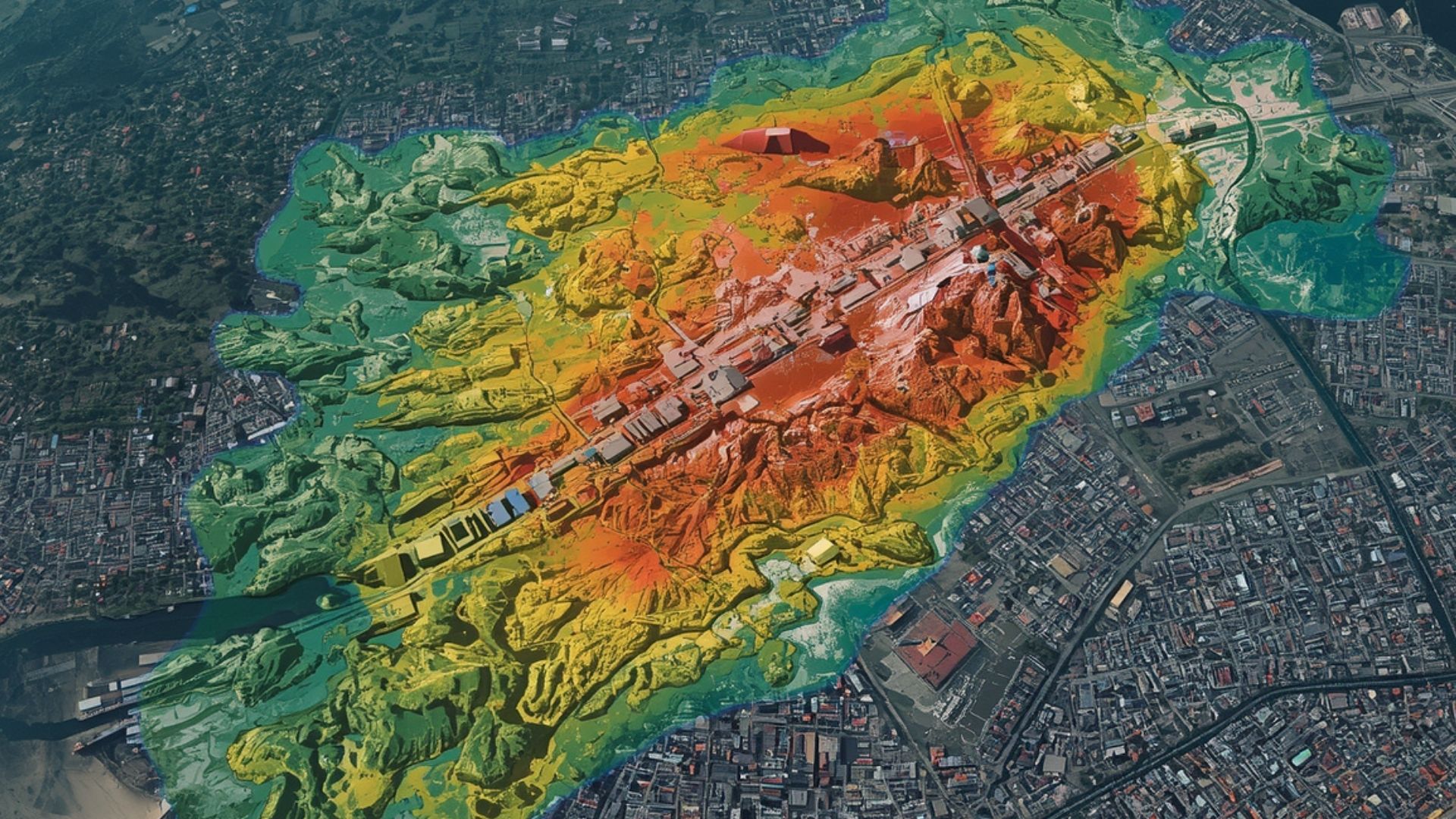
Chennai does not heat up evenly. That is the first thing the data makes clear. The city has 200 wards across 15 zones, and the newest ward-level heat work shows that heat is concentrated, not spread uniformly. Some neighborhoods are repeatedly hotter because they are dense, paved, traffic-heavy, industrial, or short on trees and open land. Others stay relatively cooler because they retain water bodies, wetland edges, institutional land, or pockets of green cover. Once the map is broken down this way, Chennai’s heat island effect stops looking like a weather problem and starts looking like an inequality problem.
That distinction matters because most of the new neighborhood mapping is based on land surface temperature rather than air temperature. In simple terms, it measures how hot the ground, roofs, asphalt, and built surfaces get. That is not exactly the same as the temperature a person feels at chest height on a street. But it is not abstract either. A peer-reviewed Chennai field study using air-temperature measurements at 30 fixed locations found a clear positive nighttime urban heat island, ranging from 3.6°C in summer to 4.1°C in winter. So the city’s thermal inequality is visible both from satellites and from conditions closer to the ground.
The citywide trend is unmistakable. A recent Tamil Nadu urban-cooling assessment notes that Chennai’s mean land surface temperature rose from 29.4°C in 2000 to 33.6°C in 2020. The Centre for Science and Environment, using IMD-linked analysis, found that Chennai’s summertime average ambient air temperature increased by 0.4°C between 2001-10 and 2014-23, while average relative humidity increased by 5 percent. That combination matters because humidity makes heat harder to escape. The same study says humidity adds an average 6.3°C of heat stress, that the city’s heat index has risen by more than 5 percent, and that days with a daily heat index above 41°C have tripled compared with 2001-10. Chennai is not just warmer. It is becoming harder to cool down in.
Nighttime is where the danger becomes more visible. CSE’s analysis says the daytime urban core is about 0.8°C warmer than the city’s peripheries in summer, while at night the core remains about 0.9°C warmer. It also notes that Chennai’s diurnal cooling, the drop between day and night, is down by 5 percent. This is not a small detail. A city that does not cool at night carries heat forward into the next day, especially for households without reliable cooling, shaded streets, or well-ventilated homes.
The built landscape helps explain why this is happening. CSE found that Chennai’s built-up area increased from 30.7 percent in 2003 to 73.5 percent in 2023, while green cover fell from 34.0 percent to 20.3 percent over the same period. A separate 2025 peer-reviewed study on Chennai’s heat geography found 82 hotspots and 18 cool spots, and reported that land surface temperature in primary residential areas rose by 2.1°C and in mixed residential zones by 1.8°C between 2006 and 2022. That last point is important. Heat is not only an industrial-belt problem. Chennai’s ordinary residential neighborhoods are warming too.
Official ward-level land-cover data now shows just how hard the city has become. In the Greater Chennai Corporation area, the 2024 land-use break-up in the Tamil Nadu urban-cooling study puts built-up land at 81 percent, water bodies at 5 percent, forest at 2 percent, agricultural land at 1 percent, and wasteland at 10 percent. The same study says Chennai’s per capita green cover is 8.75 sq. m, below the WHO reference level of 9.5 sq. m per person, and notes that the city’s vegetation has declined by 22 percent over the last two decades. Put differently, the city now has too much surface that stores heat and too little that sheds it.
So where are the hottest neighborhoods?
The most obvious hot belt lies in the city’s industrial and heavy-use zones. The ward-level LST analysis for 2024 identifies Ambattur-side wards 84, 85, 86, and 87, Koyambedu-linked wards 145 and 127, and ward 159 at Meenambakkam as places with high surface temperatures in the 31.6°C to 33.6°C range. Hotter still were parts of wards 84, 189, 37, and 103, covering Pattravakkam, Pallikaranai, Kodungaiyur, and Koyambedu, where LST ranged from 33.6°C to 35.6°C. The most intense category in that table, 35.6°C to 37.6°C, appeared in parts of ward 37 in Kodungaiyur and ward 18 in Manali. The cited causes were not random urban clutter. They were specific heat generators: the Ambattur Industrial Estate, Koyambedu market and CMBT, Perungudi dumpyard, Kodungaiyur dumpyard, the Integral Coach Factory unit, the airport, and the Manali industrial and petrochemical belt.
The time trend is even more revealing. Between 2016 and 2024, the maximum LST in ward 84 rose to 35.1°C, and in ward 86 from 33.4°C to 35.0°C. In ward 127, maximum LST increased from 32.37°C to 34.37°C. In ward 37, it rose from 33.32°C to 36.33°C, and in ward 189 from 33.16°C to 35.09°C. This is exactly what thermal inequality looks like on a map. Heat is accumulating around industrial estates, wholesale markets, airports, bus terminals, and dumpyards faster than in the city at large.
Then there is the dense old-city and working-city core. The ward-level built-up index analysis identified high-NDBI clusters in Peddanaickenpet, Asirvada Puram, Sowcarpet, Purasawakkam, Choolai, Pattalam, Pulianthope, parts of Mount Road, Nochikuppam, Ayothikuppam, Kodungaiyur, Anna Nagar, Koyambedu, Pallikaranai, and Meenambakkam. NDBI is not temperature by itself, but it is one of the clearest warning signs of neighborhoods likely to trap and re-radiate heat because vegetation has been displaced by hard surfaces. The same study says Chennai shows a clear negative correlation between NDVI and LST and a positive correlation between NDBI and LST. More vegetation tends to lower temperature. More built-up surface tends to push it up. That sounds obvious, but Chennai’s heat map shows just how sharp the relationship has become.
The coastal low-income belt is where the phrase temperature inequality becomes unavoidable. The ICLEI-Tamil Nadu study highlights coastal wards 60, 114, 116, 120, and 125, including areas such as Nochikuppam and Ayothikuppam, as parts of the city with some areas under extremely high heat zones. It also states that these low-income, slum-dominated areas show very low NDVI values of 0 to 0.1, minimal green cover, and less than 1 park per sq. km, compared with a city average of about 1.5 parks per sq. km. These neighborhoods are not just hot because Chennai is hot. They are hot because they have been left with too little shade, too little public green space, and too little cooling infrastructure.
The ward-wide classification confirms how broad the problem has become. In the 2024 GCC assessment, 68 wards fell in the high heat zone, while 12 wards had some areas in extremely high heat zones. Those 12 were 37, 84, 85, 86, 127, 189, 159, 60, 114, 116, 120, and 125. The pattern is revealing. The hottest set is not dominated by one kind of place. It includes industrial land, waste sites, market areas, the airport corridor, and poor coastal settlements. Chennai’s heat map is not just a map of concrete. It is a map of land use, economic activity, and uneven access to green space.
The city’s risk map goes a step further. The same ward-level study found that 25 percent of Chennai’s wards, or 50 wards, had a very high heat risk index. Those wards accounted for 30 percent of GCC’s population while covering only 12 percent of the city’s area. That is one of the strongest statistics in the entire dataset because it shows concentration. Heat risk is not simply where the city is hottest. It is where high temperatures overlap with more people, denser built form, weaker adaptive capacity, and less room to escape.
That is why the phrase “heat island” can mislead. It sounds like a physical feature. In Chennai, it is also a social pattern. The ICLEI study explicitly says the ward-level heat index reveals critical overlaps between low green cover, high built-up density, and socio-economic vulnerability. It notes that vulnerable communities in high-risk wards often have poorer access to healthcare, roads, parks, and water bodies. In other words, two neighborhoods can record similar heat on a satellite map but live that heat very differently depending on income, housing form, medical access, and street-level shade.
Not every part of Chennai is moving in the same direction. The 2016-24 ward analysis notes that some wards showed a decrease in LST of 1-2°C, possibly due to urban greening and waterbody restoration. The wards listed were 180, 183, 184, 185, 192, 193, 197, 198, 199, and 200. Using official ward-zone ranges, these fall largely in the southern fringe across Adyar, Perungudi, and Sholinganallur zones. This does not mean South Chennai is cool. It is not. But it does suggest that where blue-green assets survive, or where restoration work is taking effect, local temperature can still be moderated. That is a useful warning in reverse. Chennai has not lost the ability to cool itself. It is losing it unevenly.
The neighborhood pattern also tells us something uncomfortable about Chennai’s development model. A 2025 peer-reviewed study found that residential areas have warmed significantly, not just industrial or transport land. Another official assessment now recommends cool roofs in wards 73, 75, and 44 because they combine high LST above 31°C, very low NDVI around 0.12, high population density, and concentrations of low-income or slum settlements. It recommends street-tree plantation, micro-forests, and green corridors for wards 54, 55, 56, and 57, and pocket parks or community gardens for wards 32, 44, 54, 55, 56, 57, 76, 78, noting that park access there is significantly below the city average. The planning logic is clear. Chennai no longer needs generic greening slogans. It needs ward-specific cooling.
There is also a bigger climatic backdrop. Chennai already sees peak summer temperatures of about 38°C to 42°C, and the Tamil Nadu cooling study says maximum and minimum temperatures are projected to increase by 2.9°C and 3.3°C respectively by the end of the century. In 2023 alone, the state reported 12 heatwave-related deaths, and Tamil Nadu has since classified heatwaves as a state-specific disaster with relief support for affected families. That means the heat-island question is no longer academic. It is now tied directly to public health, disaster management, and urban planning.
So what does Chennai’s map really show?
It shows that heat is not simply highest in the geographic center. It flares where built surfaces are dense, where vegetation is sparse, where economic activity hardens land, where waste accumulates, where traffic converges, and where poor communities have been left with the thinnest public cooling infrastructure. Kodungaiyur, Manali, Ambattur, Koyambedu, Meenambakkam, Perungudi, Nochikuppam, and Ayothikuppam are not interchangeable places. But the data links them through a common thermal logic: too much exposed hard surface, too little green relief, and too many people living or working in conditions that trap heat.
The lesson is blunt. Chennai’s heat island effect is not just about climate. It is about where the city chose to place industry, landfill, transport hubs, dense low-income housing, and low-shade public space. It is about which neighborhoods got tree cover and park access, and which did not. The ward-level evidence now exists. The argument is no longer whether Chennai has a heat island. It does. The real question is whether the city is prepared to treat urban heat as a form of neighborhood inequality, and plan for it that way.

