


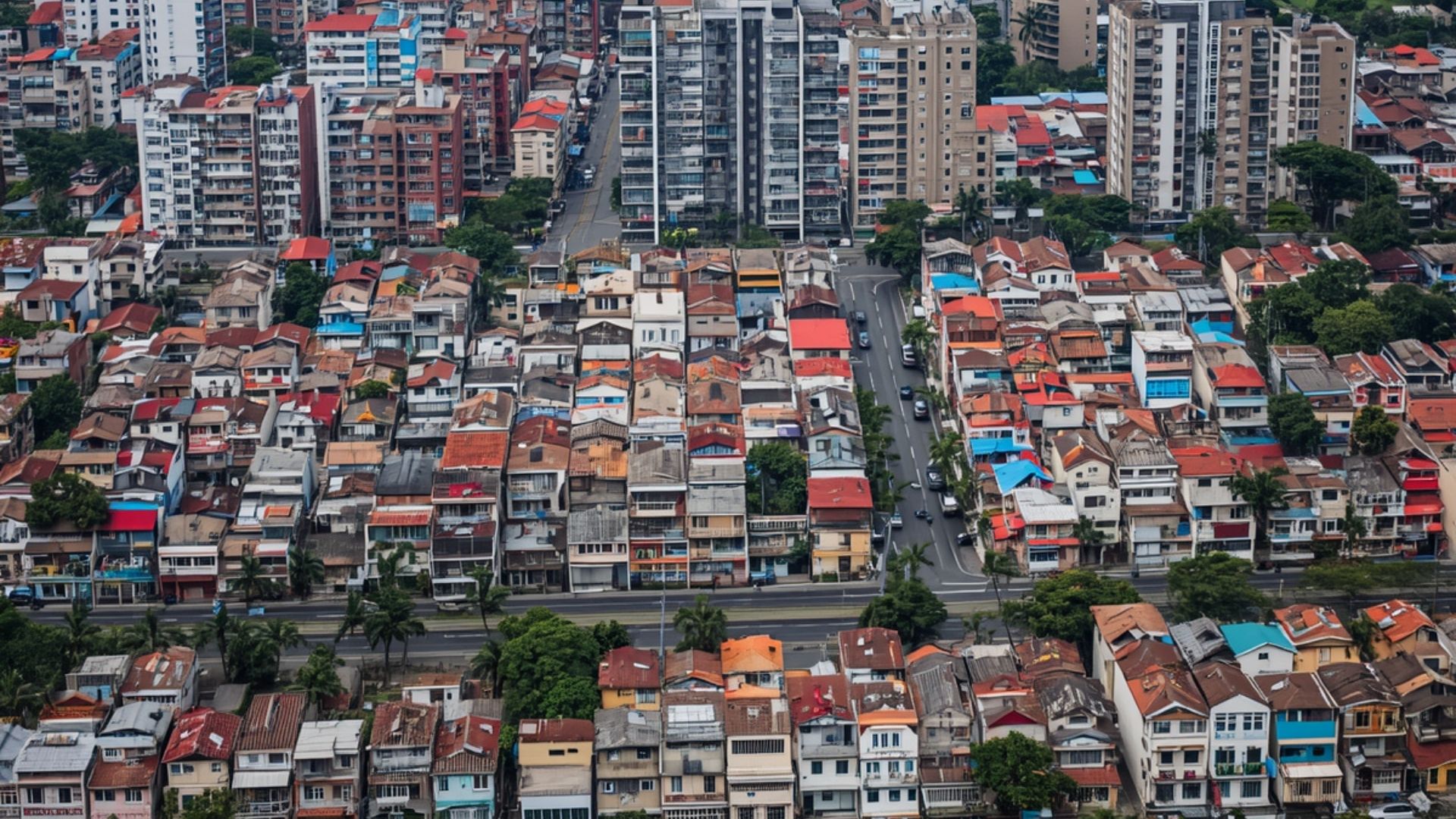
Chennai’s climate crisis is not experienced evenly. It is not even experienced neighborhood by neighborhood. It is experienced lane by lane, embankment by embankment, settlement by settlement.
That is why any serious discussion of climate vulnerability in Chennai has to move beyond citywide flood maps and broad statements about resilience. The real fault line runs through the city’s informal settlements: riverbank communities, canal-edge habitations, coastal low-income neighborhoods, dense inner-city slums, and peripheral settlements that remain under-served even after relocation. These are the places where extreme rainfall, heat stress, water insecurity, weak sanitation, disease risk, insecure tenure, and unstable livelihoods pile on top of one another. Chennai does not have a single climate risk. It has layered risk. And the urban poor carry the heaviest part of it.
The scale alone is hard to ignore. Greater Chennai’s own city action material, based on Census-linked figures, records 13.42 lakh people living in slums in Chennai. A World Bank project document on Tamil Nadu housing puts the issue in household terms and estimates around 300,000 households in Chennai’s slum population, with thousands of informal settlements built along waterways across the Chennai Metropolitan Area. At the state level, the same World Bank document says 5.8 million people in Tamil Nadu live in slums, equal to 16.6 percent of the urban population. This is not a fringe issue in a corner of the city. It is central to how Chennai grows, where it grows, and who absorbs the cost when climate shocks hit.
The climate lens makes that centrality even clearer. The Greater Chennai Corporation’s climate planning work explicitly treats slums and informal settlements as a distinct category of urban risk, and its 2025-26 climate budget tracks metrics such as the number of slums located in high-flood-risk areas and the share of slum households with access to safe, resilient, and affordable housing. That is an important signal. It means Chennai’s own institutions are no longer treating informal settlements as a side issue to be handled after infrastructure is built. They are acknowledging, at least on paper, that the city’s climate future will be judged by what happens in these neighborhoods.
1. What climate vulnerability means in Chennai
Climate vulnerability is often described in technical language: exposure, sensitivity, and adaptive capacity. In Chennai, that framework is useful because it captures what makes informal settlements uniquely precarious.
Exposure is the easiest part to see. Many low-income settlements are located along the Adyar, Cooum, Buckingham Canal, smaller canals and drains, tidal edges, marshland fringes, or other low-lying land. These are the places most likely to flood first and drain last. Some coastal settlements face added exposure from sea-level rise, storm surge, cyclones, and coastal flooding.
Sensitivity comes from how people live. Homes are often smaller, more crowded, more exposed to water ingress, and built with materials that perform poorly in heat and rain. Chennai’s climate action material, drawing on a sample of 1,131 out of 2,173 slums in the expanded city, reports that 53 percent of houses depend on external sources for drinking water and 27 percent of slum houses use asbestos sheet roofing. Those are not minor service gaps. They amplify climate stress. A house with an asbestos roof is more punishing in extreme heat. A household that depends on external water sources is more exposed during floods, droughts, and service disruptions.
Adaptive capacity is the hardest part, because it depends on money, tenure, service access, mobility, documentation, and voice. ADB’s flood-management work in Chennai states plainly that urban low-income households lack the capacity to cope with floods when access to basic services is limited. The World Bank’s housing work reaches the same conclusion from another direction: relocation can reduce physical flood exposure, but it can also create new risks, including loss of livelihood, limited consultation, increased dependency on the state, safety concerns for women and children, and even abandonment of elderly family members. So climate vulnerability in Chennai is not just about where people live. It is also about how much room they have to recover once a shock has passed.
2. The flood hazard is the core risk, and it is quantifiable
For Chennai’s informal settlements, flood exposure remains the single most measurable climate threat.
The 2015 flood is the reference point because it revealed how deeply climate risk and urban poverty are intertwined. The World Bank records that during the November-December 2015 event, Chennai received 374 mm of rain in 24 hours, major water bodies filled up, the city’s three main rivers overflowed, and around 492,000 dwellings were damaged or destroyed, most of them in slums. In response, the Government of Tamil Nadu decided to relocate households living in high-risk riverfront areas. The same World Bank document says the state identified around 58,000 low-income families occupying the banks of the Adyar, Cooum, Buckingham Canal, and 22 canals and drains linked to the Adyar and Cooum systems.
That figure alone changes how the problem should be understood. Chennai’s flood vulnerability is not only about isolated encroachments along a few rivers. It is about a dense geography of informal settlement that has accumulated over decades in the city’s drainage network. Once rain intensity rises, those locations turn from marginal land into frontline hazard zones.
Chennai’s climate risk mapping now puts hard percentages on that vulnerability. The city’s climate action dataset shows that, for the sampled slums in the expanded 200-ward city, 41.1 percent of slums are inundated under a 5-year return-period flood. Under a 25-year return-period flood, the share rises to 60 percent. Under a 100-year return-period flood, 68.1 percent of slums are inundated. That last scenario includes 257 slums in the high-risk category with a directly affected population of 330,028, another 177 slums in the moderate-risk category affecting 196,427, and 384 slums in the low-risk inundation category affecting 416,319. These categories are exclusive, meaning they are not double-counted. Taken together, they show that flood risk in Chennai’s informal settlements is not localised. It is metropolitan in scale.
The same climate-action material identifies some of the most affected slums in the whole city, including Rajaji Nagar, Thideer Nagar, and Thiruvalluvar Nagar-Kallukuttai Part III. It also notes a crucial structural fact: vulnerability is heightened by population density that is roughly twice that of the rest of the city. That is not just a statistic. It explains why a moderate flood can become a major humanitarian event in these areas. Water does not have to be very deep when homes are tightly packed, drainage is poor, and exits are limited.
Flood risk is not abstract in North Chennai either. ADB’s Integrated Urban Flood Management for the Chennai-Kosasthalaiyar Basin project describes the northern basin as a project area with about 2.58 million people, severe flood-prone areas, low ground elevation, and direct climate threats from more intense rainfall and sea-level rise. The project includes 588 km of new stormwater drains, 175 km of rehabilitated drains, channel improvements, pumping infrastructure, and 23,000 catchpits for groundwater recharge. Governments do not build interventions at that scale unless the underlying hazard is chronic.
More telling still is ADB’s due-diligence material for the same basin. It says densely populated low-income communities in Chennai remain highly risk-prone and vulnerable to extreme flood events, and notes a projected sea-level rise of 4.6 mm per year. The document also records a startling inequality marker from the pandemic period: the GCC indicated that slum areas occupying just 1 to 2 percent of an administrative zone accounted for 15 to 20 percent of all COVID cases in that zone. Flooding, overcrowding, and weak WASH conditions do not sit in separate policy boxes. They reinforce one another.
3. Riverbank and canal-edge settlements face the highest combined risk
If the question is who bears the highest climate risk in Chennai, the first answer is clear: settlements located directly on riverbanks, canal edges, drains, marsh fringes, and low-lying flood pathways.
This is where exposure is highest and adaptation options are weakest. These settlements often sit exactly where urban hydrology needs space to function. In dry months, that location may appear manageable. In extreme rain, it becomes lethal. The World Bank explicitly says that Chennai’s slums are made highly vulnerable by their encroachment on the city’s natural drains, which are prone to overflow during heavy rainfall. TNUHDB’s own project frameworks for the Inclusive, Resilient and Sustainable Housing for Urban Poor Sector Project say the same thing more institutionally: the project is meant to support the resettlement of slum households in vulnerable waterways and waterbodies to safe relocation sites, while also promoting in-situ improvement wherever feasible and more diverse housing options than a single relocation model.
This matters because riverbank vulnerability in Chennai is not merely a function of poverty. It is also a function of planning history. Low-income settlements were allowed, tolerated, or pushed onto land that formal markets and formal planning did not want to serve until that land became critical again for flood management. Once that happens, the same population is often treated first as invisible, then as a hazard, and only later as beneficiaries of relocation. That sequence is politically convenient. It is not socially neutral. The physical risk is real, but so is the burden placed on people whose location choices were shaped by exclusion from serviced land and formal housing markets in the first place.
The risk is intensified in these areas by dependence on weak local service systems. Informal settlements near drains and waterways are often the last to get safe sewerage, reliable potable water, and durable roads. They are also the first to face contamination when floodwater mixes with sewage or waste. GCC’s health department notes that Chennai’s major mosquito breeding sources include 247.09 km of waterways and 2,062.94 km of stormwater drains, while the Corporation also runs a regular slum health programme with weekly visits to cover each slum. The very existence of such a programme is revealing. It reflects an official recognition that health vulnerability is concentrated in precisely the communities where environmental conditions are weakest.
4. Coastal low-income settlements are the second major high-risk category
The second group that bears especially high climate risk is low-income households in coastal settlements, especially those exposed to flooding, storm surge, cyclones, and sea-level rise.
Greater Chennai Corporation’s climate budget states directly that Chennai is vulnerable to sea-level rise, threatening settlements, infrastructure, and groundwater through coastal flooding. The World Bank’s Tamil Nadu housing project adds that a large part of the state’s population, especially households in coastal areas, is repeatedly exposed to coastal flooding, storm surge, tsunamis and cyclones. ADB’s Chennai water and sewerage project makes the same point from the infrastructure side, describing Chennai as highly vulnerable to cyclones, storm surges, coastal flooding, and sea-level rise because of its location on the Bay of Bengal.
Why does this matter specifically for informal settlements? Because low-income coastal neighborhoods usually face a dual burden. They are exposed to direct marine and weather hazards, and they also have weaker protective infrastructure and less capacity to absorb a disruption. A formal apartment block and an informal coastal settlement may both experience the same surge event, but they do not experience the same aftermath. The poorer settlement is more likely to have lower savings, weaker insurance, less formal documentation, more fragile building materials, and fewer fallback options if livelihoods are interrupted.
The sea-level rise problem is not only about dramatic future maps. It already shapes drainage and groundwater. Higher seas reduce the ability of stormwater to discharge efficiently at river mouths and canal outlets, especially during cyclonic or high-tide conditions. That means low-lying settlements near the coast can experience longer waterlogging and slower recovery even when the rain event itself is not catastrophic. The flood hazard becomes stickier. Recovery becomes slower. Poor households end up living with repeated small losses that never make headlines but steadily hollow out resilience.
5. Dense inner-city slums face a different but equally serious climate burden
Not all vulnerability in Chennai is on the river edge or coast. A third major high-risk group is found in dense inner-city informal settlements that may not always sit in the deepest flood zones but still face acute climate stress because of overcrowding, weak services, heat, and public health exposure.
The climate-action evidence is striking here. Based on the sampled slums in the expanded city, 53 percent of houses depend on external drinking-water sources and 27 percent use asbestos sheet roofing. The combination is brutal in summer and unstable during crises. External water dependence means households rely on public taps, shared sources, tankers, or other insecure supply arrangements. Asbestos roofs intensify indoor heat exposure, especially for women, children, the elderly, and anyone who stays home during the day. Climate vulnerability here is not only about being inundated. It is about living daily with hotter, more stressful, and less serviced housing.
Heat matters more than Chennai’s flood-dominated public discourse often admits. A house that traps heat is a health risk even without a declared heatwave. In dense settlements with low ventilation, poor tree cover, and shared water or toilet infrastructure, extreme heat compounds dehydration, income loss, and disease exposure. Climate stress then becomes chronic rather than episodic. A flood may happen a few times in a year or decade. Oppressive heat and water insecurity can be routine.
Public health systems already behave as though they know this. GCC’s health department runs a slum health programme specifically targeting slum settlements, and its documentation on vector control highlights the role of waterways and drains in mosquito breeding. ADB’s WASH-related due diligence for flood-prone communities in Chennai likewise frames the problem as a compound one: low-income dense communities lack adequate water, sanitation and hygiene services, and during floods they can become hotspots for epidemics. This is an important point. Climate vulnerability is not just about injury and house damage. It is also about which communities are more likely to experience disease transmission after climate events.
6. Women, children, the elderly, renters, and workers with fragile livelihoods face the deepest adaptation deficit
Climate vulnerability is not evenly distributed even within informal settlements. Some households have less room to cope than others.
The World Bank’s housing project is unusually candid on this. It notes that relocation of at-risk households can trigger loss of livelihood, elite capture, abandonment of aged members, longer dependency on government support, and increased safety and security risks for women and children. It also highlights the need for more diversified housing options, including rental housing, products for different EWS market segments, and accommodation for women-headed households, rather than a one-size-fits-all model.
That tells us something important about who bears the highest risk in Chennai’s informal settlements. It is not just those with the highest exposure to floods or heat. It is those with the lowest ability to absorb change. Women-headed households often have less income slack and more care burdens. Elderly residents may be physically unable to evacuate quickly or to rebuild routines after relocation. Children are more exposed to disruptions in schooling, health, and nutrition. Renters and non-titleholders are more vulnerable because they have weaker claims to compensation, housing, or service continuity. Informal workers lose twice, first when climate events disrupt work and again when relocation moves them farther from jobs.
This is where many official programmes are still too blunt. A settlement may be correctly identified as flood-prone and still be poorly served by a relocation plan if the new site is too far from work, schools, transport, or social networks. The climate risk goes down. The livelihood risk goes up. A methodical vulnerability assessment has to count both. ADB and World Bank documents on Chennai and Tamil Nadu now acknowledge this tension more openly than older slum-clearance models did. That is progress. But acknowledgment is not the same as resolution.
7. Planning and land-use systems are beginning to respond, but too late and too unevenly
One reason climate vulnerability remains so concentrated in Chennai’s informal settlements is that planning and housing systems historically failed to align.
The formal regulatory framework does recognise hazard. The Tamil Nadu Combined Development and Building Rules, 2019 define flood-prone areas and restrict some forms of development in sensitive locations. CMDA’s older planning material states that development policies should discourage development in flood plains and other constrained areas. More recently, CMDA has begun moving toward a stronger climate-and-housing linkage. Its work on the Third Master Plan, under the World Bank-assisted Tamil Nadu housing and habitat programme, explicitly includes informal settlements, flood mitigation, coastal area planning, water-body rejuvenation, and disaster risk reduction as linked planning themes. Separate CMDA tenders for blue-green infrastructure also reflect this shift, calling for mapping of tanks, drains, flood plains, wetlands and related urban systems.
That is important. It means the city’s planning language is finally catching up to what hydrology has been saying for decades. But it also reveals how late the response is. When CMDA has to ask for maps showing proposals for slums and informal settlements alongside development planning, it is effectively admitting that these settlements were never adequately integrated into metropolitan land-use logic in the first place. They were treated as afterthoughts, then risks, then clearance targets. What is now needed is something more difficult: integrating informal-settlement upgrading, safe housing, flood-buffer restoration, and livelihood access into the same planning frame.
8. What government is already doing, and where the gaps remain
To be fair, Chennai is not standing still.
On flood management, the ADB-backed Kosasthalaiyar Basin project is substantial. It combines stormwater drainage, channel improvements, pumping, catchpits for recharge, flood zoning guidance, a flood resilience index, a citizen flood observatory, green infrastructure guidance, and rehabilitation of disaster relief camps with an explicit social-inclusion lens. That is a more sophisticated urban climate response than Chennai had a decade ago.
On housing, TNUHDB’s Inclusive, Resilient and Sustainable Housing for Urban Poor Sector Project is an equally important sign of change. Its project architecture is not just about clearing land. It aims to support affordable housing for vulnerable communities, safe relocation where hazard is too high, in-situ improvement where feasible, and technical reforms so Tamil Nadu’s housing policy becomes less one-dimensional. The World Bank’s concept for the broader housing and habitat programme similarly says the goal is to move away from a one-size-fits-all approach to housing for EWS households.
On climate governance, GCC’s climate budget and climate-action framework matter because they force the city to track informal-settlement risk in mainstream municipal budgeting rather than in stand-alone slum files. That is the right direction. Once climate-proof housing, flood-risk slums, and resilient access enter the budget vocabulary, they become harder to ignore.
Still, the gaps remain large.
First, flood-risk reduction is ahead of livelihood-risk reduction. Engineering is moving faster than social transition planning. That is understandable, but dangerous. A technically successful relocation can still produce long-term vulnerability if households lose access to work, schools, transport, healthcare, and informal support systems.
Second, service gaps remain deeply embedded in slum life. The fact that over half of sampled slum houses depend on external water sources and more than a quarter have asbestos roofing shows that climate vulnerability still lives inside the dwelling itself, not just outside it.
Third, public health risk remains under-integrated with climate planning. Chennai’s official documents recognise the connection between flooding, WASH deficits, and disease, but the city still tends to talk about flood control, sanitation, housing, and health through separate administrative channels. Informal settlements experience them as one combined reality.
Fourth, planning has not yet fully solved the land question. As long as affordable, well-located, climate-safe land remains scarce, low-income households will continue to face the same structural tradeoff: live near work in risky places, or move farther out and bear new economic burdens. That is not simply a housing problem. It is the core political economy of climate vulnerability in Chennai.
9. So who bears the highest risk?
Based on the combined evidence from GCC, TNUHDB, ADB, World Bank, and CMDA-linked materials, the answer is not vague.
The highest-risk groups in Chennai are:
First, households living in informal settlements on riverbanks, canals, drains, and low-lying flood pathways, especially along the Adyar, Cooum, Buckingham Canal, and linked drainage channels. These communities combine the highest flood exposure with the weakest service conditions and the strongest pressure for relocation.
Second, low-income coastal settlements exposed to sea-level rise, storm surge, cyclones, and coastal flooding. These communities face both direct physical hazard and difficult recovery conditions, especially where housing, drainage, and livelihoods are fragile.
Third, dense inner-city slums with poor housing materials and weak water access, even when they are not in the deepest mapped flood zones. These neighborhoods carry intense heat, disease, and service risks that make climate stress continuous rather than occasional.
Fourth, within all of the above, women-headed households, children, elderly residents, renters, non-titleholders, and people dependent on informal local livelihoods. They have the thinnest buffer against both climate shocks and badly designed adaptation responses.
That is the hierarchy the official evidence points to. Not everyone in Chennai is equally vulnerable. Not even every poor household is equally vulnerable. Risk rises where hazard, density, weak housing, poor services, and low adaptive capacity intersect. Informal settlements are where those intersections are most concentrated.
10. What a serious response would look like
A serious climate strategy for Chennai’s informal settlements would begin by dropping the false choice between flood safety and livelihood security. It would treat both as non-negotiable.
That means three things.
First, high-hazard riverbank and canal-edge settlements do need targeted transition plans, but those plans must be judged not only by whether flood exposure falls, but by whether incomes, school access, women’s safety, and transport access hold up afterward. The World Bank’s own warning on relocation risks should be treated as design criteria, not as an afterthought.
Second, Chennai needs a stronger programme of in-situ climate upgrading wherever physical relocation is not the only safe option. That includes drainage, safer roofs, thermal retrofits, reliable drinking water, sanitation, paved access, raised service points, and public-health preparedness. Not every climate-vulnerable settlement needs to be moved. Many need to be serviced better and climate-proofed faster. TNUHDB’s move toward multiple housing and habitat solutions is useful precisely because it opens that door.
Third, planning, housing, health, water, and flood management must operate on the same map. CMDA’s current planning direction and GCC’s climate budgeting suggest the institutions are beginning to move that way. But the shift has to become operational. Chennai already knows where many of the highest-risk settlements are. The question is whether the city can intervene before the next extreme event, rather than after it.
Conclusion
The most important fact about informal settlements and climate vulnerability in Chennai is also the simplest: the people bearing the highest risk are not random victims of weather. They are the residents of places that the city has long depended on, under-served, and tolerated in hazardous locations until climate change made that arrangement untenable.
The evidence from ADB, the World Bank, GCC, TNUHDB, and CMDA points in the same direction. Floods hit these communities hardest. Heat hits them harder. Water stress hits them earlier. Disease spreads faster after shocks. Relocation, when poorly designed, can create new forms of insecurity. And yet these same settlements remain central to the functioning of the city’s labour market and service economy. Chennai’s climate future will therefore be decided less by what happens in elite neighborhoods than by what happens in its informal ones.
So who bears the highest risk?
In Chennai, the answer is clear. It is the urban poor living on the floodplain, on the canal edge, by the coast, under asbestos roofs, with external water dependence, weak sanitation, insecure tenure, and too little margin for error. Climate change did not create that inequality. It exposed it. And it is exposing it now with increasing force.
I can also turn this into a more magazine-style long read next, or give you a version with stronger SEO subheads and metadata language for direct website publishing.

